Where the hatred started
Writing has never been easy for me. It isn’t for a lack of wanting. My experience in school wasn’t helpful.
Since I can remember, I yearned for the ability to get all my thoughts, observations and theories onto paper. My hands just couldn’t keep up. When I took a shot at writing quickly, the results were illegible. When I took the time to write cleanly, the thoughts would slip through my fingers.
I couldn’t strike a balance and wasn’t willing to push through the torture of building skill through the slow, methodical, practice of writing and rewriting my ABCs. I neither had the penmanship nor the patience. And, with that, I could only assume writing wasn’t my thing.
This frustration as a child turned into a hatred toward writing, and that hatred turned into avoidance.
I slogged through school and found creative ways around my poor penmanship. It’s not like I didn’t love other art forms, but putting pen to paper felt dull, overly academic, and unimportant. I didn’t see how writing could have the same beauty and value as a Picasso, or express the emotions of a Rachmaninov.
In an adolescent, cool-guy way, I would take a sort of pride in “not being a writer.” Or, I’d say, “I’m good at other things — how about you write it up?” It was easier to do than admit I was bad at it. The way most children respond when they try to justify a lack of skill in some area.
That became my story. And it was left unedited for decades.
Along the way, with the advent of the computer, I thought I was saved. I was one of the lucky ones where writing by hand became obsolete in my lifetime. Good riddance. I could finally leave handwriting in the rearview.
Once I was out of school and gaining balance in the real world, I took another crack at writing. Now that writing by hand was no longer a blocker, and spelling and grammar was managed by machines, maybe I could become a writer after all.
Confronting what I now realize are years of excuses, I decided writing would no longer be a weakness in my armament of tools. It was time to revise my story. Since then, I’ve had a lot of catching up to do.
Okay, let’s try that again
In my 20s, when I started my first company, I realized the power of the written word. In order to communicate a vision at scale, one must codify their thoughts so others may follow. In order to improve, I started a blog and set out to post daily for a year. While I evolved considerably from my first post to my last, I still had a long way to go.
Years later, after hitting a plateau and going on hiatus, I decided to hire a writing coach. She swore by the power of “morning pages” laid out in the book “The Artist’s Way” by Julia Cameron. In it, the author believes one must return to the written form to connect with one’s inner artist. My new teacher passed on that requirement to me, and with it, I had come full circle. In order to learn to be a writer, I had to once again slog through my pitiful excuse of penmanship.
What surprised me about this go around was, for the first time, this teacher told me she didn’t care about how my writing looked or what it said. To her, none of that was important. She just wanted me to use my hand to write — anything. As long as paper and pencil were involved, she’d be happy.
It was — freeing.
It shut down the overly critical side of my brain, further imprisoned by early schooling.
I had a second wind.
I began to write in my notepad, about nothing, for five minutes a day. Through aches in my fingers, and in spite of all my ideas vanishing right as I picked up my pencil, I followed the prescription. I planted notebooks, pencils and sharpeners around the house, so nothing could get in the way when the compulsion to write struck. At times, when I had nothing to say, I would scribble some variation of, “I am writing this even though I can’t think of anything so that I don’t stop writing until my time is up.”
After a few weeks, I could see a connection forming between my hand and my mind. Where thoughts used to swirl around in my head and go nowhere, now they had an exit route. I developed a pavlovian reaction to search for paper when the marble in my head began to rattle. And, unlike the brevity of notes I took on my phone or computer, I found my handwritten entries getting longer at each session.
The potential was certainly there, but I still had one issue to overcome: I couldn’t read any of it.
Tech to the rescue
I’m a gadget guy. And, I’ve used my affinity toward doodads as a mental hack, tricking my mind to focus on important things I need to do that I have no interest in doing otherwise. Sure, I could vacuum and begrudgingly roll over the carpets while wishing I was doing anything else, but I prefer to get a Roomba, configure it, and whistle while it works.
“Hold on!” I thought one night, staring at my pad and pencil, mustering the strength to start yet another writing session. “Can this trick help solve my aversion to writing? If a pencil and paper is a painful reprise to teenage angst, modernizing my workbench with A.I. apps that digitize hand-written text via an iPad and Apple Pencil is a different beast entirely.”
I can get behind this.
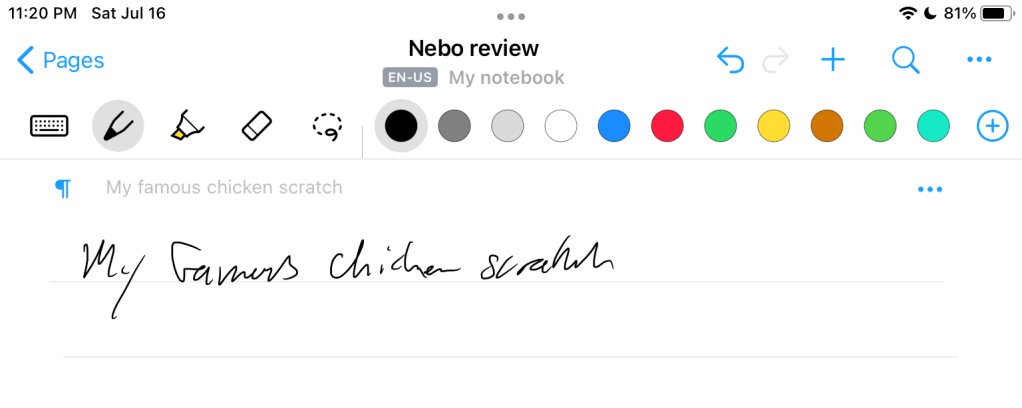
I scoured the app store for apps that could recognize my chicken scratch, while providing the right amount of tech-nerdiness to put a spoonful of sugar into my writing regiment.
I knew I found “the one” with Nebo.
The app perfectly merged modern digital tech with old-school writing and I found myself looking forward to engaging with the experience. I went from being forced to do “morning pages” each day, to feeling like I couldn’t stop journaling, writing or editing my work. What started as a few sentences a day has now blossomed into pages. In fact, this very text is being tapped out on my iPad using my Apple Pencil while laying in bed at 11:14PM with my wife asleep beside me, and I am having trouble stopping.
Whether one considers me a writer or not is unimportant, for I have fallen in love with writing, and with it my story has finally been rewritten.




 Sean Shadmand