
Author: sshadmand
Malmo Sweden’s Sites and Sweets

Get a Visa for your Startup
Have a startup? Thinking about living in a new city? Maybe even one abroad?
Well, you may be in luck.
If you haven’t noticed, there is a globalization of startups happening. The world is becoming not only more accepting of the startup mentality, but working hard to nurture it. So much so that many countries now offer visas, and even cash, to startups willing to relocate.
Below are a few I’ve heard of. If you know of others let me know and I will add it to the list!
Chile
Canada
France
Spain:
UK (United Kingdom):
EU (Europe):
Italy
Dubai
Singapore
New Zealand
Ireland
Hong Kong
http://www.rosemont.hk/worldwide-location/hong-kong-entrepreneurs-visa-/
Netherlands (Dutch)
Dutch Startup Visa / PDF
Denmark
Interested in getting a visa to the U.S?

Around the world Part II – What we packed this time
When we left in April for our first around the world trip we assumed we’d follow the sunshine and packed for a year of warm weather. This time we are heading east and starting in Ireland in the fall. As a result we’ve had to pack for colder weather, and hope what we’ve learned for our last packing experience will come in handy.
Aware of underwear
Last time I went light on under garments. Based on how they were advertised I assumed quick-dry and odor fighting under garments would come in handy. They did not. It sucks wearing underwear for more than 24 hours no matter how “antibacterial” they claim to be, and quick drying items don’t dry at jaw dropping speeds. So, this time, I packed 10 days of under garments instead of 3.
For the times we do end up washing clothes, we are packing a few washing machine detergent pods. They came in handy a few times and are pretty small and light weight.
Nix’ing some Knick-knacks
We ditched a lot of knick-knacks and gadgets this time around. The quick-dry towels and specialty water containers never added much value for a hotel hopping couple like us. After buying one bottle of water we just refilled the bottle and we always had towels in our hotels. We rarely wanted to carried the binoculars with us on our walks, and our bags always weighed the same so the bag scale was useless for 99% of the trip.
Keepers
We doubled up on the vacuum bags. They are awesome. Here is me using one below.
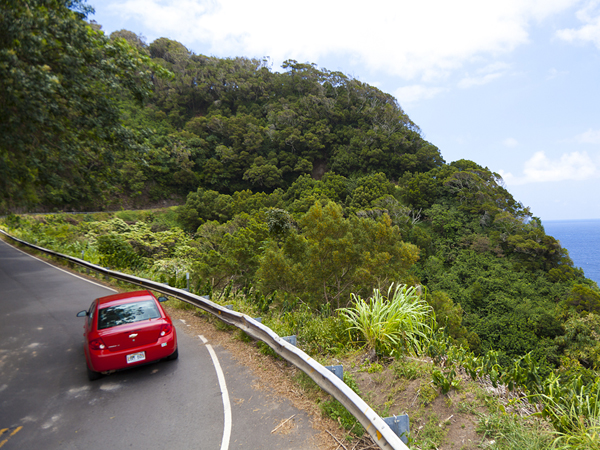
Driving through Scotland and Ireland.
U dunno have insurance here, pal!
If you plan to drive through Ireland check with your insurance company and/or credit card about what is covered before you visit.
As it turned out, our two auto insurance plans (one with our credit card and one with our regular auto insurance provider) excludes protection specifically in Ireland. Every other country in Europe is covered except Ireland.
Pay ye Toll
Stay alert. Some tolls don’t have booths, gates, or entryways, just an obscure sign on the side of the road (that look much like regular highway signs) that reads, “You must go online within 24 hours to pay your toll” with a URL at the bottom. If Jackie didn’t notice the sign we would have easily missed it.
We don’t break for Banshees
Every country has their own signature style of driving. Everyone in Italy, for example, thinks they are a pro racecar driver, and the eye in the sky keeps Australians annoyingly honest. Ireland and Scotland are a wee bit different. Sort of inbetween the two.
The average posted highway speed limits were between 100 Kph and 120 Kph. The fast lane had cars moving 20-40K faster than the posted limit and the slow lane was about 0-10K slower. There were no crazy lane changes or people cutting each other off like in Italy, but the locals have the same level of respect for letting faster folks pass.
In general the speed limits were quite high. Highways were typically between 60-70 Mph. Not too crazy, but even the small, one lane, curvy, country roads were quite high at 60 Mph as well.
Something that bothered me about Scotland was while the roads were strewn with signs warning drivers of speed cams there were few posted signs that actually let you know what the speed limit was. I guess it is just understood: if you are on a highway, drive between 60-70 Mph.
What side and what unit of measurement are we on exactly?
While driving through Ireland, Northern Ireland and Scotland we crossed through a hodgepodge of units of measurements for speed. Although all three countries drove on the left side of the road North Ireland and Scotland use the Imperial system for measurement and Ireland uses the Metric system.
This created a peculiar situation as we drove from Ireland into North Ireland. Our rental car (that we rented from Ireland) ONLY had Kph on the speedometer. Within two-seconds we went from reading signs in Kph to reading signs in Mph, followed by a whole lot of calculating what our speed should be on our phones. Talk about a crash course in conversions. (Lucky that didn’t turn into a pun. We made it out unscathed.)
Don’t get stoned
Many Irish roads are not only tight, but lined with stone walls that jut out. In a slight miscalculation I clipped the passenger side of our car on one of the narrow, curved, stone walls. (Jackie has made it hard to forget about it.) Luckily it was small enough that our rental company let it slide. Maybe this is why no auto insurance company wants to cover Ireland drivers.
Aye, that price? Not bah.
Here is a huge tip: Before coming to the area be sure you learn to drive stick! The price of a manual transmission rental car is around $20 per day. Compared that to a car with an automatic transmission at around $80 per day. As such, it can be super cheap to drive through the country and as I’ll explain below – you will most definitely want to.
THE COUNTRYSIDE IS A BEAUT!
Oh my gosh, what an amazing country side! Ireland is filled with ancient structures dating back to before the pyramids. Scotland has rolling hills filled with rocks and picture perfect lakes (AKA Lochs). The grass is emerald green and lush. You will be in awe.
If it is your first visit to either country then: Explore the south of Ireland (the Kearny loop). For Scotland make your way up to the north (AKA Highlands) and especially in the north west for majestic views of the country side.
Golf courses
You may not be a golfer, but many of the golf courses we saw in Scotland were worth stopping for anyway. Some are situated between amazing lakes and mountains and other straddle quaint towns. They make for a great walk, and, if you ARE a golfer, a magical round.

I <3 Polymer 1.0
One of my more recent pet projects has been to create a web-based application using Polymer 1.0, a web framework Google released at their I/O conference this past Spring.
In short, I don’t think I can ever go back to developing on the web without it. Not only do I strongly suggest everyone give Polymer 1.0 a try, but I implore new developers to learn web development by implementing it, and current dev teams to incorporate it into their product lifecycle – at the very least during their rapid prototyping stages.
Why is that? Good question!
For one, it is the first time I’ve ever used a web framework where the resulting code base feels legitimate, complete, and inherently organized; not a mesh of scripts and views that the original developer will need to walk other devs through to ramp them up.
For new devs, the clean, class based, object-oriented structure will help mature their web development habits. Even as an engineer with over 15+ years of development experience, I felt like using the framework improved my habits.
For product teams, the scoped modularity of the elements allow their group to quickly re-work layouts and functionality – on an element-by-element basis. You can inherit core elements and layouts, and test them individually as you assemble the project. Designers can perfect a single element’s look and feel even before the structure of the application is built. It makes for an excellent segway between mockup and final product.
What makes Polymer so Different?
1: It uses web components, shadow dom, and pure HTML/CSS to render templates.
2: Each element you create is packaged individually and contains: a tag based HTML layer, a scoped CSS layer, a JS layer and an import framework.
The web world is made up of hacks
The truth is most (if not all) HTML/JS frameworks are made up of what could be described as a series of “hacks” that attempt to create a consistent end-product across all web browsers (and versions of browsers) out there. These hacks are necessary due to the slow pace to which web standards evolve, and exacerbated by the fragmentation created by the popularity, and propriety, of those browsers.
A Polymer Breakdown
Shims and Polyfills
Shims and polyfills are hacks that transparently help protect a developer from the need to implement legacy or cross browser functionality. As the name describes, they fill in all the compatibility holes browsers leave behind.
Shadow DOM
You actually interact with the Shadow DOM all the time on the web without realizing it. When you use an HTML tag such as <video> you are requesting an element to be rendered by the browser. That element is composed of many subelements you can’t see in the inspector, ergot “shadow dom”. These subelements, such as the ones composing the video tag for example, manipulate and manage each frame of your video content. By creating your own custom elements utilizing the shadow DOM you are able to encapsulate entire chunks of your application’s functionality into a single tag.
WebComponents.org
Webcomponents.org has created a Polyfill library that allows users to take advantage of custom elements like the ones descrived described above. For example, a profile card you create can be shared and implemented as a single tag: <profile-card></profile-card>, by simply importing the “/profile-card.html” component.
Unlike other frameworks or libraries (such as Angular, Handlebars or JQuery) which work to manipulate and manage separately constructed HTML tags and CSS code, Polymer combines web components, polyfills, shims, CSS, HTML tags, two-way binding and the shadow dom into into a single package.
Scoped CSS
The Polymer/WebComponents structure solves certain small annoyances of web development, like having to keep track of all your CSS styles and hierarchies across your app. Every Polymer element scopes its CSS selectors to the element itself, thus, these selectors will not affect other CSS selectors outside of the custom element you create. In other words, you can use “.my-box” over and over to style different boxes based on their element context without affecting one another.
Some other useful features:
- Drop-in documentation rendering system
- Drop in testing frameworks
I could really go on and on about how smooth and organized it feels to develop something using Polymer, but it’s best for you to give it a shot yourself. Let me know what you think or if you have any questions.
Getting Started
Here is a look at a basic custom element setup:

If you are unsure of where to begin, start by using Polymer’s sample project (aka Polymer Starter Kit). It is a fully functioning app with a folder structure and gulp file built in. I original strayed away from the starter kit structure, but found myself ending up the same place as they did eventually. They did a good job with it, and it looks like they keep iterating on it.
Note: I should mention that there has been one annoyance I’ve had to deal with while learning Polymer: the lack of documentation and relating forums. The things that ARE available refer to Google’s originally releases Polymer 0.5 from a few years ago. These posts are often unhelpful since so many nuances are different in 1.0. The good news is my new questions posted on Stackoverflow had responses within a matter of hours.

On the road again – an Homage to Dr. Robert Williams
Tragically, and unexpectedly, Jackie’s father passed away while we were in London in early August. After hearing the news we cancelled our trip and caught the next flights we could back to Virginia; neither of us have posted any updates since. It has been a nightmare to say the least; it’s a phone call you can never be prepared to receive – especially when so far away from home.
I wanted to dedicate this long overdue post to him.
Jackie’s father’s name was Robert Williams … eh hem … Sorry – **DR.** Robert Williams. He was an ex-military, urologist who graduated from West Point and served 27 years in the Army.
Jackie explained this all to me the first time I was to meet him at her family’s house for dinner about 4-years ago. She continued …
“Just so you know my Dad is a former Colonel of the Army. Don’t slouch and be respectful!”
She seemed anxious and was only half kidding. I assume she knew I would be respectful, but I think she wanted to instill a little fear in me so that I would be prepared.
“And whatever you do – don’t call him ‘Mr.’. It’s ‘Dr.”“
To this day I still don’t know what she was so concerned about. Dr. Williams was polite, soft spoken, and kind. He was reserved at the dinner table but had a properness about him that spoke volumes. That being said, you could tell straightaway that he didn’t take well to B.S.
After dinner we moved on to a movie and desserts in the family room. As we were shuffling rooms he found a chance to pull me aside in the kitchen for a brief one-on-one.
“You do know what I did in the military, right? Did Jackie tell you?”
“Yes. A urologist?”
“That’s right. And you know what a urologist does?”
He made a scissor clipping motion with his two fingers and stared me directly in the eyes. I nodded. My forehead wrinkled.
“So if you do anything to hurt my daughter…”
He purposefully left the sentence hanging to allow a dramatic pause to take its effect. I decided to end the silence.
“I understand, sir. I will take care of your daughter. You have nothing to worry about.”
“Just remember what I said.”
I think, for many people, that encounter could be viewed as “aggressive”. Not me. I found it to be a comical way to make a very important point. He didn’t exactly smile when he said it, but I could see in his eyes it was a sincere request with sharp edge he attempted soften. He loved his daughter helplessly and found a simple way to protect her while he wasn’t around: Medical experience and vivid imagery. I could see where Jackie got her prep strategy! Instilling fear via subtle comedy is a powerful mix.
Since then Dr. Williams had been a strong supporter of Jackie and I, and a champion for our love of travel.
Before we left for our “around the world trip” he bought us a Nikon CoolPix Waterproof camera and said:
“This is a once in a lifetime trip and you’ll want to make sure you get great pictures that you can appreciate for the rest of your lives.”
It was a gift from someone who knew what they were doing. We’ve used that camera EVERYWHERE! His only ask in return was that we take pictures of ourselves standing in front of signs wherever we went, and to send them to him. We were looking forward to seeing the result of what he had in mind, likely a picture book of some kind. Sadly it is I gift we will never see. Nevertheless, we will continue to take pictures of ourselves in front of signs from here on out and create a book at the end of our adventure, just as he would have done.
Dr. Williams traveled extensively; he was a wanderluster in his own right. Not only through his tours in the military, but he made a point to bring Jackie and her sisters along with him to see the world as they were growing up. He took them to places like Rome, Paris and London when they were teenagers, and continued the tradition into retirement. Most recently he took Jackie to Hawaii for some father/daughter time in 2014. It was their 5th visit together. She loved it.
He loved to travel vicariously through us. He did so by either tracking our flights, watching a tiny plane move across his computer screen (a tradition we plan to continue with one another), or by asking us to stop in places he had always wanted to visit (or re-visit) and sifting through the pictures and collecting souvenirs we’d send him. We got him tapestries from India of Hindu gods, pictures of architecture indicative of Turkey, and a medallion of Saint Bernadette from Lourdes, France. Hunting for items he requested became a sort of game for the three of us.
It only feels right that after his funeral Jackie and I made a cross country trip to collect his things in Palm Springs to bring them home. By doing so we completed our westward tour all the way around the world, starting and ending in California. We were lucky enough to meet his friends and loved ones while in Palm Springs and hear about all the sides of Dr. Williams that we hadn’t had a chance to know while he was with us.
So many of the people we met that knew him remembered him as I did: reserved at first but a loving, fair, forgiving and respectful person once he became more comfortable with those around him. It was a testament to him that all of his friends were so kind and welcoming to us. We were invited to dinners, to have drinks, see homes and even had a plate of delicious homemade fudge brought to our door (which was one of Dr. William’s favorites). In light of this tragic time I also got a chance to get closer with Jackie’s family and had the absolute pleasure to spend a great deal of time with one of them in Palm Springs as we packed up the house together. I like to think of that as his final gifts to Jackie and I as a couple.
Now, over a month and a half later we are back in VA and preparing to start our trip up again. This time we will be moving eastward to complete our second revolution. We are re-invigorated to continue not in spite of Jackie’s father’s passing but as an homage to him. To carry on the love he had to see the world. He had dreams to visit us in Scotland where he wanted to visit Dunnottar Castle, a landmark that is part of his family’s heritage. Even though he is gone we will be completing that dream on his behalf within the next few weeks. It will be an emotional experience. We are also eager to visit South Korea by the end of the year, another of the places he was hoping to meet us.
I hadn’t written or posted anything here or FB since he passed because it honestly hasn’t felt right to do so. But now, as I sit here at BWI about to board our plane to Ireland, I can only imagine how happy he would be that we are carrying on. How proud he would be of how strong Jackie has been through the whole process. How excited he would be that we have found the energy to continue our trip, valuing experiences over things as did he.



 Sean Shadmand