I quite liked driving through New Zealand and Australia. Like most countries outside the U.S., they use roundabouts to deal with intersection traffic.
The rules of a roundabout are quite simple: you must yield to oncoming cars to your right – otherwise – go. Most of the time there are no cars coming and you can avoid the “come to a complete stop” law all together.
I find the iterative development cycle works in much the same way. In older more classic models, a product manager and their stakeholders work diligently to make sure specs are completed thoroughly before marking them as “ready for development.” In reality, the a majority of what *can* be done dramatically changes as new information is made available (digging into the problem, user feedback, stakeholder feedback, complexity etc.) The “stop” heavy culture of elaborately planned tasks are often thrown away the seconds after development, and issues, start. The real knowledge comes from implementation and iteration once each atomic feature is released. It also requires trust in those that implement to have a good enough understanding of the high level purpose of what your product is trying to achieve.
What if something goes wrong? Well, just like with a round about, development yields when there is” oncoming traffic” (AKA an issue getting flagged.) In scrum, the flag can be raised at standup meetings or planning meetings. If there is no flag then the developer does the best they can to implement the best way they can. In essence, they are entering the intersection and driving on through. This lack of congestion on spec creation can be better spent on feedback, iterations, and issues that come up. (In reality it is where the most critical time has always been.)
So, next time you’re concerned about how a task *should* be completed, and feel the need to surround yourself with stop signs, imagine the steady flow of a roundabout. Give your team the freedom to produce, stay available for issues that *may* come up, and when a change needs to be made revisit the task at hand.
As a whole I found this book enlightening and well deserving of my “Must Reads” list. For some it will provide insight into a community of like minded people. For others it will provide a fresh perspective on those they live with and work with. In addition to interesting stories and statistics on introverted and extroverted personality types, Susan offers ways she believes they may best interact, be it a parent/child relationship or between coworkers or spouses.
Some of the more interesting stories are of the author’s first hand experiences, as an introvert herself, where you follow how she deals with the extroverted world around her. She recounts stories of how she pushed herself to her boundaries by attending situations outside her comfort zone and paints a vivid picture of the emotions and thoughts that went through her mind while living them.
As a closet introvert myself, the stories bring a sort of comfort in knowing others have the same feeling and battles as I do, and, as a special bonus, they are told within a structure I can learn from. It is nice to know all those seemingly unrelated thoughts and emotions I’ve had can actually all be related to a more explicitly defined state of mind.
Those who know me well have been a part of many of my post (or pre) interaction stress, warm up time and exhaustion, and those who are shocked to hear it gives me a sense of pride that I have come so far. One event that is probably the most publicly noted, is the story of how I met Jackie (which she loves to tell) and goes, “I noticed Sean reading a book in the middle of a keg filled pool party when I wanted to walk over and say hi to him.” While writing this blog I found a Ted Talk of Susan Cain speaking of her book (below.) I couldn’t help but laugh a bit when she opened with a story explaining all the same feelings I had leading up to that moment.
Does it put me completely at ease that there is now a definition and even a positive perspective on these emotions? Not quite. I have worked quite hard, like the Author, to constantly challenge myself to go against these anxieties and practice being a better extrovert. As such, there are stories I no longer relate to as much. Now, for example, when I need to give a presentation I write a script, rehearse it, and turn anxiety into a sort of adrenaline rush; like going skydiving. Though, afterwards, I still spend hours analyzing how badly I did and need a serious nap.
But have I beat it? Is it even something that I should consider needing to be beat? Have I changed or grown or just adapted slightly? On one hand, I don’t think I could have done all things I’ve done if I stayed in my introverted mindset. I mean, how can I fully embrace my introverted tendencies in a world where the writer of a pro-introversion book has to get on Ted Talk in front of thousands of people to get the word out?
I think the overarching lesson may be that it is okay to adapt, but it is even more important to know how to manage your emotions and energy and not ignore them so you can find time to decompress and process your day without guilt. I think I can find a bit of closure on that.
Introverts are drawn to the inner world of thought and feeling, said Jung, extroverts to the external life of people and activities. Introverts focus on the meaning they make of the events swirling around them; extroverts plunge into the events themselves. Introverts recharge their batteries by being alone; extroverts need to recharge when they don’t socialize enough.
Many introverts are also “highly sensitive,” which sounds poetic, but is actually a technical term in psychology. If you are a sensitive sort, then you’re more apt than the average person to feel pleasantly overwhelmed by Beethoven’s “Moonlight Sonata” or a well-turned phrase or an act of extraordinary kindness. You may be quicker than others to feel sickened by violence and ugliness, and you likely have a very strong conscience. When you were a child you were probably called “shy,” and to this day feel nervous when you’re being evaluated, for example when giving a speech or on a first date.
we know that 70 percent of sensitives are introverts, and the other 30 percent tend to report needing a lot of “down time.”)
Americans found themselves working no longer with neighbors but with strangers. “Citizens” morphed into “employees,” facing the question of how to make a good impression on people to whom they had no civic or family ties.
In the increasingly anonymous business and social relationships of the age, one might suspect that anything—including a first impression—had made the crucial difference.”
One of the most interesting findings, echoed by later studies, was that the more creative people tended to be socially poised introverts. They were interpersonally skilled but “not of an especially sociable or participative temperament.” They described themselves as independent and individualistic. As teens, many had been shy and solitary.
introverts prefer to work independently, and solitude can be a catalyst to innovation.
Deliberate Practice is best conducted alone for several reasons. It takes intense concentration, and other people can be distracting. It requires deep motivation, often self-generated. But most important, it involves working on the task that’s most challenging to you personally. Only when you’re alone, Ericsson told me, can you “go directly to the part that’s challenging to you. If you want to improve what you’re doing, you have to be the one who generates the move.
Here I thought I just loved to work at night when everyone was asleep. And, my desires of working on an isolated farm no longer seem as random as I once thought.
Open-plan offices have been found to reduce productivity and impair memory. They’re associated with high staff turnover. They make people sick, hostile, unmotivated, and insecure.
He also suggests “No-Talk Thursdays,” one day a week in which employees aren’t allowed to speak to each other.
Indeed, after all these years of evidence that conventional brainstorming groups don’t work, they remain as popular as ever. Participants in brainstorming sessions usually believe that their group performed much better than it actually did, which points to a valuable reason for their continued popularity—group brainstorming makes people feel attached. A worthy goal, so long as we understand that social glue, as opposed to creativity, is the principal benefit.
This is a very controversial topic she drops into. It is so counterintuitive to what we learn these days in the workplace it challenges so much of the ideation sessions we have become accustomed to. Not sure if it changes my mind just yet, but it does answer a lot of questions I’ve had internally about working alone or in groups.
Psychologists usually offer three explanations for the failure of group brainstorming. The first is social loafing: in a group, some individuals tend to sit back and let others do the work. The second is production blocking: only one person can talk or produce an idea at once, while the other group members are forced to sit passively. And the third is evaluation apprehension, meaning the fear of looking stupid in front of one’s peers.
the question of how your inborn temperament interacts with the environment and with your own free will. To what degree is temperament destiny?
Enjoyment appears at the boundary between boredom and anxiety, when the challenges are just balanced with the person’s capacity to act.
realize it’s not true that I’m no longer shy; I’ve just learned to talk myself down from the ledge (thank you, prefrontal cortex!). By now I do it so automatically that I’m hardly aware it’s happening.
Imagine how much better you’ll be at this sweet-spot game once you’re aware of playing it.
sweet spots have the power to leave jobs that exhaust them and start new and satisfying businesses.
I also speak on topics that matter to me deeply, and have found that I feel much more centered when I truly care about my subject.
This touched me as well. I have always said I would be an awful salesman since after the initial feeling of an idea or concept is revealed it no longer is as interesting to me and that loss of interest can hurt a sale. My former co-founder, who is an awesome salesman, can give the same pitch with the same intensity multiple times a day. I’ve always admired that, but this puts it into more perspective. I just simply enjoy depth and so I should follow that preference in what I do.
Sometimes speakers need to talk about subjects that don’t interest them much, especially at work. I believe this is harder for introverts, who have trouble projecting artificial enthusiasm.
The highly sensitive tend to be philosophical or spiritual in their orientation, rather than materialistic or hedonistic. They dislike small talk. They often describe themselves as creative or intuitive (just as Aron’s husband had described her).
They feel exceptionally strong emotions—sometimes acute bouts of joy, but also sorrow, melancholy, and fear.
Amazing. It is like she gets inside my thoughts. Things I don’t talk about openly and have always had since I was kid. My love of philosophy, my aversion to getting drunk and a like, and myself regulation of my emotions on big events. While others rave about an event they always ask why I am not more excited – and I never could answer it. I’ve always disliked that question…
sensitive people also process information about their environments—both physical and emotional—unusually deeply. They tend to notice subtleties that others miss—another person’s shift in mood, say, or a lightbulb burning a touch too brightly.
It may also help explain why they’re so bored by small talk. “If you’re thinking in more complicated ways,” she told me, “then talking about the weather or where you went for the holidays is not quite as interesting as talking about values or morality.”
scientists have discovered that approximately 20 percent of the members of many species are “slow to warm up,”
Remind me of how my cousin Reza would mention my slowness to warm up, and as we got older he would play into it and almost study it when we would hangout with new groups.
In most settings, people use small talk as a way of relaxing into a new relationship, and only once they’re comfortable do they connect more seriously. Sensitive people seem to do the reverse. They “enjoy small talk only after they’ve gone deep,” says Strickland.
“When sensitive people are in environments that nurture their authenticity, they laugh and chitchat just as much as anyone else.”
In short, introverts just don’t buzz as easily.
extroverts are more likely than introverts to be killed while driving, be hospitalized as a result of accident or injury, smoke, have risky sex, participate in high-risk sports, have affairs, and remarry.
In one study, scientists gave participants the choice of a small reward immediately (a gift certificate from Amazon) or a bigger gift certificate in two to four weeks. Objectively, the bigger reward in the near but not immediate future was the more desirable option. But many people went for the “I want it now” choice—and when they did, a brain scanner revealed that their reward network was activated. Those who held out for the larger reward two weeks hence showed more activity in the prefrontal cortex—the part of the new brain that talks us out of sending ill-considered e-mails and eating too much chocolate cake.
Introverts seem to be specifically wired or trained so when they catch themselves getting excited and focused on a goal, their vigilance increases.”
According to IQ scores, the two types are equally intelligent.
Extroverts are better than introverts at handling information overload.
Introverts’ reflectiveness uses up a lot of cognitive capacity, according to Joseph Newman.
This is because most tasks are goal-directed. Extroverts appear to allocate most of their cognitive capacity to the goal at hand, while introverts use up capacity by monitoring how the task is going.
If you are threat-oriented: 1. Criticism or scolding hurts me quite a bit. 2. I feel pretty worried or upset when I think or know somebody is angry at me. 3. If I think something unpleasant is going to happen, I usually get pretty “worked up.” 4. I feel worried when I think I have done poorly at something important. 5. I worry about making mistakes.
But when you’re focused on a project that you care about, you probably find that your energy is boundless.
If you’re the kind of person who frets every time the quarter is good, you may have trouble rising to the top of a corporate pyramid.
Johnson, who is a frequent public speaker on education despite a lifelong public speaking phobia, knows firsthand how well this works. “I haven’t overcome my shyness,” she says. “It is sitting in the corner, calling to me. But I am passionate about changing our schools, so my passion overcomes my shyness once I get started on a speech. If you find something that arouses your passion or provides a welcome challenge, you forget yourself for a while. It’s like an emotional vacation.”
I have to work far less when presenting on a topic I care about. Instead of fighting it I think the lesson it to find things you enjoy being “extroverted” about.
Figure out what you are meant to contribute to the world and make sure you contribute it. If this requires public speaking or networking or other activities that make you uncomfortable, do them anyway. But accept that they’re difficult, get the training you need to make them easier, and reward yourself when you’re done.
Here’s a rule of thumb for networking events: one new honest-to-goodness relationship is worth ten fistfuls of business cards. Rush home afterward and kick back on your sofa. Carve out restorative niches.
If you’re a manager, remember that one third to one half of your workforce is probably introverted, whether they appear that way or not. Think twice about how you design your organization’s office space. Don’t
If it’s creativity you’re after, ask your employees to solve problems alone before sharing their ideas. If you want the wisdom of the crowd, gather it electronically, or in writing, and make sure people can’t see each other’s ideas until everyone’s had a chance to contribute.
There were at least three foot fish spas in Santorini, some dirtier or less cordial than others. We ended on this one which was recently opened, had a professional staff and was neat and tidy.
Jackie could not stop laughing once those little fishies went to work. Luckily I got it on film!
Another winner of our “places we will return to” list is Santorini Greece. Sure, it is hella touristy but the beauty of the island and its unique cliff side restaurants and bars are unbelievable. In the video below we hiked down to one of the famous Santorini churches hidden behind the Skaros Rocks.
My friend William and I started a book club – of two. So, I guess book duo would be more precise. Anyhow, our first book we read together was How Google Works by Eric Schmidt and Jonathan Rosenberg. One question that sparked a conversation at one of our meetings was was with the definition in the book on innovation.
The book states “For something to be innovative, it needs to be new, surprising, and radically useful.”
The questions that came up were:
Did we agree with that definition?
To what extent do you agree with this statement?
Is the innovation defined on a continuum/scale, or is the question of something being innovative a yes/no question?
How do you measure “radically useful”?
Why must it be “surprising?”
When do you determine when something is useful?
After some disagreements and concession this here is what we concluded:
Innovation is not binary, it can lie on a continuum.
We broke “innovation” down into invention (something new), innovation (an invention that is 2X or more better than what exists), disruption (an invention that is 10X+ better than what exists and that displaces, or noticeable begins to displace, something heavily used today.)
Using an example in the book, where does an improvement such as the auto-search functionality lie? Is what you are planning to do iterative? Is it 2X, 3X or 10X better?
I’ve had applied this more detailed perspective to some projects I am working on during the planning of potential roadmaps. In some cases this question hurt the iterative process, it caused us to overthink simple iterations that in aggregate could lead to something greater in the future. After all, sometimes *trying* to innovate kills the creative free thinking environment that breeds innovation. In other cases it helped us stretch our ideas into something more impactful, for example asking “How much better do you think that is than what we have, 2X, 3X ….?”
A news story is just that,. It is not the entire picture of an event – it never is and probably never will be. The world creates too much information to pack into an hour or less of stories.
Responsibly balance what you interpret
This is where your brain and heart come in. It is up to you to always remember that with each story there are two sides and perspectives on every matter. It is important to remember:
That groups of people aren’t all bad
Power is a delicate asset (and privilege) to have over someone
There is still racial (and religious and economic …) tension in the U.S., if not the world. If you ignore it then, like an infection, it will only get worse.
The words we choose are powerful in fueling or dousing the issues above. Negatively classifying a group may be easier for you, but can unnecessarily create a bigger divide per #3 .
For every story you show me of a “black” person shooting a “white” person, I could Google the opposite. Show me A Muslim shot in America, I can Google a tragedy of another group’s loss. We see it every day on social media. The untold stories of a group desperately trying to prove that their group is not the problem. Sadly, I’m doing so, they often try to prove how another group is the problem. They do so directly or indirectly, on purpose or sometimes on accident. Both sides rarely get covered in the same breath. Rarely is there any attempt to see how both sides have pain, loss or tragedy. Why? What would be lost?
Wrong is not exclusive
Can we start by agreeing that these are all wrong? If a police officer dies or an unarmed civilian dies they are both wrong, right? Is it wrong when a police officer frames a civilian? Of course it is. Since they are an authority with power news of it will cause a shock wave of fear in citizens minds that hear it. More so than a story of a civilian framing another civilian. It goes for all types of power: A teacher taking advantage of a student; a political official taking advantage of their constituency; a boss taking advantage of their employee; a wealthy person kicking a homeless person on the street. People fear the powerful preying on the less powerful and praise a David that takes down a Goliath. Not all people of power are corrupt, but when corruption infiltrates the powerful the consequences can be widely devastating to a society.
The dynamic of these fears toward the powerful are likely learned from our history: Once those of power gain absolute power, freedom is lost. – But I digress. What I am really driving at here is: it is all wrong. Why not nurture a society that openly confronts each wrong individually and makes an effort to put an end to them all?
The Importance of Being Heard
Average Comcast callWhen people aren’t feeling heard they get angry. Think of how mad you get when Comcast (or another cable monopoly) takes your money and gives you no options to resolve the problem on the phone. Being rendered powerless sucks. Of course, you *have* the power to sue or visit their office, but, for the most part, there isn’t much you can do without exerting far more effort than should be required.
Now imagine all your neighbors have no money, and Comcast does it to your entire neighborhood – at the same time or in the same building. More directly, imagine a group of any [race|religion|etc] in a town of low income or out of work people (more importantly, imagine a group “just like you” with less) that simultaneously see multiple shootings of “their own” killed on TV by an alternate group. Imagine hearing the victim was unarmed or under age. What if they felt they didn’t have a voice or options? Would they riot? Probably. Would they be wrong to do so? Yes. Is the other group wrong for killing their unarmed, less fortunate, less empowered person? Yes. It is all yes!
You don’t have to choose a side. You don’t have to say “no” to one thing just so you may agree to another. Believe it or not, you can agree it is all wrong at the same time! No one gets hurt when you support people that have been wronged. Your group will not suffer as a result. (Those that do are probably the outliers that have gotten us in this tense situation in the first place. Help educate them too.) Believe it or not you can openly understand why a person has been wronged and is angry. You can also openly not agree with how they reacted too.
The wrong & right seesaw
We often try to highlight one wrong doing to that best represent how we feel, and, inadvertently, we can end up belittle the other wrongs that occurred in the situation. As a result, more people feel unheard and more problems pop up. What would happen if people understood the other side and let them have the voice they are dying to have. “Hey [person relating to a tragic event], we are all sincerely sorry for your loss. It shouldn’t happen and we will sincerely going to try and make sure it doesn’t happen again.” We don’t use slurs or classifications to supplement our condolences, and, then, we follow up with action. What if we just said – yeah – about what happened – that’s not right. It shouldn’t happen again. What if those with more power or money or influence said, “Yes, I can see how we can make others feel powerless. Can I use my position more responsibly in some way? Can I use my position to squelch these issues instead of just fearing I will lose the position I have?”
Practical answers to wrongdoing
Is it wrong when a Muslim is easily labeled a “terrorist” but a non-Muslim of the same offense is just a “shooter”? Yes, of course it is. Is it wrong when an unarmed child is killed? Yes. Terribly so. Is it wrong when an officer is shot in the line of duty? Of course! It is tragic. Is it wrong that anyone is racially singled out, verbally or more tangibly so? Why do you need a rebuttal to that question? Of course it is wrong. Does it happen all the time? Yes. Far too frequently. Can we stop it all? Probably not. Can we try? Yes. Are there income gaps? Yes. Are they all for unjust reasons? Probably not. Are there many that are? Definitely. Is income inequality in those cases wrong? Without a doubt. Do we lose anything by admitting it? No.
We can always try to put an end to any of those wrongs. It is each of our individual responsibility to do so because when we don’t EVERYONE suffers eventually – in some pent up, anger filled, mob assembled way. Call it societal debt: You may want it easy now and ignore how others feel, but eventually it bubbles up – with compounded interest.
It seems like the world has so many “but”s, and “only if”s and “what about mine”s to divvy out. Sure, have those words – it’s natural. What I am asking is that you try and supplement a story with, “I see”, “I understand”, “Yes that is wrong”, “How can we make it better” or “I agree with one part, but it doesn’t help anyone that they said the other.”
My approach
How does it work in practice in my mind? Well if you read this far maybe you’d like to know 😉 If a group I don’t agree with says something that makes sense I try and say “okay that is a good point. I agree with that single point.” And follow up with , “However I don’t think it is right to also say X. Can you dig into that more?” or “can you explain what you mean by Y?” Do I fear I will lose my overall position if I concede one iota of ground? Absolutely. But that fear is one to battle within yourself, not support. It is really hard to do, but when it is all said and done I feel like often both sides walk away feeling more bonded, fulfilled and with much to think about.
I have found, as I take this approach of openly agreeing to points that make sense to me (even if the larger argument does not) and being specific with what I don’t agree with, the other side follows suit. As a whole the debate becomes a conversation. I have found that you may get flack for saying “I agree with what you said, but you probably shouldn’t use this word”, or asking “why did you use that word?” may get an initial negative reaction, but it often ends well.
I am also trying to be more balanced on my social media. If a story has a fair point (no matter what side) I try to “like” it. If people gang up on a figure or group, but the point the group is making seem reasonable – I try to ask them to dig in more. Even at the risk of being deemed “wrong” or some sort of traitor by my friends for asking.
If the story has terms that divide unnecessarily like “thug”, “terrorist”, or uses grouping terms like “cops”, “blacks”, “muslims” I try to dig a bit deeper into their reasoning. Why? As Ghandi said, be the change you wish to see. It is just as much an exercise in self improvement than it has to do with changing minds. It is hard as $h!t to do those things – and deep down I know it is the overall right thing to do. Usually working on things with that combination are pretty valuable in life.
I may get flack for this post, but in the spirit of it – feel free to let me know where you disagree and I will try to see your side while offering mine 🙂
We stopped at Naxos on our way to Santorini from Mykonos. It was a much smaller relative experience than Santorini, but we enjoyed shopping in the white alley ways at night and checking out the sunset while standing in the famous Portara. Both made for a beautiful way to spend the evening.
So I make my way to the Alpha bank here in Naxos. The bank is only open until 2 o’clock and it was 1 o’clock; I had to hustle. It was a 10 minute walk and when I arrived the line was out the door. I asked the manager if I could change money at this bank. His response was, “Yes, you can change here. No problem.” Great.
I waited an hour in that line. I was the second-to-last person there now that the bank was mostly empty since closing 45 minutes ago. I walked up to the teller, cash in hand, and waited patiently until he stopped doing his paperwork and asked “What would you like?” I say, “May I change this money, please?” I swear he looked at me with a smirk on his face and asked, “May I see your passport?” Almost as if he knew he checkmated me. “Um, passport to change money? I didn’t bring it to the bank. Is there any amount I can change without it?” He quickly replied, “No. No passport no change.” And looked back down at his papers.
At first I wanted to punch everyone working in the bank in the face, and then a few moments later I wanted to cry a little. The bank was now closed (and will be closed all weekend) – it was all for not. Some of you may be thinking that it is obvious that you need a passport to change money. Well, I didn’t and I haven’t had to until that moment. So – that’s that. Lessoned learned. I think the manager saw how deflated I was and said, “No problem, you can change the money next door at the tourism office.”
I walked with my tail squarely between my legs to the tourism office. “Excuse me”, I said, “may I please change money here?” The person behind the desk looked at me and said, “you need to go to the bank.”
You really need to know when a mission is lost and it was quite obvious I failed it today. It was time to give up and return to the hotel.
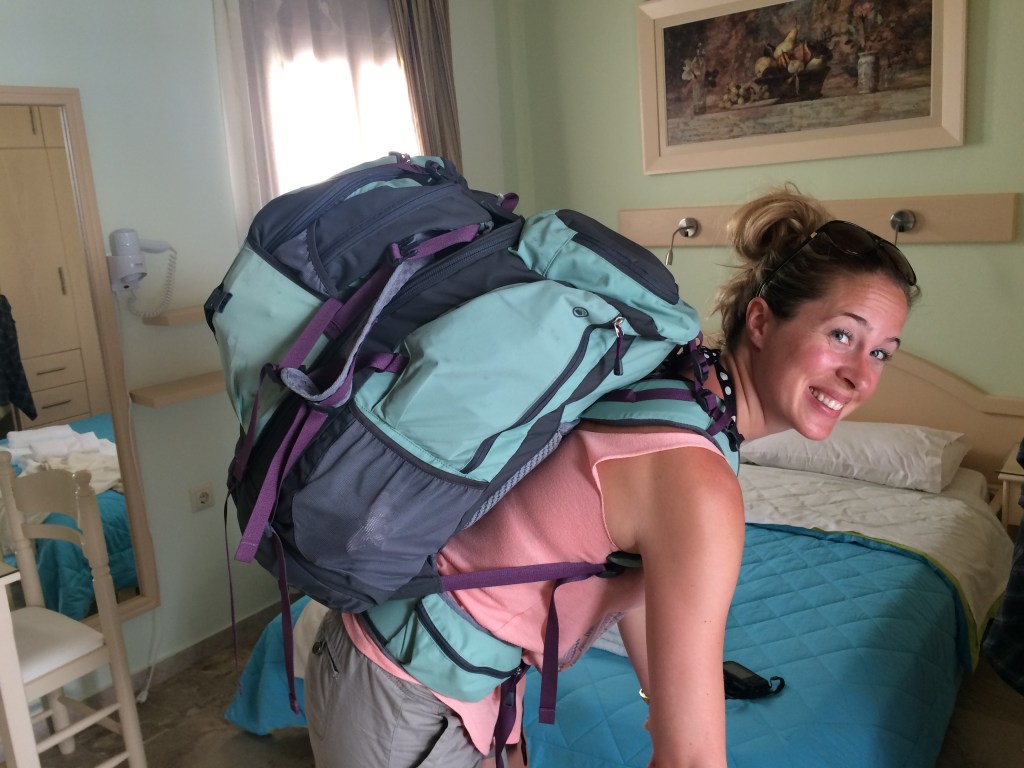
So. This was hard. Really hard. It’s still hard because just as much as I want some other items that I left at home, (i.e. perfume, Sperry shoes, long cotton blue and white dress, my straw beach hat,) I just as badly wish I had less to carry in my 80L backpack. It’s heavy! Just as the hotel front desk worker in India put it, “HOW do you CARRY that?!” I ask myself that everyday! haha Strong like bull.
So what made the cut:
3 pairs of shoes – 1 pair of sneakers, 1 pair of flip flops, 1 pair of cute sandals –flats of course – I call them my Jesus Sandals, some of you may remember these 😉
1 bathing suit
1 light jacket with removable hood (this has been clutch since we don’t have an umbrella)
1 long sleeved cotton t-shirt
1 pair of (skinny and stretchy) jeans and 1 pair of long, white cotton pants
2 pairs of Lululemon workout pants –1 capri type and 1 full length type
2 pairs of shorts–1 pair of Nike workout shorts and 1 pair of khaki type shorts
1 pair of light cotton pajama pants
2 pairs of bedtime/lounge around shorts
1 pair of khaki type capri pants (I wear these the most! wish I had another one!)
2 skirts — both cotton, 1 full length and 1 above the knee
1 beach cover up type dress
3 (cute) short sleeve t-shirts –not the kind that are big, baggy and only worn to sleep in
about 7 or so tank tops, mostly wife-beater type
4 sports bras and 2 regular
about 20 or so pairs of underwear (mine don’t take up much space so why skimp on that?)
6 pairs of socks
1 baseball hat (SF Giants)
jewelry — 1 watch, 1 pair of earrings, 2 necklaces, 4 bracelets, and my FitBit (leaving out most of my jewelry was hard for me, but has given me an excuse to buy some along the way–hey, its a souvenir AND its something I can wear now!)
1 paperwhite Kindle (thanks Odios!)
1 iPod Nano and headphones, my iPhone, and 1 underwater, point-and-shoot camera (thanks dad!)
1 (infinity) scarf — doubles as a headscarf while visiting Mosques
1 makeup bag, 1 toiletries bag, and 1 medicine bag (I’m a nurse!)
What I’ve acquired along the way:
1 long sleeved flannel shirt
1 t-shirt from Istanbul that says “Hello Dear Ist” (Get it?! I love this! Sean said, “THAT’S what you bought?!” after I shopped in one store for about 1.5 hours, haha)
1 t-shirt that Turkish airlines gave me when they lost our bags (thanks guys!)
1 travel journal from New Zealand that says, “I haven’t been everywhere, but it’s on my list” on the front (Sean says, “Why don’t you just type it?!”)
Christmas ornaments (or trinkets that we can transform into a Christmas ornament) from each country we visit, including from Saudi Arabia even though we never left the airport — but it’s my favorite one!
1 (engagement!) ring
1 makeshift burqa from India to wear while in Saudi airport for 4 hours
What I’ve ditched along the way:
The makeshift burqa, cus let’s face it, it was cheap, ugly, and I was never gonna wear it again
My Garmin, since it’s only capable of uploading U.S. maps on it (duh. Should have checked this before leaving the states. Wah-waaahhh).
I’ve done really well with the clothes that I have, and wish I had more if we go to a nice place, (like 1 time clubbing in Turkey, or a nice restaurant). In those instances I find myself wearing my “Donkey clothes” as I put it, but in reality, if I brought dressier stuff, I wouldn’t really wear them that much. Besides, I hate wearing heels anyway! 😛


 I quite liked driving through New Zealand and Australia. Like most countries outside the U.S., they use roundabouts to deal with intersection traffic.










 Sean Shadmand
