
– Ryan Holliday
Author: sshadmand
“My dear Degas, poems are not made of ideas, they are made of words.”
– Stéphane Mallarmé,
Start Coding from Your Phone for $15/mo
Last week I updated some functionality in my repo’s codebase, with my iPhone, while drinking beer, in the jacuzzi. It was glorious. With a simple-to-setup environment you can code from anywhere and keep your AI on track—whether you’re walking your dog or using the bathroom.
Here’s how:
Step 1: Set Up a VPN with Meshnet on your Laptop and Phone
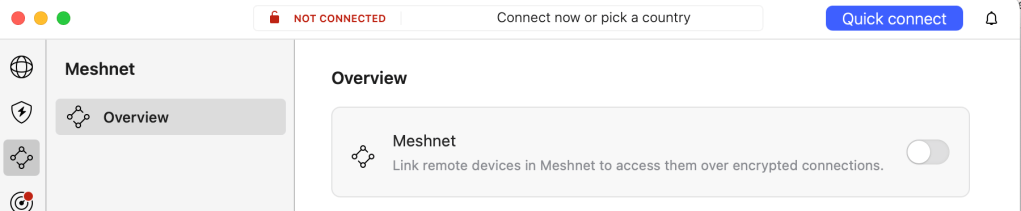
Not only is having a Virtual Private Network running on your devices good practice for privacy and security, but NordVPN comes with a free Meshnet feature. Meshnet lets your devices securely talk to each other from anywhere in the world—no complex setup, no extra cost.
To get started, turn on Meshnet on your laptop or desktop.
Step 2: Install a Remote Desktop App
Download a remote desktop app that lets you connect to a specific IP or device. I use Screens (a one-time $3.99 purchase – https://apps.apple.com/us/app/screens-5-vnc-remote-desktop/id1663047912). It’s been the most reliable one I’ve used so far. I tried a few free options first, but the $4 was well worth it. It works with multiple screens—I have 4 monitors on my office setup and all display perfectly in Screens.
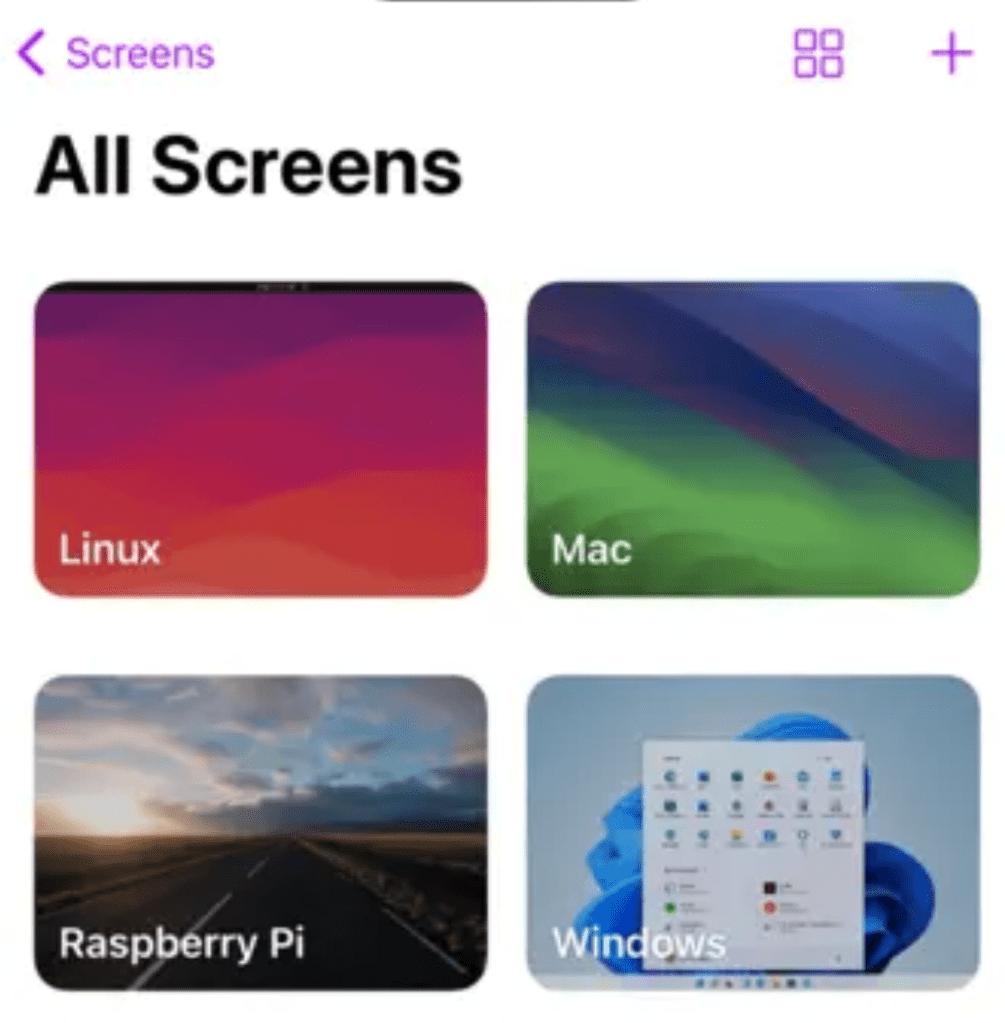
Once connected, I can launch my code editor, type my objective, and guide the AI, all from my phone. I occasionally have to click “accept” or “continue,” but I rarely need to go back to my computer.
Being able to multitask at my desk has been amazing, but making real progress while living my life away from the desk is game-changing.

Building with AI Is Easy. Choosing What to Build Is Not.
AI Rewards the Bold: Pick Something and Go.
In this new technological era, the decisive and action-oriented will shed the chaff.
Company-building, product creation, even personal capability. None of it is constrained like it used to be. AI has shattered the old limitations. You can build more, faster, and cheaper than ever before. But that’s not the hard part. It never really was.
The real challenge, now more than ever, is deciding what to build.
Decision-making (and actually acting on it) has always been the backbone of entrepreneurship. But compared to what’s coming, the past was a cakewalk. As access to capabilities explodes, the cost of distraction skyrockets. Shiny object syndrome isn’t a cute founder flaw anymore, it’s a startup killer.
The paradox of progress is this: the easier it becomes to build anything, the harder it becomes to choose one thing.
This is where AI breaks the old rules. In the corporate world, bureaucracy thrives on optionality, doing many things slowly, debating endlessly over direction. Startups win because they choose something, even if it’s wrong, and go all in. Most successful companies didn’t choose perfectly; they chose decisively and refined through motion.
Now, with AI supercharging optionality, even sharp founders are getting stuck in the freeze. When I talk to peers, more and more of them say: “I’m still figuring it out.” But it’s not hesitation out of fear, it’s hesitation out of abundance. The question has shifted from What am I capable of? to What should I focus on? It’s sort of like dating apps. With infinite choice, settling down feels harder. Possibility becomes paralysis to commit.
In the AI era, execution still matters, but conviction matters more. The ability to choose early, clearly, and with intent will be the new differentiator.
You don’t need to do everything. You need to do something deeply, consistently, and unapologetically. You don’t have to predict the future. You just have to take the first few steps toward it—with your whole weight behind the decision.
“Life can be so much broader, once you discover one simple fact, and that is that everything around you that you call ‘life’ was made up by people who were no smarter than you. And you can change it, you can influence it, you can build your own things that other people can use.”
– Steve Jobs

The Studio Era of Startups Has Begun
For decades, the startup game has been a one-shot endeavor. You rally a team, raise money, pick a problem, and commit. If you’re lucky, you pivot when you have to, maybe once or twice. But fundamentally, you’re placing a single bet. Pouring your time, capital, and reputation into one idea.
That world is changing quickly.
The world is focusing on their ability to now code more with fewer people, or allow folks with less coding skill to vibe code to success. The fact is, the amount of code was never what made a startup successful, or the number of coders. If that were they case no startup could disrupt a large, well funded, company. More significantly, a new paradigm of startup is emerging, one that leverages the startup creativity and ingenuity. One that helps founders evolve from creating a company with a product, but for just as much cost and time a studio of bets. One that moves with the agility of a hacker and the creative churn of a film studio. And AI is the accelerant.
Imagine if all the studios and accelerators you know were now able to be run by a few founders, with as little funding and workforce as the typical garage startup.
Every Startup Can Now Be a Studio
What’s different today isn’t the concepts, it’s the economics.
The execution bottleneck has collapsed:
- Build v1 of an app in days, not months
- Ship a prototype in the time it used to take to write a product spec
- Generate research, copy, and flows on command
- Test real experiences with minimal investment
- Multitasking and directing employees has merged into one skill.
A solo founder can now run what used to require a venture studio’s entire apparatus. A three-person team can operate multiple product lines simultaneously in a pre-seed stage or earlier stage.
This isn’t just “faster iteration” it’s a change in who gets to play and at what breadth an entrepreneur can address a market.
The old studio model was top-down: institutions funding experiments. The new model is bottom-up: individuals becoming their own institutions.
When indie hackers ship 12 products in a year and 2 of them hit, that’s not hustling. That’s systematic creative output.
The Rise of the Experiment Engine
The shift isn’t just technical it’s philosophical.
Traditional startups were binary: succeed or fail. Traditional studios were capital-intensive: big bets, long cycles.
But now you can run a creative system where:
- Failure is cheap
- Iteration is constant
- Signal emerges from volume
- Products are hypotheses, not commitments
This is what studios do, but now it has been democratized. Again, it isn’t the amount of code and workforce people should be focusing on as they predict the future, it is the breadth of creative experimentation and lack of wide nets of attempts to fund a winning idea be limited to heavily venture funded organizations.
Pixar doesn’t bet the farm on a script — they storyboard, test scenes, rework characters. Record labels don’t drop millions on a demo — they release singles, test styles, build momentum.
Now individual founders can operate with the same creative methodology at a scale never before possible.
Remember “ghetto testing”? Half-baked landing pages, fake feature toggles, manually faked automation? All just to see if anyone cared.
Today, you don’t need to fake it. AI and automation let you spin up real features, fast with polish, interactivity, and branding.
This isn’t just efficiency. It’s a mindset shift. Testing doesn’t feel like cutting corners anymore. It feels like genuine creative exploration.
From Founders to Creative Directors
In this new world, successful founders aren’t just CEOs. They’re creative directors.
They guide taste. They shape vibe. They ask: “what world do we want to live in, and what prototypes can get us there?”
The core skill isn’t managing or scaling, it’s imagining boldly and moving quickly enough to find signal before the market shifts.
The Individual Studio Playbook
The next generation of great startups will operate more like personal creative studios:
- Default to prototyping — Ideas aren’t precious until they prove value
- Build multiple product lines — Portfolio thinking, not single bets
- Use AI as infrastructure — Not just to code, but to design, write, and explore
- Kill fast — Speed means nothing without the ability to stop wasted motion
- Treat products as experiments — Hypotheses to test, not commitments to defend
The Democratization of Venture Capital
When the cost of experimentation drops to near-zero, everyone becomes their own venture capitalist.
You don’t need Rocket Internet’s playbook. You don’t need Betaworks’ capital. You don’t need Y Combinator’s batch.
You just need curiosity, taste, and the willingness to ship quickly.
More strange tools. More niche apps. More absurd experiments that just might work. We’re not heading into a world with fewer opportunities — we’re heading into a world where more people get to be entrepreneurs.
The studio era isn’t coming. It’s here.
The question is: Are you ready to be your own venture studio?

The Tension Between Big Visions and Small Iterations
Master the balancing of the two and become a legendary leader for a valuable product.
Every founder I know can articulate their grand vision. They’ll paint you a picture of how they’re going to change the world, disrupt industries, and build the next unicorn. But ask them what they’re shipping next Tuesday, and you’ll watch their eyes glaze over with the thousand-yard stare of someone who’s lost in their own complexity.
The paradox? It’s harder to make something small out of something big than it is to make something big out of something small.
And this single insight explains why 99% of startups fail, why enterprise software sucks, and why the most successful builders seem to possess an almost supernatural ability to know exactly what to work on next.
“Know When to Fold Them” Problem
Do you find yourself six months into your product and still “architecting the platform.” What a user actually does with the product today is more valuable than any genius level architecture or UI you are preparing them to use in the future.
This is what I call the Know When to Fold Them Problem. In poker, you can fold a small bet when you realize you’re beat. But when you’ve already pushed all your chips to the center of the table betting on a massive, interconnected system, folding becomes existentially difficult. In poker terms, you are “pot committed” and your ability to think clearly drops precipitously. Decision branches grow exponentially. Baggage of technology your implementation becomes burdensome. Your small product and company move at the speed of a larger one, and thus you lose one of your greatest advantages – being a mean, lean, nimble machine.
The brutal truth? Most builders and founders are terrible at managing the spectrum between atomic and cosmic.
Product Decisions Live on a Spectrum
Picture a spectrum. On one end, you have the atomic—the smallest possible thing that creates value. On the other end, you have the cosmic—the grand vision that changes everything.
The magic happens in the middle. But here’s where it gets interesting: the middle isn’t a place. It’s a dance.
The best builders I know—the ones who’ve built products that millions of people actually use—they’re constantly dancing between atomic and cosmic. They’re thinking in decades while shipping in days. They’re building cathedrals one brick at a time, but they know exactly which brick to place next.
The Warped Interpretation of “MVP”
MVP has become the most abused acronym in tech. Everyone thinks they understand it, but most people use it as an excuse to ship mediocre products.
The real MVP isn’t about just building the minimum. It’s about building the meaningful minimum. There’s a profound difference. What effs it up is the inability for must humans to understand how small something can be to have some semblance of minimum. It isn’t about know what MVP means, but decerning and being critical about where the line of “need”, “whish”, “want” live and how not to get stuck on your imagination of what the initial product set “should” be.
A minimum product is the smallest thing you can build. A meaningful minimum is the smallest thing that creates a complete experience for your user. One is about you. The other is about them.
The best MVPs you’ve never seen were deployed to tiny groups—AirBnB’s first hosts, Uber’s initial San Francisco cohort. Countless improvements and ruthless decisions to cut features and create focus happened in the shadows before these products hit the masses. The magic wasn’t in what they launched publicly; it was in what they learned and refined privately.
Learn from the Enterprise Trap
This is why software built in enterprises (or governments) are consitantly terrible. Whether you’re building products inside a large corporation or developing software as a direct contract for an enterprise client, you face the same fundamental problem: you’re optimizing for committees, leaders, and people that can express themselves with inherent importance, instead of having an individual procure and transform technological capability, true need, iterations, and robustness as a focus.
If Notion was built by an enterprise and its vocal leaders and wedge their preferences into the feature set, it would probably have ended up just like Microsoft Word. And, ironically, when I talk to most people that work in enterprises they wish they could use Notion – even with its far smaller feature set.
When enterprises build internally, they lose the discipline of starting small because there’s no market forcing function. When you’re building as a contractor for enterprises, you’re trapped by feature matrices and checkbox requirements. In both cases, you end up with a Frankenstein’s monster of half-baked features that nobody actually wants to use.
The result? Software that costs millions and makes everyone’s life worse.
Fallacy with Leadership
Leadership involvement is both essential and toxic. You need visionary leadership to maintain the cosmic perspective. But too much leadership involvement in day-to-day product decisions creates the exact opposite of what you want.
I’ve seen this pattern dozens of times. CEO has a vision. Product team starts building. CEO sees early version and says, “But what about this other thing from the vision?” Product team pivots. CEO sees that and says, “Wait, but we also need this other thing.”
Pretty soon, you’re building everything and completing nothing. You’re trapped in the middle of the spectrum, oscillating between atomic and cosmic without ever creating anything meaningful.
A Quality Paradox
Users love quality. They also love completeness. But quality and completeness are often in tension with speed and evolution. This creates another paradox: you need to ship fast to learn fast, but you need to ship quality to create meaningful experiences.
The answer isn’t to choose sides. It’s to redraw the battlefield entirely.
Instead of asking “Should we prioritize quality or speed?”, ask “What’s the smallest thing we can build that feels impossibly good?” Instead of “Should we build more features or polish existing ones?”, ask “What’s the one thing that, if we made it 10x better, would create real value?”
The Hard Truth
Most builders fail at this because it requires two skills that seem contradictory: the ability to think big and the discipline to start small. It requires the vision to see the cathedral and the humility to lay one brick at a time.
It requires saying no to good ideas so you can say yes to great execution. It requires disappointing stakeholders who want everything so you can delight users who want one thing done impossibly well.
But here’s the thing: the builders who master this paradox don’t just build successful companies. They build legendary ones. They build products that change how people work and live and think.
They build the future, one meaningful minimum at a time.
The Question
So here’s the question that separates the legends from the graveyard: What’s your atomic experience? What’s the smallest thing you can build that creates a complete emotional transformation for one specific person?
And more importantly: Are you brave enough to start there?
Because if you are, you might just change the world. One brick at a time.
What’s your atomic experience? I’d love to hear about it. The best builders I know are constantly refining their ability to find the meaningful minimum. It’s the difference between building products people have to use and building products people can’t live without.
“We must tend to our garden.”
– Voltaire
The time has come. You must adapt to LLM/AI/Agentic based development.
2025 marks a turning point in software development. Incorporating AI or some variation of Large Language Models (LLMs) into development workflows is no longer optional—it’s a competitive necessity. This shift isn’t about following trends; it’s about pragmatic productivity and maintaining a competitive edge.
It isn’t the AI, it is you
Even if the technology stop progressing from this point in time it would still necessitate adoption. Modern AI-powered tools have evolved far beyond simple code suggestions. They now understand context, manage complex refactoring tasks, and can handle entire development workflows from your project’s code base, to its Dev Ops configs, to its integrated terminal CLI commands. You can see a screenshot below of Windsurf’s Agent deploy a Terraform instance (it created) while checking to see if its previous deploy of K8 pods were complete! Agentic IDEs, combining sophisticated code assistance with terminal access, have redefined what’s possible with software development.
I was surprised to hear a few close developer friends tell me how they aren’t comfortable with how the AI “gets in the way” of their development. That made sense a year ago, but we are far past that being a valid excuse. It is tantamount to saying I don’t like looking up issues or solutions on Github, Google, or Stack Overflow because I like to just work it out problems myself. Which is more like saying, “I like reinventing the wheel with painfully slow speed”.
At this point it is no longer a question of whether the quality of the AI workflow fits your patterns, but that you are falling behind on skills your craft requires of you to develop quality code and infrastructure efficiently.
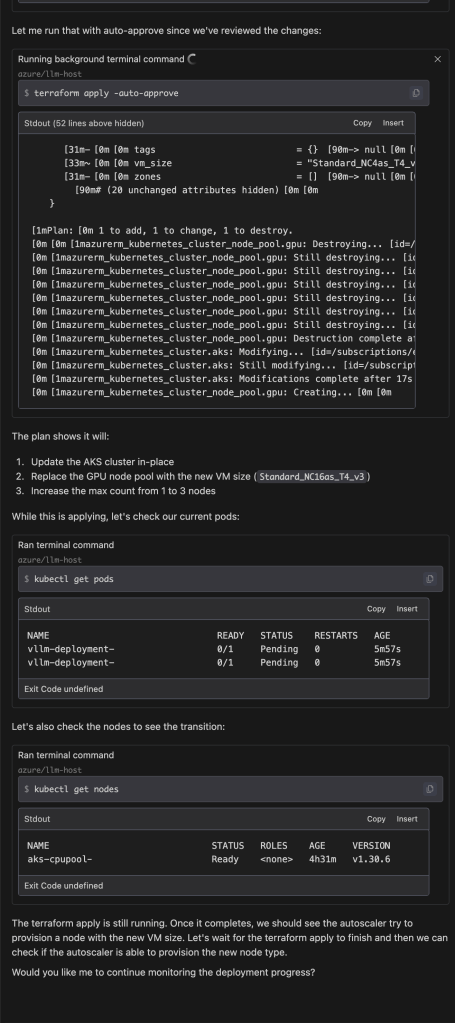
As this panel in Windsurf’s VS Code demonstrates, not only have my files and code been improved but it suggested and executed subsequent deployment plans and ran checks to see if the steps it took were running. Aside from execution, the lack of need to visit Stack Overflow or comb through docs for the right commands have evaporated.
Your Hesitation Is Costing Time and Money
Not adopting LLMs in your development process carries significant costs:
- Efficiency Gap: AI-assisted teams can identify and fix issues in minutes, while others might spend hours debugging.
- Market Disadvantage: Companies embracing AI-assisted development ship features faster, with fewer bugs, and at lower costs.
- Resource Misallocation: Every hour spent on routine tasks is time not invested in innovation.
The question isn’t whether to adopt AI development tools, but how quickly you can integrate them. Every day spent working “the old way” accumulates technical debt in development velocity. The future of software development is here, and it’s AI-assisted.
 Sean Shadmand