Leave the caves and create your tools!

GAE offers a free to get started approach, along with an instant “hello word” initial environment, making sandboxing ideas and building helpful tools for productivuty a snap.

To get started, download GAE, press the plus sign in the bottom left corner. Set the directory you would like to work out of and your almost done. Well, at least you are already at the stage you need to be to start playing with the system locally, in what we call the development environment (No one can see your system but you.) Just hit the [play] button on the GAE dashboard and you are running with your first environment. Just click the Browser (the compass looking thing), or go to http://localhost:8080 in your browser, and you should see your first “hello word! It is quite reassuring to see it work so smoothly (if indeed it does), and if this is the first time you have coded, trust me they have taken out a hell of allot of pain out of the tedium it can take to get here.

Without getting into the nitty gritty of code just yet, let’s push your baby to production (That means make it live/accessible to the world). That’s right, you are about to push a web application live to production!  First create a new app at the google app engine home page and follow the steps there (setting up your yaml for upload). Your yaml file tells google which app your are updating when you do so. Not making sure your yaml matches your project is like  you sending mail through the USPS without out a “from”/”to” address.

Once complete, press the blue arrow pointing upward (the “deploy” button) and it will deploy (AKA: push to prod, go live.)

Once deployed, you can update, monitor, or even share you application with the world. And all for free. Not that this baby would get allot of attention in its current state (just a “hello world”), but if it did, it would also be scalable. I mean 10 years ago this would have cost you quite a bit of time money, especially if you didnt know allot about server configurations, apache, linux, or windows server, or…well you get the idea.

There are a few sample apps you can play with on the GAE site. If you are ready, start developing some code i Python. Maybe had a hellow world message of your own.

When you start feeling saucy, try and create a model. A model is a data structure you can save, or persist, data to your system. Again to you newbies out there, this is the equivelent of your granfather telling you, “back in my day I had to walk up a hill in the snow to get to work, and up a hill in a blizzard to get back.” Setting up a database on a production server was a skill on its own, but to create one that is scalable, and without the need to architect it is amazing. You see, based on the models you create GAE intuitivley creates your “database”, stores it efficiently, and assumes where indexes need to be placed. You really don’t have to understand any of this, but if you want to you can look up those terms have at it: indexing, database, architecture, MVC…. Like I said, I’m just an old guy complaining about hills.

If you are still a bit timid about getting started, don’t worry there is a baby step in between these tween sized steps that can help you get ramped up before you start churning out lines and lines of code. Click on the “SDK Console” button on the GAE dashboard. It will open up a web page that is running locally, on your stage environment, that gives you windows into your system to hack around with. (This console lives inside your development app, so don’t forget to run your new app to get access to it.) Once in the console, click “Interactive Console”. There you will have a very rudimentary terminal that you can write temporary test scripts in. The output is shown on the right of the screen. This is a great place to get errors, make mistakes, and go nuts! (Note: The SDK Console also houses your development DB, so you can check to see what data you are saving after you have attempted to save it.)

Note: The easiest way to get started as a newbie, in my mind, is by using Python in GAE. Java, although awesome, is a bit more advanced.

I recently used GAE to create a few projects to help out the team. One for TeamCity monitor to view coverage reports and if a build is broken or not. And also one for Pivatol Tracker to help our press and marketing interpret what is coming out of the product pipeline, if its ready, and what are the stories of value within. I will post templates for those projects in the near future.

What do you and Sonic the Hedgehog have in common?

Sonic and his rings
Sonic and his rings

Have you ever played Sonic the hedgehog? Man, what a classic! The objective: Get your hedgehog, named Sonic, to jump, run and even roll through a stage, avoiding the array of animal-ish enemies, only to reach a guarded exit, protected by your arch nemesis, Dr. Evil. Beat him and the entrance to the next level is opened. Keep this up, level after level, enemy after enemy, and you will win the game. — But wait there’s more! If you are attacked without a collection of magical “rings” in your possession, you will die. With one or more rings you can narrowly avoid death by attack.

So which was more important, getting to the next level, or acquiring the rings? Well, any kid would tell you: Duh, both! Obvi. If you only collect the rings you may never get to the end of the level. Alternatively, if you only try to get to the end of the level, rendering yourself ringless, you dramatically decrease your chances of survival.

Of course, one could play the perfect game, dodging all would be attackers, and avoiding falling off cliffs to a spikey-floored doom. By doing so you would indeed win the game, just as anyone else. But who could make it through all those levels without one misstep, one slipped finger, or distracted moment when your Mom calls you down for dinner? I’m going to take a stab at it and say — not a single person. So, thanks to those gracious creators at Sega, you were given those wonderfully magic rings, giving you a fighting chance. You and everyone else jumped at the opportunity, capturing as many rings as you could. You mitigated risk, balanced your options, and grabbed on to what ever you could, outside of the clearly laid goal of completing the level, to of course do just that, complete the level and win the game; achieve success.

That is not a theme reserved for just hedgehogs named Sonic, or any game for that matter. Success is a goal some of us can see, and once we see it, we direct our focus directly at achieving it. But it is often that deterministic direction that creates a far more subtle misdirection.

Nine out of ten startups fail, right? I bet most of them are hard workers and/or have great ideas and/or have a focus and/or goals. A major hurdle to overcome, one that is far less obvious then the cliche advice to work harder/smarter, and the basis for why so many startup fall victim to those one-in-ten odds, is that it is the very focus on the goal that can cause the unbalance in your business, and ironically dooms your chances in achieving it.

Success may live on a straight-line, but the line seen is not necessarily the path to take. The best path is almost always one that dances around the line formed. Looking away, towards an entirely different direction, can reveal a path with far less hurdles when the focus is returned to the goals directive. You must let something go in order to truly have it — a clichĂŠ theme that works in almost any environment, and often takes a lifetime to master. Simply put, our “rings” come in the form of friendships, support systems, a passion for what you do, mistakes that need to be made, failures to learn from, vacations to escape to, and random ideas that inspire. When we remember to grab onto those rings when the opportunity to do so arises, or even sometimes when it doesn’t seem like it can, we will be far more able to last the “attacks” the startup game will inevitably throw our way.

So my fellow hedgehogs, should you grab at all the rings you can, even if at times by doing so you are unable to race towards the goal? Most definitely! Any kid who had a sega will tell you: you have to do both. Duh! Obvi.

Diet: Start with — well — your diet.

I was talking to a friend of mine about the perils of staying healthy as I find myself getting older and in the midst of spending every hour on growing my business and not my body. He apparently bumped into a friend of ours from collage that is now an MMA fighter and noticed how fit and in shape he seemed. My friend asked, this now professional athlete, for a short “intro to a healthy body ‘201’”, becuase, as he put it, we have all heard the “101” before. This is what he said followed by the email he sent to add some clarity. I figured it was postable. Some things you may know, somethings are just good to hear again and others may be new to you, so enjoy how ever you choose 🙂

======================

Basically diet is everything, not just important, but everything. And breakfast is more important then people realize even though they may hear “breakfast is the most important meal of the day”, all the time.

———————————–

As soon as you wake in the morning, you should consume 16-32 oz of cold water. You body is in dehydration and starvation mode at this time, so the water starts your metabolism by up to 33%.

You want to have something to eat within 30 minutes of waking up as well. I usually eat a bowl of oatmeal with a banana or egg whites. They are both easy to prepare and easy for the body to breakdown.

Doing these two really simple/very important things will have you on you way to being health, losing weight, and having more energy.

Two hours from when you eat breakfast you want to have a light snack. (Protein shake,health bar, powerbar, 10 almonds, pack of peanuts, yogurt, fruit, trail mix) Or some combo of the two.

This helps to sustain your metabolism in between meals, and aids you in not overeating during lunch.

You want to eat lunch 4 hours after breakfast.(Give or take 30 min)

2 hours after lunch you want another small snack.

2 hours after the snack you should eat dinner.

2 hours after dinner you should have a light snack before bed. (If you want, but not needed) But you should go to bed hungry.

So you are comsuming a meal every 4 hours and a snack every 2 hours in between. (This is VERY important)

You should be consuming plenty of water throughout the day. I drink at least a gallon of water, sometimes more. Water helps push everything through your system and aid in digestion. It’s a no-brainer, but people still don’t do it. And NO, you will not be drinking too much water if you consume a gallon, so don’t worry. However you will be going to the restroom quite often.

Stay away from fast food, fried foods, sweet snacks, candy, cakes, and other crap food. Once you start cleaning up what you eat, you’ll start feeling all the bad stuff you have in your food plan.

You do want to pick one day out of the week to have whatever you want. Pizza, Beer, wings, donuts….you get the point. I use Saturday’s as my cheat day and I go to town. Eventually you want to take this Cheat day down to just one cheat meal, but it’s a gradual process. Starting off cutting everything ‘cold turkey’ has negative results, so don’t do it.

Add this with a workout 3-4 times a week and you are off to the races. I’m including two meal plans my nutrionist had me on. You can switch foods around as you choose, but try to stick to the overall theme.

Will you please "BeMyApp"?

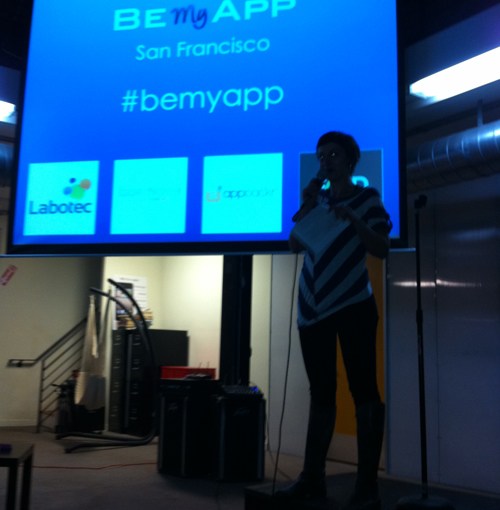
The BeMyApp Competition was held at pariSoma’s new building, an innovation “hotspot” and office space in San Francisco. There, a group of innovators, developers, marketers and entrepreneurs got together to try and create an iPhone application that would change the world in forty-eight hours.

People who registered as innovators submitted their ideas on the BeMyApp site,
and a select group presented at the pariSoma building to the rest of the attendees. After the innovators presented their strictly monitored (only one minute!) pitches, the attendees voted on their favorite idea. To cast a vote, each attendee used poker chips as tokens to represent one vote towards an idea. Innovators with the most chips made it to the next round.

Forty-eight hours later, I returned to judge the submissions. I found the new team members, fully integrated with one another, preparing for the presentation. They were laughing, backing one another up and finalizing their demos for the judging. It was great seeing how quickly the camaraderie developed around the common objective of innovating through apps. It was even more surprising to see how dedicated they were to that objective as a single unit in such a short amount of time. The time was finally here: the five finalists presented their demos and a short summaries of their business objectives.

Next, the other judges and I deliberated backstage to pick the winner. It was tough to essentially choose “losers” in a group of teams that did more in a weekend than many large companies could do in a month, but we made the decision.

In the end, the decision went to a two-person team, a vast difference to the more common three- to five-person teams at the event. Their product, “FilmMe,” allowed users to upload ten- to twenty-second clips that would automatically stitch together to form a single video. YouTube made uploading and distributing video easy, which allowed the common PC user to become a producer. FilmMe took video a step further, solving the complexity and time drain that comes with composing multiple video clips from many sources. The presentation of the concept without the demo left me a bit skeptical about its usefulness, but after seeing their demo I was surprised to discover how entertaining it was to watch a single stream of videos mashed together about “who was your first kiss?” To give an example, think about interviewing a few friends at a birthday party. With one click, FilmMe automatically updates and converts all the videos into a single video you can post to Facebook or YouTube to share. Simple concept? Yes. But a huge time and energy saver. Simply put, with FilmMe I would try my hand in compiling and sharing short clips from a night out. However, I will—and have—avoided at any cost the effort it would take to copy videos from my phone, request clips from friends, load them into iMovie and render them into a single movie just for the sake of sharing.

All in all, it was inspiring to be a part of the BeMyApp competition. It reminded me that losing red tape and doing away with corporate structure can allow for true innovation to occur and that forty-eight hours is all one needs to turn an idea into a working reality. All it takes is a few like-minded entrepreneurs to get together with a common purpose. I will certainly take what I saw at the event back to my company and encourage more adhoc, fun, innovative sessions like these for my team.


pariSoma’s New Digs

Old McDonald Kills Raccoons E-I-E-I-O

Raccoon in Suit
Raccoon in Suit

I was just telling a friend about a story I heard when I was younger, about how farmers used to trap raccoons. It reminded me of business strategy — So, I thought I would share.

Raccoons are notorious for destroying farmers’ crops. Because farmers are so resourceful they devise a way to trap raccoons in their fields by using only a piece of bread and a large silver spoon in a small jar.

While walking through the field the raccoon sniffs out the jar and out of curiosity attempts to retrieve the food. While doing so, the raccoon, which is known for its love of shiny objects, is distracted by the silver spoon reflecting in the moonlight. It grasps the spoon, and since the opening of the jar is smaller than its closed fist, it relentlessly pulls on it for hours.

The noise from the spoon clacking against the glass alerts the farmer of the raccoon’s presence. Determined  in removing the spoon, the struggling raccoon gives the farmer enough time to put down his dinner, grab his gun and make his way to the ill-fated rodent.

In this example, the raccoon did some things well:

  1. It stumbled onto an abundance of food on a farm.
  2. It found some delicious bread and went after it.
  3. It found something shiny that it liked and went after it.

What was its deadly mistake? It couldn’t give up on a bad situation once its investment went south. In other words, he wasn’t able to reassess risk/reward and how it compared to its higher purpose.

The gist: Sometimes giving up on what we love/desire can be distracting from what we need to win. An entrepreneur is risky enough to take a chance on the delicious bread even though it is surrounded by a field of food, but it knows a shiny spoon in a small hole when he sees it. 😉

Farm
Farm

Reg Ex: Replace all tags except style and script tags

Took me a bit of hacking some regular expressions together using look aheads until I realized although it worked it’s not what I wanted after all….guess its late —

I figured I would post it to have it be at least worth a bit of SEO since i couldn’t google it myself…

Java String: “<(((/)|())(?!(/)|((script)|(style))).*?>)>*?”