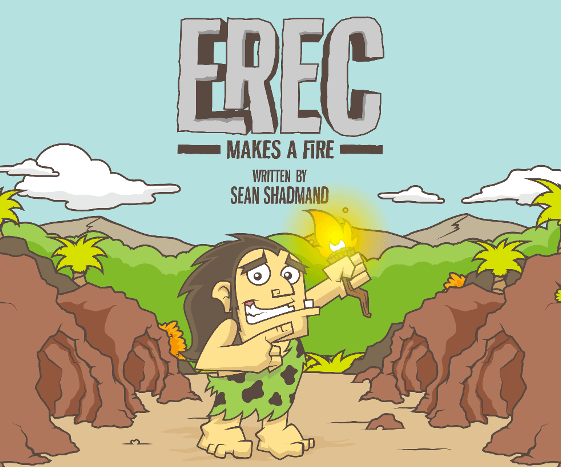
Erec Makes A Fire: A Children’s Book About Entrepreneurism

Erec Makes a Fire was successfully funded on Kickstarter! Thanks for all your support.

What is the book about?

Erec Makes a Fire is a story of how a group of kids stumble upon a cave covered in ancient writings depicting the story of how a unique young cave boy (Erec) accidentally created his first great invention, fire. The story shows how, even in the simplest of times, one is able to form a business, sell a product, and create a success. The book is written to subtly embed one of the most fundamental parts of business in a child’s mind: leveraging an opportunity when finding demand in your community and providing a supply for it. Even before cash, computers, technology, LLC formation or business entities, business and entrepreneurs thrived through observation and invention,  and they still do so today. This story helps teach youngsters, and remind their parents, that entrepreneurism is all around us and to keep an eye out for one’s own personal “fire” opportunity.

Why did I write the book?

As a person who loves the world of entrepreneurism, I also love telling a story about how anyone can turn a will or idea into a business. I have enjoyed telling that story, and giving tips on how to do it best, for a number of years through various mediums such as interviews in print, in person, and on TV. Now that more and more of my close friends are having kids I want to share that passion and story through a form that their kids can benefit from. I noticed there wasn’t much out there in the world of children’s books that took business concepts and simplified them into stories kids could love, as well as learn from. So, what else was I to do as an entrepreneur but to fill that void. Erec Makes a Fire is the first in a hopeful series of books that builds a foundation of business mindedness in our children.

Beliefs that inspired

Two major beliefs of mine contributed greatly to the creation of this story: First, immersion is a great key to early developmental learning, and secondly, kids are extremely capable of learning and understanding complex concepts early on, especially when it is told through story and analogy.
In regards to immersion, I believe that even if a child does not understand a concept introduced to them directly, being surrounded by that concept will help them become more comfortable with the subject matter as they mature. This makes the principles taught far less foreign to them, and therefore more easily consumed when they grow up, as compared to those learning the same concepts for the first time later in life.

I also believe that children can grasp complex concepts, like supply and demand or finance, far earlier in their lives than is generally taught today. I have always been amazed at how kids pick up core concepts so deeply. Yet, adults at times “protect them” from complicated concepts for worry of it going over their heads. Supply and demand can have complexities within – yes, but the basics are – well – basic and building stories around those concepts can most definitely be consumed by children. Look how well they understand other stories we give them, like ones around “how to share”, a concept that I find many adults still struggling to grasp. I remember sitting with adults during dinners as a kid while they talked to one another about their businesses around me. Over time and many family diners a grew more familiar with many of the things they talked about while still being a child. Although I was unable to articulate my perspectives on the subjects at the time I mades notes to remind myself that one day, when I got older, I would remember this: kids get more than you think.

Stickers
Sticker Collection Available Through KickStarter

Erec Makes a Fire is a new kind of children’s book that immerses young people in concepts they should be given the chance to understand early in life so that they can have a foundation for understanding it more deeply as they grow up. As such the company under which the book is created is called “Small People. Big Ideas. LLC”

How and When Can I get it?

The first few copies will be made available as gifted items through a fundraising drive on KickStarter. I have my initial proofs and prototypes complete. Based on how much I can raise through KickStarter I am shooting to making it available by the spring of 2015. There will be special gifts given out through KickStarter in addition to the books themselves to make things more interesting, such as: signed copies; custom printed copies; packages including digital, print  version and stickers; as well as custom designs where our artist injects a characterization of your child  into a character in the book! Books will be made available through softcovers, hardcovers, and ebooks.

About Kick Starter:

KickStarter is a crowd funding platform that allows projects to get funded before they start. It is a great way to start a business or project and works perfectly with the Erec Makes A Fire book as the funds are only released if the book gets enough demand. The simplest way to think of KickStarter is this: think of those PBS drives on TV, the “If you pledge more than $50 you get this free tote bag” type of promotions. For a project like mine my gift will be an early copy of the book and other creative unique offers mentioned above that only funders will be able to receive. You can read more about KickStarter here: http://www.kickstarter.com/help/faq/kickstarter%20basics#Kick 

Erg: Erec's first customer as a Sticker
Erg: Erec’s first customer as a Sticker

Why Did you Spell “Erec” with an “e” instead of an “i” ?

The names of the book are witten with some historical significance in mind. Homo Erectus and Homo Ergaster are the scientific names for the two homonids believed to be around during the time period fire was discovered. So, the characters names in the book take each half of each of those names: Erec, and his friend Tus are the first two characters introduced. Followed by his first two customers Erg and Aster. Just in case though, we made sure Eric Makes a Fire works too 😉

Slides of Creative Process

Original Idea Draft
Original Idea Draft

Draft Rewrites
Draft Rewrites

Preliminary Sketches and Character Development

Backdrop Scene Development Sketches

Story Board Final Sketches

Final Sketches Converted to Digital

Final Layout Colored for Publishing
20130211-P1090359
Printed Proofed Books
Sticker (kids) Proofs

Get in to the cheering section and like us at http://www.facebook.com/ErecMakesaFire, and subscribe to email updates as we neat the big release here (http://signup.erecmakesafire.com)!

Fake Response Server: Slow response time generator

Here is another quick tool built on AWS. This one is super simple, but pretty handy. Today Twitter went down, and somewhere in our system we were using the Twitter API to display one of our status feeds. Them being down became us being slow.

Well, I wanted to do some quick tests to keep this from happening again, but byt the time I got to it Twitter was responsive again. To fix it I would need to create a bad URL. The crappy thing is I wanted a slow response time, not exactly a bad response/error. Creating a 404 error is easy, just go to some url that doesn’t exists and test. But I want a slowwwww response.

I quickly searched Google for something I could use, and didn’t find one. When I realized I would have to create a fake pause endpioint somewhere I figured someone else out there might benfiift from a quick public version of this system. So, I created fake response server. The first default endpoint available sleeps for a variable time.

https://fakeresponder.com

and add a sleep param to change the sleep time in milliseconds

https://fakeresponder.com?sleep=500

Nothing major, but why not publicize the tool incase it can help some other shmuck out there like me 🙂

Cheers.

Finally audio based commands and tagging that doesn't suck

QR Codes

I have kept an eye on QR codes for a few years now; it is a simple technology. Simple technologies win because – well, they just plain work. So many new technologies do a better job of adding complexities to solve a problem than they do to decrease them. I mean, as an example, the majority of the world still uses headphone jacks and earbuds to listen to their iPod, even though blue tooth is a great technology that removes the need to use those easily tangled cords. BUT those annoying tangled cords are still far more reliable and simpler to use than bluetooth. So we wait for the “simpler” technology to become – simpler. QR codes have the same M.O. They are simple and work, but they are also annoyingly primitive. For example, that QR code image you see on the left of this article means absolulty nothing to you visually. Yet I use it to take up space on the page, because it can provide value if you are willing to pull out your phone and take a snapshot of it.

The QR code works becuase it is a unique image that contains data within all its black and wite specks, like a data finger print or a bar code.  A device with an app that can read those specks convert the “fingerprint” into a equally unique URL that the app can then direct you too.

A more complex, yet more direct solution, is to have an image that is human readable, like and ad, act as the data rich finger print. That way a person can either take advantage of the precious realestate of the ad by siimply reading it, or taking a picture of the ad and get directed to the related URL. It looks like technolgies such as Google Goggles are on their way to crakingthat nut. For now however, Google Goggles is not more reliable or simpler to use then our ugly, cryptic; yet simple, and relaibale QR code.

Audio Commands and Tagging


The use of audio commands has had a problem finding its place as a “simpler” solution to the everyday problems they always claim to have solved, but as often fall short on expectations. I don’t know how many friends of mine have had voice-command car systems that in the end just dont work as reliably and effectively as turning a dial or pressing a button on their dash.

John’s car: “bee-eep. Can I help you?”

John in his car: “Call Sean”

John’s car: “Looking for Jons and bathrooms in the area.”

John: “Ugghhh! No , Call Sean!”

Car: “Bee-eep. Thank you. Calling Don now…”

John: :-[

Siri seems to be making voice commands better, or at least marketing it that way, but the dream of talking to our computers, as the easier way to interact with them, still seems as far away as it did here (See min 3:00 in 1984) http://www.youtube.com/watch?v=2B-XwPjn9YY


Okay, Siri and Google voice commands are doing better, and getting used more use than I have ever seen in the past with similar technologies, so that is promising…but yelling into your phone to “search for near by bars” in a crowded room is – well – shitty.

Shazam made some great leaps forward in the audio tagging and command space by finding the unique characteristics in songs, and turning that into pertinent data. That uniqueness is used so that the app can determine the song name, and its singer, just by holding up your phone to a song you hear on the radio.

This year, as some you may have already seen, Shazam has gotten into the QR related space by bringing their technology to TV comercials. When you see the Shazaam logo on a comercial open your Shazam app and let Shazam listen to the commercials unique audio. Their ability to link the unique “fingerprint” of sound coming form the commercials audio, and turn it into useful data allows them to link commercials to open a website on your device; much like a QR code. It is neat because the audio is as easily interpreted by human ears as it is by the Shazam app; maximizing the use of the allotted ad space. Unfortunately it falls short in the fact that it is impractical to expect a viewer to chase down their phone, open the Shazam app, and tag the comecials audio, before the comercial is over.

Audio Sync


I think I just saw a technology that actually make sense. Practical in its use, efficient in it implementation, and it solves a problem by decreasing complexity more then it adds.

In this case the audio is used to sync your tablet to a show you are watching. With this strategy you’re truly decreasing the steps needed to get what the show, and the viewer wants. No extra steps, no rushing for a unrelated app to open a web page, no ugly QR code images taking up space, just simply a way to help the user link the app their are using to the show they are watching.

It works by listening to the show you are watching, and applying the Shazaam like technology to the audio of the show to recognize what part of what show you are watching. The data is processed, and instead of just opening a web page, it sync your application’s experience to meta data surrounding the show on you TV. You can then interact with others watching the same moment at the same time, or listen to back stories related to the segment. Cool beans.


Team City Monitor (with coverage history) for GAE

Per my last post about the splendor of GAE, below is one example of a tool I built for us at Socialize to keep an eye on code coverage and lets the group know if a build is broken (if our tests have failed.) This script is built to run on Google AppEngine, checks against a TeamCity Server install, and expects that each project in team city has code coverage outputted to its artifacts folder.

What is C.I. Server and why is it important?

C.I. stand for Continuous Integration, and is a system used to constantly/”continuously” checks to see if a code base is “working” or not. Team City (by JetBrains) is a product made for that process. Usually it is used to run tests against a code base to make sure it is working as expected, as a part of the QA life cycle. These tests are made up of “unit tests” that are created by the developers whom write code to test the code they are writing. It can be a bit odd for those that have not ever done so, but it is quite important when trying to deliver stable code. In short, and in its simplest form, this whole system makes sure new code/changes doesn’t break old code already in place. You can read more about these processes and purposes here: Unit Testing & Integration Testing.

What is code coverage, and why is it important?

Code coverage examines how much of your code is being tested. For instance, you may have a C.I. system in place, and a unit test frame work running within it, but if the tests only test/”cover” 1% of all of the code you aren’t really delivering a level of confidence you should be. In this tool we track the coverage percentage over time. Seeing it as a graph helps recognize dips in coverage easily.


Download Team City Monitor for GAE


Or fork and contribute on GitHub

What do you and Sonic the Hedgehog have in common?

Sonic and his rings
Sonic and his rings

Have you ever played Sonic the hedgehog? Man, what a classic! The objective: Get your hedgehog, named Sonic, to jump, run and even roll through a stage, avoiding the array of animal-ish enemies, only to reach a guarded exit, protected by your arch nemesis, Dr. Evil. Beat him and the entrance to the next level is opened. Keep this up, level after level, enemy after enemy, and you will win the game. — But wait there’s more! If you are attacked without a collection of magical “rings” in your possession, you will die. With one or more rings you can narrowly avoid death by attack.

So which was more important, getting to the next level, or acquiring the rings? Well, any kid would tell you: Duh, both! Obvi. If you only collect the rings you may never get to the end of the level. Alternatively, if you only try to get to the end of the level, rendering yourself ringless, you dramatically decrease your chances of survival.

Of course, one could play the perfect game, dodging all would be attackers, and avoiding falling off cliffs to a spikey-floored doom. By doing so you would indeed win the game, just as anyone else. But who could make it through all those levels without one misstep, one slipped finger, or distracted moment when your Mom calls you down for dinner? I’m going to take a stab at it and say — not a single person. So, thanks to those gracious creators at Sega, you were given those wonderfully magic rings, giving you a fighting chance. You and everyone else jumped at the opportunity, capturing as many rings as you could. You mitigated risk, balanced your options, and grabbed on to what ever you could, outside of the clearly laid goal of completing the level, to of course do just that, complete the level and win the game; achieve success.

That is not a theme reserved for just hedgehogs named Sonic, or any game for that matter. Success is a goal some of us can see, and once we see it, we direct our focus directly at achieving it. But it is often that deterministic direction that creates a far more subtle misdirection.

Nine out of ten startups fail, right? I bet most of them are hard workers and/or have great ideas and/or have a focus and/or goals. A major hurdle to overcome, one that is far less obvious then the cliche advice to work harder/smarter, and the basis for why so many startup fall victim to those one-in-ten odds, is that it is the very focus on the goal that can cause the unbalance in your business, and ironically dooms your chances in achieving it.

Success may live on a straight-line, but the line seen is not necessarily the path to take. The best path is almost always one that dances around the line formed. Looking away, towards an entirely different direction, can reveal a path with far less hurdles when the focus is returned to the goals directive. You must let something go in order to truly have it — a cliché theme that works in almost any environment, and often takes a lifetime to master. Simply put, our “rings” come in the form of friendships, support systems, a passion for what you do, mistakes that need to be made, failures to learn from, vacations to escape to, and random ideas that inspire. When we remember to grab onto those rings when the opportunity to do so arises, or even sometimes when it doesn’t seem like it can, we will be far more able to last the “attacks” the startup game will inevitably throw our way.

So my fellow hedgehogs, should you grab at all the rings you can, even if at times by doing so you are unable to race towards the goal? Most definitely! Any kid who had a sega will tell you: you have to do both. Duh! Obvi.

“And” and How it Can Kill Your Business

Focus is extremely important, especially in the early days of a startup or idea. It is easy to fall into the trap of thinking that the best thing to offer your customers is everything they need. I mean why wouldn’t you want to be the one stop shop for a user’s needs? Then you can be sure they’ll keep coming back for more, right? Unfortunately, it may sound good in theory, but in reality it’s a concept that kills.

The problem is, everytime you add an “and” to a to what you offer you risk proportionally devaluing each other thing you claim to be the best at; which I call value dilution.

Say we are a company that focuses on the very best linens (but then you think: how do I get the linens to the customer – so you continue on) … and we will deliver the very best linens to your door in under an hour. What just happened there is once you started thinking about alternative ways to increase the value of your company you have inadvertently admitted that the “fine linens” part of your company’s offerings isn’t good enough to stand on its own. I have the finest linens – [period]. I am so focused and great at making fine linens you will want them – [period].

Internally, (and here is a point of import) in every conversation and meeting that comes up, if the discussion doesn’t ultimately improve the quality of your fine linens don’t waste your time talking about it until you have the very best linens. Every new offering (if you want it done well) deserves all the attention it needs and will suck attention from another offering unless you have the brand, management, money, exposure, head count, or customer base to help carry your company into a new offering.

No idea is too small to warrant focus. You will be amazed at how deep you can dive into any one concept. The improvements you can bring to a single idea are infinite. There is always as much depth available in any one subject as there is breadth to the number of subjects available to explore.

A side benefit of going deep in one area, as opposed to picking many things to get involved in, is with each iteration of depth you find on any one subject the differentiating knowledge and expertise you gain will grow exponentially.  As a budding startup this exponential gain in knowledge through focus is the far better bang for your buck than compared to the costs of having to learn unrelated points of information when creating new products in new directions.

People try to avoid this law all the time. I’ve heard, “our team is special – we can do it (without more talent or time)” or “why can’t you move all your chess pieces at once?” or “it’s not technically a different focus and blah blah.” Sorry, you can’t avoid this law no matter how smart or hard working you are.  In order to provide the amount of time and energy needed on a each core value  you will need more people, a larger budget and more time (at all levels of the company.) Without it you will give your customers mixed signals, employees contradicting objectives , and a product that can’t compete with a rival that has chosen to focus all its time on one of your things.

When can you add an “and”? I’d say a good rule of thumb is, you can add an “and” when the “and” is not novelle/unique/innovative. Though, often if you are and’ing something that is not innovative then you probably don’t need to “and” it at all. It can come into play when your offering is a novelle way to offer an aggregate of many non-novelle things — but you had better be the best damn aggregator out there and make sure your team works toward that focused goal.

Note: I should make one more point. This doesn’t mean that you can’t have new ideas, just recognize that the new idea will need focus and attention and if you think your original idea/business isn’t good enough to stand on its own then it may be time to decide whether to keep the old business or shift focus completely to the new one. There is a time and place for R&D, and there is a time and place to grow your offering, but without total market fit your “and” should not be added to your core. There is also a difference between supporting features and additional cores that people get confused about a lot – I’ll save that for another post.

Points of Life

pointsoflife
Visual

Life has two very distinct points. Birth and death. You cannot escape these points and the run in only a single suggestion. As you may know the shortest distance between two points is a straight line. COnversly the only way you can increase the distance between two very static points points is to focus less on the fairly impossible task of moving sad points but the extremenl easy tasks of increasing the diversions and curvatures of the path itself.

I. Life has two very distinct points — birth and death. You cannot escape these points, and the path always runs in a single direction.

II. As you may know the shortest distance between two points is a straight line. You cannot increase the distance between these two points because they are static. Often times people focus on the fairly impossible task of changing the final point, death. It is far easier to increase the quantity of diversions/curvatures of the path itself. You cannot control the points, but you CAN control the path.

III. I think that’s why we all know instinctualy that increasing our experiences, taking chances, and traveling “off the beaten path” is so very important to living life. It is the only way you can “extend” your life.

Do not plan for death and do not take the next obvious step so quickly when given a path. Live the longest richest life possible by pulling yourself out of any path plainly laid out, for a a clear path is a short one with one very obvious conclusion.

Some Thoughts on Entrepreneurship

I was recently asked to put together some quick points around entrepreneurship. Points became paragraphs and since I rarely get a chance to blog I figured I would kill two birds with one stone….

You have the x-factor
Try to listen, question, get help and delve into guidance and advice that makes sense or intrigues YOU, not just what people tell you makes sense or what is the current common thought. If you are special enough to be successful, it’s because you have your own mind and perspective that’s different and it’s the advice YOU consider and hold onto that matters (if you simply just listen to experts and do what they say because they are soooo smart then you should work for them and not yourself).

Experts eh?
If two experts disagree in a room on something then no one really knows the right answer – take a step back, it’s time to find your own path.

Do what you love
Do what you love — I know it’s cliché but truly getting that point is harder then it seems. You are an instant success if you’re doing what you love because otherwise you’re working hard at something you don’t love just to pay for the things you do love. Just cut out the middleman! If you accept the love-of-doing more then the love-of-having life gets so much simpler (sounds kind of hippie , I know). For example, If you love Ferrari’s then you should work around, on, or with them at any capacity you can (instant success). Don’t work your way up at some random office or profession that you don’t love just to buy a Ferrari some day. Seems like alot of wasted time just to experience some distant moment of possession.

Focus
Focus hard and focus on your core. Most anyone can make any one thing great if they focused on it and dedicated their life to it. If all you did was think about how to make one specific thing awesome every day I think you would succeed. P.S. Focusing on two things has half that chance of success or less and so on.

Blank pages suck!
Blank pages suck! Conceptualizing abstractly too long can kill an idea. Create, draw, promote, attempt, try, share, and do as much as possible even if it seems unneeded or premature. Don’t let technical know-how stop you. A movie can be cartooned without a camera, a car body can be made with clay, and a site for something to help a user base can be an office excel spreadsheet that is passed around via email in its infancy. You’d be surprised how much can be learned and/or gained traction from such things.

Actions + Ideas = Something Great
Every idea can be great, from a specialized trash can, to a purse design, to an ornament you place on your Crocs, or a website to share simple two line messages with friends (just look around you at what you own or do). Just stick with it (and mind you that doesn’t mean simply bull-headedly pushing a singular concept – that’s “lazy hard work”). Stick with improving an idea, listening to users, reacting and adapting yourself and idea to what you learn and come across. If you do all the above, you most certainly will succeed, right? 😉

Don’t Save Money, Save Time and Stress
Often times we go cheap to get things started, and being exceptionally frugal myself, this lesson was hard for me to see. Often times saving money comes at a greater cost then the time you lose, the stress you gain and the expertise you fail to implement. Hire people that can do a job exceptionally well, get equipment that will make your business work exceptionally well, etc. That doesn’t mean be lazy and spend money without research or thought…spend smart BUT getting someone cheap, bad equipment, lack of staff to handle the load, and cutting corners bites you in the ass often and seems to always end up more expensive and threatens your growth down the road; like death by a million paper cuts. Always get the best and figure out how to make it work in your budget!

7 tips on being an Entrepreneur

I was recently asked to put together some quick points around entrepreneurship. Points became paragraphs and since I rarely get a chance to blog I figured I would kill two birds with one stone….

You have the x-factor

Try to listen, question, get help and delve into guidance and advice that makes sense to YOU. Don’t just do what people tell you to, or what is the current common thought. If you are special enough to be successful it’s because you have your own mind and your own great perspectives. Those differences should be the lens in which you consider the advice you’re given, and how you choose to embrace the ones you connect with the most. It’s important to listen, but if you JUST do what the “experts” say then you should work for them and not yourself. It is a tough skill to master, listening well to experts is a key component to learning, growing, and it helps you avoid making the same mistakes. What I am driving at is how YOU work is unique, and that uniqueness greatly changes the result of advice you decide to implement. To put it in terms that may risk an oversimplification, true “jerks” work well employing jerk-like tactics, but nice people do it awfully – and vice-versa.

Two Experts Walk Into a Bar

If two experts disagree on something then it’s fair to say no one knows THE right answer – take a step back, it’s an opportunity to find your unique path.

Can’t Buy Me Love

Do what you love — I know it’s cliché but truly adopting it is harder than it seems. You are an “instant success” if you’re doing what you love. Otherwise, you may be working hard at something you don’t love just to pay for the things you do. I say cut out the middleman! If you accept the love-of-doing more than the love-of-having life gets simpler (sounds hippie, I know.) For example, if you love Ferrari’s you should work around, on, or with them at any capacity you can (instant success.) Don’t work your way up at some random office or profession that you don’t love just to buy a Ferrari some day. Seems like a lot of wasted time just to experience some distant moment of possession.

Focus is Deep

Focus hard and focus on your core. Focus doesn’t always mean doing less, it often just means doing more on one specific thing. Most anyone can make any one thing great if they focused on it and dedicated their life to it. If all you did was think about how to make one specific thing awesome every day I think you’d succeed. P.S. Focusing on two things has half that chance of success or less and so on. However, doing two things that both directly impact the greatness of one thing can compound your greatness. Careful, when you’re in the weeds those two examples can seem very similar.

Blank pages suck!

Blank pages suck! Conceptualizing abstractly too long can kill an idea. Create, draw, promote, attempt, try, share, and do as much as possible even if it seems unneeded or premature. Don’t let technical know-how stop you. A movie can be cartooned without a camera, a car body can be made with clay, and a site for something to help a user can start as a spreadsheet passed around via email. You’d be surprised how much can be done, learned from, or gown into from such basic experiments.

Actions + Ideas = Something Great

Every idea can be great, from a specialized trash can, a purse design, or an ornament you place on your Crocs. Just stick with it. Stick with improving an idea, listening to users, reacting and adapting yourself and your ideas.

Don’t Save Money, Save Time and Stress

We can often go cheap to get things started, and being exceptionally frugal myself, learning the difference between cheap and smart is tough. Instead of saving money compare costs: the time you lose is a cost, the stress acquired is a cost, and so on. Hire people that can do a job exceptionally well, get equipment that will make your business work exceptionally well, etc. That doesn’t mean you get to justify spend wads of cash in the persuit of excellence. It means first focus on what you truly NEED and what will make you successful and THEN figure out frugal ways to attain those things. Find out what costs are you incurring unnecessarily and cut it. Then, re-invest those saving into the more important things. Spend smart, but don’t get trapped in a death by a million paper cuts pinching pennies across the board. Always aim for the best and then figure out how to make it work in your budget.