Socratic AI: The debate-based Writing Method to create better content

When asking AI to write articles, I think most people prompt apps to “Write about this…”. They provide some details about what to write, more or less, and then use AI to help with the editing. It’s a kin to having an editor or ghost writer.

I started in the same way, but always felt like I was battling the AI instead of working with it. I’ve come to use it very differently. Not do I love this new method but I learn a lot from the experience each time.

Instead of asking AI to write for me, I use it to think through concepts with me. To have it debate or question my thoughts. To specifically “not write an article” for quite some time until I think we are on the same page. This can sometimes take weeks strewn with small chats with long breaks in between until a new thought spark up again.

This whole approach started by accident when I discovered more personality with GPT 4. One day I got riled up from reading some shallow post. It sparked a mental argument with myself to try and see how “the other side” could come to such a different conclusion. On a whim I gave ChatGPT a chance to give me the other side and it surprised me. It not only delicately agreed with my POV, but it gave another potential position followed by “if you could change the circumstance how would you do it?”

It didn’t just echo my points. It pushed back. It made counterarguments. It sharpened the conversation. I ended up having a long conversation with the AI. By the end of it, I understood my own idea better. I felt like I had a smart, patient thought partner who genuinely got what I was trying to work through. It was mind blowing.

That’s when it hit me. If GPT can do this with abstract ideas, why not use the same kind of back-and-forth to help me write?

That’s how this process was born. I’m not starting with a goal to create a draft. I’m starting with a goal to think through a conversation and see where it leads.

What I’ve found feels like a modern revival of the Socratic dialectic. It gives me a space where I can toss out half-formed thoughts, question assumptions, test ideas, and refine them through dialogue. Some go nowhere, but all end with a better grasp of my original thought or counter thoughts.

I keep all my writing in a single project so GPT has context from everything I’ve written or said before. When I want to explore something new, I open a fresh thread and say:

“I don’t want anything created yet. I want to jot thoughts down and then I’ll let you know if I’m ready to create something or if I want to dig deeper.”

Then I just post whatever comes to mind. No outline. No goal. Just the original vapor of a concept. Sometimes I ramble. Sometimes I loop back or take side paths. Sometimes I ask:

“What do you think?” or “Is there a counterpoint I’m missing?”

And it responds. Not with a final draft, but with friction. With momentum. With more angles to explore.

I think best in conversation. I rarely find clarity in a vacuum. Often I will argue a point with someone and walk away with a whole new version or perspective on my belief. Often, I push on ideas, debate myself, and churn.

So when GPT became more conversational, it clicked. It felt like I finally had a thinking partner who didn’t judge, remembered everything, and has no distinct side. The result isn’t just better writing. It’s better thinking.

Once the idea has been explored enough, I ask GPT to turn the thread into an article. Since it has been there for the full conversation and already knows my tone from past articles, the first draft usually comes back pretty close to what I want.

It is never final, but far more inline and final than anything I have ever tried to create with AI before.

Once I am done I end the thread with my final post in my project:

“Here’s the one I actually used. Save this to memory. No more feedback or follow up needed.”

Over time, it learns me. My tone. My rhythm. The kinds of lines I keep, the ones I cut, and the ones I repeat for emphasis. It becomes both a mirror and a co-writer.

So no, I don’t start by asking GPT to write something. I start by asking it to listen. To push back. To help me think through things better. This isn’t AI-assisted writing, it is AI-assisted dialectic.

More tips for early stage startups

Key Strategies for Startups: Control Your Tech, Move Fast, and Value Equity

If you’re a tech company, don’t outsource your core tech to another firm.

Think of your core tech as the heart of your company. It’s what sets you apart and drives your unique value. When you outsource this vital part, you risk losing control and potentially building something unnecessary as you adapt to feedback. No matter how loyal and supportive an outsourcing firm may seem, their primary goal is to grow their own business, not yours. Even if you offer them equity, their interests won’t fully align with yours—they are billing by the hour while you’re focused on trimming down for an MVP.

I’ve seen many bootstrapped firms spend hundreds of thousands of dollars, only to end up with an unfinished product they don’t fully understand. By keeping your core tech in-house, you stay agile, protect your intellectual property, ensure everything aligns perfectly with your vision and goals, and invest in your corporate tech culture.

You’re supposed to be a fast, nimble startup. Being stealthy will more often hold you back than set you up for a “blowout” go-to-market strategy.

You are building your startup because something is missing from the market. This inherently means it has yet to be addressed or addressed successfully. Either you will be the one to succeed where others have failed, or you won’t. Rarely does a large firm, which is not already chasing the market you are attacking, suddenly “steal your idea”. Large firms are slow-moving and full of bureaucracy. They have not innovated because their goal is to preserve their brand and existing income streams. If they did “steal your idea” chances are they would do a horrible job. More importantly, if you can’t do better than what they attempt, what’s your “x-factor”?

More likely, those large companies will become one of your investors or try to acquire your business and novel expertise. Why would they risk building a new department or team internally (and potentially fail – bad for the brand) when they can simply buy it after it has proven successful? If you’re still not convinced and think a few months to a year of stealthiness will prevent another company from copying you, consider this: if it were possible to copy you so easily, would you really have a chance of succeeding in the long term anyway?

As a startup, your biggest strengths are your speed, focus, talent, and flexibility. Large companies aren’t built for these advantages. Staying in stealth mode might seem like a smart strategy to build suspense or keep others in the dark, but it will slow you down and limit your options. Early feedback from customers, investors, and the market is invaluable for refining your product and strategy. By staying too secretive, you miss out on crucial insights and an opportunity to build relationships. Instead, embrace openness—engage with your market, gather feedback, and iterate quickly.

You aren’t bootstrapping well if you are paying others cash to do your core work. Your equity is even more precious and should motivate value, knowledge, and culture.

Bootstrapping is all about making the most of your resources. If you’re spending cash on tasks you could handle internally, you’re not bootstrapping effectively. Instead, consider using options to attract and motivate talent who are passionate about your mission. This not only saves cash but also builds upon your value with equity while creating a committed team culture that’s deeply invested in the company’s success. Equity can be a powerful tool when focused on building long-term value. Remember, your cash is limited. Equity will be the foundational element for future rounds, when used wisely it can drive long-term value and loyalty.

You may not yet be a venture business

It’s exciting to think about raising money, but venture is meant to fuel powerful growth and value. If you already have paying customers lined up, and those sales or design partners could lead to changes in the product you may be giving up equity for the wrong business. If you need money to pay for the time between invoices and payments consider debt financing to cover your float. This isn’t always the most exciting feedback to hear, but if you haven’t considered these tactics then you may be doing a disservice to your business’s ability to evolve properly.

Updated Review of LLM Based Development

I tried developing using GPT mid-2022. While I was amazed by the potential, I was not impressed enough to add it to my daily development workflow. It fell off my radar as a development tool, outpaced by a far more impactful use of text generation and image creation. A toolset that has significantly changed my day-to-day productivity.

Recently, a group of peers convinced me to give coding with LLM another shot. They loved using A.I. to develop code in languages they were not comfortable with. Or, as a manager, a way to better explain what they wanted to see in a project from their team. What convinced me to try it again was their highlighting of how well the results were formatted, syntactically correct, and well documented from the get-go. While they admitted the development of code may not be faster, the prospect of all those benefits culminating into a cleaner, well formatted final product convinced me to develop with GPT again in earnest.

I began my reexamination of the tooling via demos, as we often do. I was very impressed. I converted code into PowerShell (which I don’t know well) and re-created functionality I came across in weeks prior. I was so impressed, I showed my team examples of how the work they completed in the past could’ve been done with the help of GPT instead.

After those successes, I committed to using GPT to develop. Over the next few weeks I made sure to use it on projects I was working on.

While the technology showed incredible advancements since I tried it last year, it still hasn’t become my go-to in the same way using ChatGPT has for writing content.

Here are some areas I was both impressed with but left wanting:

  1. Code completion
    • Pro: Impressive. The look-ahead came in handy similarly to code-completion functionality of the past, with the added benefit of more contextual relevance that was not just a “cookie cutter” snippet.
    • Con: It gave me a useless hint quite a bit and I found myself typing almost as much as before with the incumbent “dumb completion”. I think it is because my mind is moving ahead to what I want the code to do, not necessarily what it is doing on the console at the moment. In the end, it is using patterns to make predictions. So, any new code that is a result of changes to my approach, or my on-the-fly reworking to fix a bug (that was not due to syntax issues) took as much time to develop as non-GPT-based code completion.
  2. Testing
    • Pro: When it comes to testing an existing application, the A.I. hits it out of the park. Ask it to “write a test for myFunction() using Jest” it creates an awesome base test case that I would have hated to write for each function.
    • Con: Some of the same issues outlined in the “Code Completion” and Functional Development” can be problematic here. It doesn’t always create a great test for code I haven’t written yet. (i.e. TDD) However, if the code is already there, it uses that context I’ve provided and its LLM to unpack what it the function is suppose to do and generate all the mocks and assertions needed to create a well written unit test.
  3. Functional Development
    • Pro: Much like helping me get past the dreaded blank page in text generation, I found it more useful than Google searches and StackOverflow reviews to develop a series of functions I wanted, without developing entirely from scratch. Better than code snippets, the snippets A.I. gave were pre-filled based on my prompts, variables, and existing object definitions. That was appreciated. I didn’t have to review the documentation to tweeze out the result I wanted. The A.I. pulled it all together for me.
      Additionally, the fact that it almost always has an answer goes under appreciated in other reviews I’ve read. The part that makes it so advanced, is it fills in a lot of grey area even if I (as a stupid human) carelessly leave out an instruction that is critical in generating a solution. If I were to get the response, “could not understand your request” due to my laziness, I would never use it. The assumptions it makes are close enough to my intent that I am either using the solution, learn a new path, or see what my explanation is missing so I can improve how I communicate with it.
    • Con: The end result did not work out of the gate most of the time. Sometimes it never got it correct and I had to Google the documentation to figure the issue. This was due to what I think was more than one documentation existing for various versions of the library I was using. I’m not sure. While the syntax was correct, the parameters it assumed I needed, or the way the calls were made to interface with a library/API led to errors.
  4. Debugging
    • Pro: Per the “functional development” points above, I was impressed at how I could respond to a prompt result with “I got this error when using the code above: [error]”. It recognized where it went wrong, and attempted to rewrite the code based on that feedback.
    • Con: Each response had a different result than the original. So, instead of fixing what I found was wrong (like a param missing) it also added or removed other features from the code that were correct. This made the generated result difficult to utilize. In some cases, it could never understand the issue well enough to generate working code.

One limitation I am not too surprised about, and am hopeful to see evolve in the future, is the AI’s understanding of a project in its entirety. Done so in a way that context is used in its function creation, making the solutions it provides “full stack”. Imagine a Serverless.com config, for an AWS deployment, that generates files and code that creates and deploys workflows using Lambda, DynamoDB, S3 and so on, all being developed based on prompts. With the yearly (and more recently) weekly leaps, I don’t think we are to far away.

As of today, I find myself going to GPT when filling in starter templates for a new project. I find it’s a much better starting point than starting from cookie cutter function as I set up my core, early, “re-inventing the wheel”-type, skeleton.

For example, I will use a Gitlab template for my infrastructure (be it GL Pages, Serverless, React, nodejs or Python and on and on), then fill in the starter code an tests via a few GPT prompts, and copying them over. Beyond that copy, I find myself detaching from GPT for the most part, and returning to occasionally “rubber duck” new framework functions.

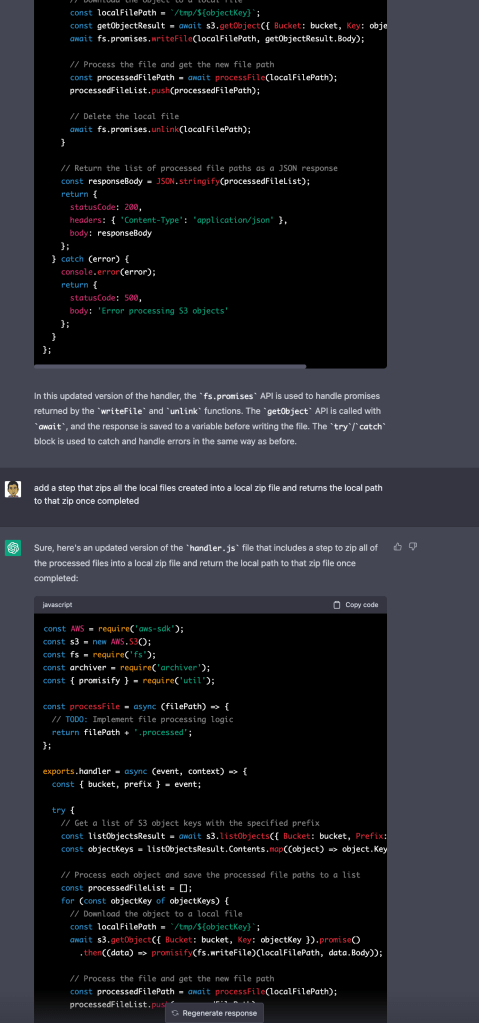
Examples referenced above

Here I asked for a non-3rd-party use of promises (only await/async) which worked. Then I asked to modify the code by adding a zip task, and it re-introduced the promisify utility when it added the zip process.

Don’t sell the sale

Being on either end of a sales call can be tricky. The aim is to either engage with potential customers and sell, or for a buyer, get the transparency needed and end with the best bang-for-the-buck. One of the most effective strategies adopts the “simple” art of not talking. It may sound easy, but the drive to make conversation is deeply embedded in our culture. Filling space, or finding it awkward to rest in open space, can push us further from our goal. There are a few simple ways you can remember to avoid falling into conversational land mines that work against your best interests.

Selling the Sale

The first example of this mistake is described by my group of friends as “selling the sale”. One of us will try to convince the other to take part in an activity. Say, you want to convince your friends to go on a ski trip. On the call you get through the first couple reasons you’ve prepared to convince them. Your friends unexpectedly agree. But, you are so excited to present the rest of your “great reasons” that you continue on. Even after they have agreed, you continue pitching the idea. In that moment you may hear my group call you out: “Hey man, I said yes. Don’t sell the sale”. Why do my friends call this moment out? Well, once a person says “yes” they are “in”, anything else out of your mouth can only work against you. You have gone from summiting a mountain of agreement to barreling down a hill filled with land mines. In short, once an agreement is reach – Don’t sell the sale and create opportunity to lose the ground you’ve gained. Don’t forget that your goal is to convince them, not show them how great of a sales pitch you can make. In other words, don’t sell the sale, sell the product.

Silence is Powerful

Another advantage of creating space in a conversation is humans have a bias to assume silence means “disagreement.” It means no such thing. For example, I was once on a call with a vendor. The sales rep ended their pitch and gave me their price. I said nothing. Honestly, I had no idea if it was expensive or not. Moments later I heard “…but we can do cheaper if that’s too high.”

I have seen this uncomfortable silence change rates, contracts, and features with not so much as a whisper.

Literally.

By allowing statements to sit – and breath – you allow the other person to find time to air out what is running through their mind, be it doubt, logic, or ethics. At the end of their thought process they may realize their asking price is too high, for example, or their proposed agreement is too strict as their conscience felt icky once the words left their mouth and they wish they could take it back. This approach can sound like a silly game, but it is not. It is simply allowing non-verbal communication to fast-forward any snake oil quips or rehearsed phrases. It allows the party to turn their asks into a discussion. Best of all, it required very little added effort from you.

Invest

Finally, while I haven’t researched it, I have found in practice that giving a person space to speak creates a sense of comfort. They remember the experience having went well.

Whether it be by building rapport, establishing a connection, and creating a sense of trust and collaboration, you can make your goals on a call much more achievable by practicing the art of silence. The next time you are on a call, try to allow for longer gaps of silence and see the difference it can make.

“We all have a comfort zone, a learning zone, and a panic zone.Aim toward the outer edges of the learning zone. While you don’t want to panic, you’ll grow the most when you’re past your comfort zone and stretch yourself to learn something new.”

Lev Vygotsky

Finding hidden talents lost to your childhood

The reason why I suck at writing, hate reading and have never been able to pick up languages – and how I proved myself wrong.

I’m sitting in my dimly-lit, third-grade classroom. My mom and I are sitting in hard, vibrantly-colored, plastic chairs. My English teacher, who is sitting across from us, is your typical sweet southern grandma, until she opens her mouth.

“I know I’m not supposed to say it,” she says anyway, from her wrinkled, fuzz-covered lips, “but, if I were you, I’d go home and give him a good spanking.”

I don’t know if my mom nodded, ignored it, or what came after, other than the feeling of betrayal from my teacher, mom, and the educational system. I wasn’t a bad kid or bully. This discussion wasn’t the result of my lobbing spitballs. This was Mrs. Manard’s solution to my “C” level performance.

Looking back, I tried to do the things required to excel in school but, try as I might, I couldn’t do them the way I was supposed to. I disliked the slow pace of English class and reading large books that seemed irrelevant to my life. I already knew how to read, write, and speak. Knowing the rules as to why one should never end a sentence with a preposition felt unimportant.

Without knowing it, Mrs. Manard redirected my educational trajectory, and, by 10 years old, I decided, “I suck at English.”

My foreign language class wasn’t much different. Aside from having a much nicer teacher, I didn’t do well memorizing all the rules. There was no satisfaction in the months of repetition required to eventually say, “Your cow is fat.”

I had another epiphany at 12 years old. I was never going to be able to pick up new languages.

——————————————————————————————

Some stories, like mine above, become obsolete in adulthood, but never get a makeover.

Being a “bad speller,” “bad at math,” or “not being witty” are a few examples of stories you may have calcified during childhood. They are either told to us, beat into us, or remnants of unwanted consequences we had to endure.

These stories are as relevant to us now as a favorite toy or blanky. They are anchors that swaddle us in chains, leaving us comfortably limited. We see these features as foregone conclusions, but, somehow, we are unable to remember when these features formed or when we last questioned them.

Maybe it’s time to update our stories.

The story above is part of my history. It made me who I am today. But, it’s based on old experiences and, therefore, outdated. 

If a 10-year-old kid walked up to me now and told me how to live my life, I would think it was a joke. Yet, somehow, my 10-year-old self is still telling me how to respond to my environment. 

I can’t continue to rationalize this logic. It is time to update my stories and make them more relevant to my current environment, social circles, and interests. It’s not about changing who I am, but ensuring I am not limited to who I thought I once was.

Like the rest of the world, the isolation of COVID provided me with an opportunity to pause, reflect, and assess. An opportunity to dissolve the negative assessments of my capabilities. This simple reframing immediately altered my perspective. I went from reasserting my shortcomings out of habit to searching for ways to reexamine them. 

Take languages, for example. Soon after I took this new approach, I caught myself responding to the question,  “Do you speak any other languages?” with a canned,  “I am good with learning software languages, but have never been able to grasp foreign ones.”

The first time I used that response was in high school. High school?! It has been a reflex, hidden, very literally, under my nose for decades. 

I decided to test the theory. I began looking for language apps. If one didn’t suit me, I tried another. I found groups at work that were studying languages (turns out a lot). I Googled hacks to learn languages quickly. I found platforms that connect users to native speakers around the world, so they could learn for pennies on the dollar. I kept what I liked and threw out what didn’t work for me.

A year later, I’m speaking French and Spanish at an Intermediate level. I now see the world in a new light. Like a veil being lifted around me, I now recognize the lyrics of foreign songs, follow dialogue in foreign flicks, and eavesdrop on tourists at my local coffee shop. I didn’t just learn languages. By challenging my old thinking, and with little effort, I illuminated a new world.

Enthused by the results of this formula, I applied it to my “sucking at English” and so many other false truths weighing me down over the years. 

Through this experience, I had an epiphany: Maybe, I have always loved English and languages. Maybe, I just hated a few child classes that unfortunately bound me to a false narrative. 

Let’s close the book on these old narratives and make room for a new, liberating reality.

Redefining your reality 

Introspection is paramount in discovering and redefining outdated stories.I had to catch myself repeating old facts to others, and then determine whether it is outdated. 

That’s your clue. 

Then, reset and re-create that truth from scratch.

  1. Catch yourself. When you hear yourself assertively self-deprecating what you’re capable of, replace it with, “I haven’t taken time to be good at it.”
  2. Step back and see if you can pinpoint when you formed that opinion. Who were you then? Is it possible you’ve evolved in other ways since then? Are the issues that blocked you still present now?
  3. Cut out what’s no longer serving you. Do you spend hours on the phone or TV? Maybe cooking everyday is a burden and ordering out once a week removes it. Can you trade a day, hour, or activity to investigate this question? Maybe block your work calendar for 30 mins, one day a week, or add an activity to your wake-up or sleep ritual. Maybe you mow the lawn one fewer time a month, and it grows just a bit longer. These are a few trade-offs you can make to open yourself up to new possibilities. Personally, I deleted all my social apps and replaced them with Duolingo.
  4. Chose one thing from #1 and start researching ways to engage it for a few minutes gained in #2.
  5. Give it 6 months and see if your story changes.

From a writing hater, to a writing lover

Where the hatred started

Writing has never been easy for me. It isn’t for a lack of wanting. My experience in school wasn’t helpful.

Since I can remember, I yearned for the ability to get all my thoughts, observations and theories onto paper. My hands just couldn’t keep up. When I took a shot at writing quickly, the results were illegible. When I took the time to write cleanly, the thoughts would slip through my fingers.

I couldn’t strike a balance and wasn’t willing to push through the torture of building skill through the slow, methodical, practice of writing and rewriting my ABCs. I neither had the penmanship nor the patience. And, with that, I could only assume writing wasn’t my thing.

This frustration as a child turned into a hatred toward writing, and that hatred turned into avoidance.

I slogged through school and found creative ways around my poor penmanship. It’s not like I didn’t love other art forms, but putting pen to paper felt dull, overly academic, and unimportant. I didn’t see how writing could have the same beauty and value as a Picasso, or express the emotions of a Rachmaninov.

In an adolescent, cool-guy way, I would take a sort of pride in “not being a writer.” Or, I’d say, “I’m good at other things — how about you write it up?” It was easier to do than admit I was bad at it. The way most children respond when they try to justify a lack of skill in some area.

That became my story. And it was left unedited for decades.

Along the way, with the advent of the computer, I thought I was saved. I was one of the lucky ones where writing by hand became obsolete in my lifetime. Good riddance. I could finally leave handwriting in the rearview.

Once I was out of school and gaining balance in the real world, I took another crack at writing. Now that writing by hand was no longer a blocker, and spelling and grammar was managed by machines, maybe I could become a writer after all.

Confronting what I now realize are years of excuses, I decided writing would no longer be a weakness in my armament of tools. It was time to revise my story. Since then, I’ve had a lot of catching up to do.

Okay, let’s try that again

In my 20s, when I started my first company, I realized the power of the written word. In order to communicate a vision at scale, one must codify their thoughts so others may follow. In order to improve, I started a blog and set out to post daily for a year. While I evolved considerably from my first post to my last, I still had a long way to go.

Years later, after hitting a plateau and going on hiatus, I decided to hire a writing coach. She swore by the power of “morning pages” laid out in the book “The Artist’s Way” by Julia Cameron. In it, the author believes one must return to the written form to connect with one’s inner artist. My new teacher passed on that requirement to me, and with it, I had come full circle. In order to learn to be a writer, I had to once again slog through my pitiful excuse of penmanship.

What surprised me about this go around was, for the first time, this teacher told me she didn’t care about how my writing looked or what it said. To her, none of that was important. She just wanted me to use my hand to write — anything. As long as paper and pencil were involved, she’d be happy.

It was — freeing.

It shut down the overly critical side of my brain, further imprisoned by early schooling.

I had a second wind.

I began to write in my notepad, about nothing, for five minutes a day. Through aches in my fingers, and in spite of all my ideas vanishing right as I picked up my pencil, I followed the prescription. I planted notebooks, pencils and sharpeners around the house, so nothing could get in the way when the compulsion to write struck. At times, when I had nothing to say, I would scribble some variation of, “I am writing this even though I can’t think of anything so that I don’t stop writing until my time is up.”

After a few weeks, I could see a connection forming between my hand and my mind. Where thoughts used to swirl around in my head and go nowhere, now they had an exit route. I developed a pavlovian reaction to search for paper when the marble in my head began to rattle. And, unlike the brevity of notes I took on my phone or computer, I found my handwritten entries getting longer at each session.

The potential was certainly there, but I still had one issue to overcome: I couldn’t read any of it.

Tech to the rescue

I’m a gadget guy. And, I’ve used my affinity toward doodads as a mental hack, tricking my mind to focus on important things I need to do that I have no interest in doing otherwise. Sure, I could vacuum and begrudgingly roll over the carpets while wishing I was doing anything else, but I prefer to get a Roomba, configure it, and whistle while it works.

“Hold on!” I thought one night, staring at my pad and pencil, mustering the strength to start yet another writing session. “Can this trick help solve my aversion to writing? If a pencil and paper is a painful reprise to teenage angst, modernizing my workbench with A.I. apps that digitize hand-written text via an iPad and Apple Pencil is a different beast entirely.”

I can get behind this.

I scoured the app store for apps that could recognize my chicken scratch, while providing the right amount of tech-nerdiness to put a spoonful of sugar into my writing regiment.

I knew I found “the one” with Nebo.

The app perfectly merged modern digital tech with old-school writing and I found myself looking forward to engaging with the experience. I went from being forced to do “morning pages” each day, to feeling like I couldn’t stop journaling, writing or editing my work. What started as a few sentences a day has now blossomed into pages. In fact, this very text is being tapped out on my iPad using my Apple Pencil while laying in bed at 11:14PM with my wife asleep beside me, and I am having trouble stopping.

Whether one considers me a writer or not is unimportant, for I have fallen in love with writing, and with it my story has finally been rewritten.

I finally mastered my reading list!

Over the years, I’ve tried a number of ways to plow through the never ending suggestions of books that I “need to read”. I’ve kept lists in paper notebooks, Facebook books, Goodreads, my iOS Notepad, and even as a Reminders list. The list keeps getting longer. I buy books I don’t end up liking or reading, or just forget to place one in the barrel next time a get some free time to read.

Recently I discovered a way to automatically manage my list and get the book in my hands in almost any format or device — for free! Here’s how:

First, download the Libby app.

Libby is an app by Overdrive that helps make checking out books from the library easy. No, don’t worry, it’s not a way to checkout paper books. Libby is focused on helping you download audiobooks and digital books and allows you to push them to your Kindle, iBooks or whatever works for you.

Now, before you disregard the power of your local library (the institution your tax dollars pay for) let’s flip the script. Libby allows you to grab books you’re interested in.

So, think of how it plays out: You hear about a book that “you need to read.” You search for it on your Libby app, and you place a hold on it. Yes, there is a wait list for your book, and popular ones often have longer wait lists. But, guess what? You don’t care!

This is your reading list!

When books are available, they pop onto you phone or Kindle. If you don’t have time to read it, just put it back into the hold lists for the next go around. If you want to read a few chapters and put it away, that works too. The hold queue isn’t just some arbitrary list you keep that is disconnected from the act of reading — they are one and the same.

I have been doing this for the past year and love the fact that I don’t need to feel bad about falling behind on my reading. I know I’ll just read the next book that becomes available, and not think twice about my queue.

It took a while to get to “reading zen”, so I thought I’d share it. Hope it works for you too!

Biohacking: The Iceman Runneth

Ever heard of Wim Wof? If not, take a minute to Google him. What you’ll find will garner a few reactions. First, amazement as you watch videos of him climbing K1 or Everest in just his skivvies. Maybe, a feeling of disbelief when the Dutchman characterizes his extraordinary feats as simply an act of “mind-over-matter”.

What really perked my ears, however, was the Vice episode I came across that reported how science has been able to not only prove his ability to “focus and breathe” his way into recovery from an injection of a viral disease, but also an ability to teach his others how to harness the same powers. By being repeatable and very much teachable, I thought, “Hey, maybe this Iceman guy and process is legit.”

While watching the Vice episode, I caught a short glimpse of Wim teaching the correspondent a breathing lesson that is supposed to trigger an adrenaline response that will keep them warm when they take a swim in the frigid Amsterdam waters. I caught, “breath deeply longer than you breathe out.”

That stuck with me.

land-on-your-forefoot-700_0

I wouldn’t call myself a runner. At my peak running condition a few years back, I ran a 5K once or twice. I haven’t run much since, and, lately, when I’ve gone for a jog, I’d clocked myself around a 10″ mile. It isn’t an easy run either.

Shortly after I saw the Vice episode on Wim Wof, I went for a jog with my buddy Vishal. He is a far better runner than I, running marathons in the past. He always dusts me on the last leg of our jogs, proving just how much he holds back in the beginning. For some reason, the thought of Wim’s breathing method and how it spikes one’s adrenaline came to mind.

I started to breathe in deep – hold – and breathe out quickly; repeat. A minute later, Vishal began to slow down.

Soon I realized that he wasn’t slowing down at all, but, in fact, I was speeding up. It was happening effortless to boot. My lungs felt like they were stretching beyond comfort, but I wasn’t out of breath. My legs didn’t feel like they were moving any faster – I felt like I was gliding. It was a wonderful feeling. By the time I stopped, Vishal was a block or so behind and he said it was odd. That  seemed to start pulling away in front but that I didn’t look like I was even trying hard.

I explained the story of the Iceman and the breathing I used and a week later, he told me that he used the same technique and he went from a 9min mile, to a 7min mile in a matter of a couple days.

Again, just like the Vice episode I saw, the process is repeatable, teachable and the results are amazing. The Iceman now runneth.

I’m not sure whether it is simply a question of focus spawned my my focus on breathing, or if I am in fact manipulating my physiology through a control of my adrenaline, like the Iceman claims to do. But One thing is for sure, I have found a new way to run and I am loving it!

Creating your deck: 5 tips to avoid common pitfalls

A deck is often the first impression a VC, Angel or potential customer will have of your product or company. How can you make sure it is a great one?

First off, I get that there is much to love about your business, and I assume you’ve worked really hard to get it to where it is today. It isn’t surprising you’d want to share those experiences with others to impress upon them your level of commitment and demonstrate your ability to overcome obstacles.

That being said, nothing conveys your understanding of a problem, its solutions and its potential obstacles more than your ability to clearly deliver a compelling message. The goal of a deck is to do just that.

Here are some tips to help make it happen:

Tip #1 – Less is More.

Your deck is an intro to your business. It tells the reader concisely what the problem is,  how you’re solving it and that they too can benefit from your success. Everything else is a peripheral to those points and are better located in an appendix or follow up.

If you don’t think you can convey your problem and solution clearly, or you feel you need to say a lot to convey your value, then take a step back and try to find ways to trim down and prioritize your message. It is imperative that you can do more with less.

Worried your reader will miss out of some great nuggets? Try thinking of it this way: if you’ve grabbed someone’s attention in your deck then rest assured, they will have follow up questions. All that extra data you are eager to show off will find its way to the surface eventually, and at a time where it will make a greater impact.

An adage that hopefully drives the point home: “if everything is important then nothing is”.

Tip #2: No, You Will Not Just “Get Through All the Slides Quickly.”

A common rebuttal to #1 is, “Yes, there is a lot of information but it’s necessary. We will get through them quickly.” Heck, I use to say that too when working on my decks. The truth is, you’re wrong in more ways than one.

Ask yourself, when have I ever found any points impactful and important when I am rushed through them? Could you imagine the climax of your favorite movie in fast-forward? If anything, “let’s get through it quickly” is a clear sign that someone has other more important things to do.

If your points are important then give them due justice. Be sure to convey them impactfully. Pauses in speech can create that, and leveraging a few, carefully selected words and images do too.

Think about the mixed signals you are sending if your plan of attack is to rush through slides. For example, you may be saying, “I want you to see these slides because they are important, but not important enough to allow you to take the time to understand them.” or  “I want to make an impact on this point, but I also think my time is better spent elsewhere.”

Trust me, I get that you have 15-30 minutes to make your pitch, maybe less. What I am trying to impress upon you is that speed is not your saviour. Prioritization of your key points and trimming the rest are.

Tip #3: Follow Guy Kawasaki’s 10/20/30 rule

Guy Kawasaki has a great rule of thumb for creating a slides:

10 Slides

20 Minutes

30 point font

You can diver deeper into his 10/20/30 rule here: http://guykawasaki.com/the_102030_rule/

Tip #4: If the information you present doesn’t impress the reader move on or change the information

You will not change someone’s mind by adding more information. If they like your angle they will be in touch to learn more. If they like what you have had to say they will ask questions. If they are having trouble making them time to take in everything you have to say then it’s over before it started.

What are some reasons people may pass on your deck?

  1. They are not interested in your space or industry
  2. They don’t understand what you are doing
  3. There is a conflict of interest
  4. They are not in a position to take action

It is hard to change the results for #1, #3 or #4 with your deck, it may be best to move on and find someone better suited for you. As for #2, you will likely need to step back and refine your messaging. Even if the reader is the wrong audience for you, the ability for them to understand may help push your deck to someone that is a better fit.

Tip #5: Be Critical.

Assume you received your deck in an email on a busy day. Would you take the time to dive into each of its 30 slides filled with hefty bullet-point lists?

The more critical you can be with yourself the more time you will save with advisors, customers, and investors. Hopefully the tip above can help make that happen.