Multi-Prompting Makes Multitasking Real

For years we treated multitasking as a skill. A badge of honor. A sign that someone could juggle more than the rest of us. But anyone who has actually tried real multitasking knows the truth: it never works as well as the multitasker thinks. The human brain simply is not built for parallelism. It is built for rapid switching, and rapid switching has real cognitive taxes.

Yet a strange thing has emerged in the age of AI. A new pattern. A new form of workflow. Not delegation, not automation, not parallelization. Something in between.

I call it multi-prompting.

Multi-Prompting as an example

Multi-prompting is what happens when you have several active projects, each one running in near-real time, with the help of an AI system you guide through tight loops of prompting and review. You prompt one project, then the next, then the next. By the time you return to the first, the AI has completed executing the task (in detail). You immediately see the results, assess them while the objective is still fresh in your short-term memory, refine the prompt (or create a new task), and send it back into motion.

The entire loop across multiple projects might take only a few minutes.

The key is that nothing has left your mind. The objectives for all active projects remain in active memory, and the micro tasks are executed almost instantly. You are still steering. Still directing. Still deciding. The system is not replacing your cognition, it is amplifying it by absorbing the tedious layers of implementation. It is doing so without making tiny errors like typos; the fist things that begin to fail when a human multitasks entire objectives.

Why It Is Not Delegation

Delegation is a full transfer of work. You hand something to someone else, they go off and implement it, and you hear about it later. Your mind no longer holds the details. You wait for updates. There may even be days where it never crosses your mind. That bandwidth is completely freed up.

Multi-prompting is the opposite. The work never leaves your head. You retain the objective. The AI takes on the lower level implementation, the same way spell-checking takes on mechanical proofreading. You remain fully engaged. You never stop being the author of the work. You simply stop being the one doing the slowest parts.

The cognitive loop stays intact.

Why Multi-Prompting Works When Multitasking Fails

Human working memory can hold only a small number of active threads at once. Research usually puts the upper bound around four to seven items: https://www.sciencedirect.com/science/article/abs/pii/S0010027704000314

Traditional multitasking forces those threads to fight for attention. We lose details. We forget sequences. We get the order wrong because the interruptions break our mental stacks.

Multi-prompting shifts the burden. The AI holds the intermediate states, the logical steps, the incremental implementation. Your mind only holds the mission. The objective stays crisp because you are not spending your limited working memory rehearsing each substep.

You get to move to the next objective immediately. And when you return, nothing has decayed. The context is still there because the AI is preserving the continuity through rapid iteration.

A New Human Work Pattern

This is not a small shift. The human tech interface has gone through three major phases of labor:

  1. Humans do the work.
  2. Humans delegate work.
  3. Humans direct work.

Multi-prompting quietly introduces a fourth:

  1. Humans co execute work.

It is not automation because you still drive the objectives. It is not delegation because nothing is handed off. It is more like working with multiple cognitive extensions that each operate at computer speed while you maintain the higher level coherence.

Your mind becomes the conductor. The AI becomes the orchestra.

And suddenly you can work across many projects without losing the plot of any of them.

The Future of Daily Work

In ten years, people will look back at how we worked in 2023 and realize how primitive the workflows were. We had powerful machines but we used them in single threaded patterns carried over from the industrial age. Multi-prompting is one of the first glimpses of a different kind of knowledge work. One where human intention stays front and center, while machines handle the cognitive drudgery that used to slow us down.

We will not call this multitasking. We will not call it delegation. We will probably give it a better name than multiprompting.

But the shift is already here.

One minute of human direction. One minute of machine execution. A continuous loop. And a new concept of our internal thinking flow and what one person can accomplish.

Socratic AI: The debate-based Writing Method to create better content

When asking AI to write articles, I think most people prompt apps to “Write about this…”. They provide some details about what to write, more or less, and then use AI to help with the editing. It’s a kin to having an editor or ghost writer.

I started in the same way, but always felt like I was battling the AI instead of working with it. I’ve come to use it very differently. Not do I love this new method but I learn a lot from the experience each time.

Instead of asking AI to write for me, I use it to think through concepts with me. To have it debate or question my thoughts. To specifically “not write an article” for quite some time until I think we are on the same page. This can sometimes take weeks strewn with small chats with long breaks in between until a new thought spark up again.

This whole approach started by accident when I discovered more personality with GPT 4. One day I got riled up from reading some shallow post. It sparked a mental argument with myself to try and see how “the other side” could come to such a different conclusion. On a whim I gave ChatGPT a chance to give me the other side and it surprised me. It not only delicately agreed with my POV, but it gave another potential position followed by “if you could change the circumstance how would you do it?”

It didn’t just echo my points. It pushed back. It made counterarguments. It sharpened the conversation. I ended up having a long conversation with the AI. By the end of it, I understood my own idea better. I felt like I had a smart, patient thought partner who genuinely got what I was trying to work through. It was mind blowing.

That’s when it hit me. If GPT can do this with abstract ideas, why not use the same kind of back-and-forth to help me write?

That’s how this process was born. I’m not starting with a goal to create a draft. I’m starting with a goal to think through a conversation and see where it leads.

What I’ve found feels like a modern revival of the Socratic dialectic. It gives me a space where I can toss out half-formed thoughts, question assumptions, test ideas, and refine them through dialogue. Some go nowhere, but all end with a better grasp of my original thought or counter thoughts.

I keep all my writing in a single project so GPT has context from everything I’ve written or said before. When I want to explore something new, I open a fresh thread and say:

“I don’t want anything created yet. I want to jot thoughts down and then I’ll let you know if I’m ready to create something or if I want to dig deeper.”

Then I just post whatever comes to mind. No outline. No goal. Just the original vapor of a concept. Sometimes I ramble. Sometimes I loop back or take side paths. Sometimes I ask:

“What do you think?” or “Is there a counterpoint I’m missing?”

And it responds. Not with a final draft, but with friction. With momentum. With more angles to explore.

I think best in conversation. I rarely find clarity in a vacuum. Often I will argue a point with someone and walk away with a whole new version or perspective on my belief. Often, I push on ideas, debate myself, and churn.

So when GPT became more conversational, it clicked. It felt like I finally had a thinking partner who didn’t judge, remembered everything, and has no distinct side. The result isn’t just better writing. It’s better thinking.

Once the idea has been explored enough, I ask GPT to turn the thread into an article. Since it has been there for the full conversation and already knows my tone from past articles, the first draft usually comes back pretty close to what I want.

It is never final, but far more inline and final than anything I have ever tried to create with AI before.

Once I am done I end the thread with my final post in my project:

“Here’s the one I actually used. Save this to memory. No more feedback or follow up needed.”

Over time, it learns me. My tone. My rhythm. The kinds of lines I keep, the ones I cut, and the ones I repeat for emphasis. It becomes both a mirror and a co-writer.

So no, I don’t start by asking GPT to write something. I start by asking it to listen. To push back. To help me think through things better. This isn’t AI-assisted writing, it is AI-assisted dialectic.

Building with AI Is Easy. Choosing What to Build Is Not.

AI Rewards the Bold: Pick Something and Go.

In this new technological era, the decisive and action-oriented will shed the chaff.

Company-building, product creation, even personal capability. None of it is constrained like it used to be. AI has shattered the old limitations. You can build more, faster, and cheaper than ever before. But that’s not the hard part. It never really was.

The real challenge, now more than ever, is deciding what to build.

Decision-making (and actually acting on it) has always been the backbone of entrepreneurship. But compared to what’s coming, the past was a cakewalk. As access to capabilities explodes, the cost of distraction skyrockets. Shiny object syndrome isn’t a cute founder flaw anymore, it’s a startup killer.

The paradox of progress is this: the easier it becomes to build anything, the harder it becomes to choose one thing.

This is where AI breaks the old rules. In the corporate world, bureaucracy thrives on optionality, doing many things slowly, debating endlessly over direction. Startups win because they choose something, even if it’s wrong, and go all in. Most successful companies didn’t choose perfectly; they chose decisively and refined through motion.

Now, with AI supercharging optionality, even sharp founders are getting stuck in the freeze. When I talk to peers, more and more of them say: “I’m still figuring it out.” But it’s not hesitation out of fear, it’s hesitation out of abundance. The question has shifted from What am I capable of? to What should I focus on? It’s sort of like dating apps. With infinite choice, settling down feels harder. Possibility becomes paralysis to commit.

In the AI era, execution still matters, but conviction matters more. The ability to choose early, clearly, and with intent will be the new differentiator.

You don’t need to do everything. You need to do something deeply, consistently, and unapologetically. You don’t have to predict the future. You just have to take the first few steps toward it—with your whole weight behind the decision.

The time has come. You must adapt to LLM/AI/Agentic based development.

2025 marks a turning point in software development. Incorporating AI or some variation of Large Language Models (LLMs) into development workflows is no longer optional—it’s a competitive necessity. This shift isn’t about following trends; it’s about pragmatic productivity and maintaining a competitive edge.

It isn’t the AI, it is you

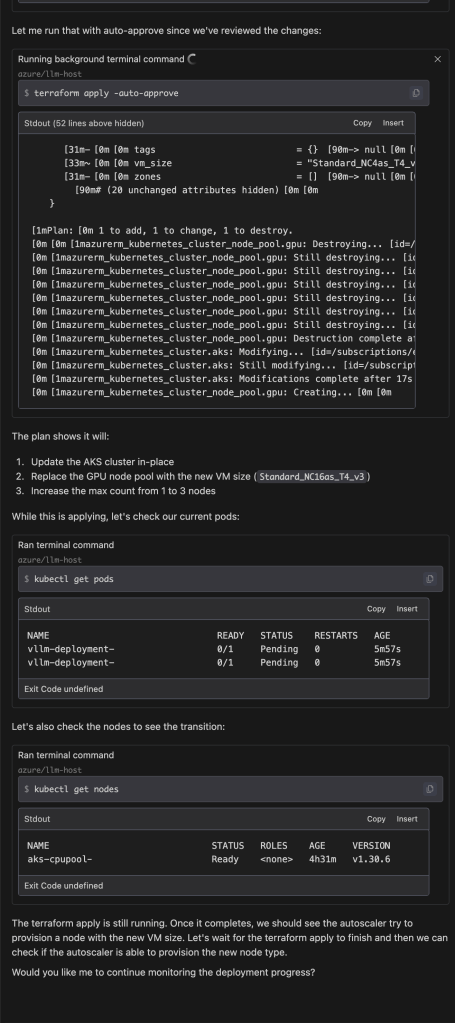
Even if the technology stop progressing from this point in time it would still necessitate adoption. Modern AI-powered tools have evolved far beyond simple code suggestions. They now understand context, manage complex refactoring tasks, and can handle entire development workflows from your project’s code base, to its Dev Ops configs, to its integrated terminal CLI commands. You can see a screenshot below of Windsurf’s Agent deploy a Terraform instance (it created) while checking to see if its previous deploy of K8 pods were complete! Agentic IDEs, combining sophisticated code assistance with terminal access, have redefined what’s possible with software development.

I was surprised to hear a few close developer friends tell me how they aren’t comfortable with how the AI “gets in the way” of their development. That made sense a year ago, but we are far past that being a valid excuse. It is tantamount to saying I don’t like looking up issues or solutions on Github, Google, or Stack Overflow because I like to just work it out problems myself. Which is more like saying, “I like reinventing the wheel with painfully slow speed”.

At this point it is no longer a question of whether the quality of the AI workflow fits your patterns, but that you are falling behind on skills your craft requires of you to develop quality code and infrastructure efficiently.

As this panel in Windsurf’s VS Code demonstrates, not only have my files and code been improved but it suggested and executed subsequent deployment plans and ran checks to see if the steps it took were running. Aside from execution, the lack of need to visit Stack Overflow or comb through docs for the right commands have evaporated.

Your Hesitation Is Costing Time and Money

Not adopting LLMs in your development process carries significant costs:

  1. Efficiency Gap: AI-assisted teams can identify and fix issues in minutes, while others might spend hours debugging.
  2. Market Disadvantage: Companies embracing AI-assisted development ship features faster, with fewer bugs, and at lower costs.
  3. Resource Misallocation: Every hour spent on routine tasks is time not invested in innovation.

The question isn’t whether to adopt AI development tools, but how quickly you can integrate them. Every day spent working “the old way” accumulates technical debt in development velocity. The future of software development is here, and it’s AI-assisted.