
Product bloat is often blamed on too many ideas or not enough resources to get speed. More often, it comes from too few decisions catching up with you.
A team delays deciding if a feature is required, who it is for, is the value it brings worth it to the overall product and company stage. The team hopes that time is saved by moving on to the next feature or issue will speed them up or “fix it”. The unanswered question feels like a temporary issue that doesn’t deserve time because there is not enough time for it. The work can continue. But nobody has removed the question. They have simply created compounding overhead.
So, “for now”, the feature will to serve anyone.
It gains settings for one interpretation, exceptions for another, and workarounds for the cases nobody wanted to rule out. What began as an effort to stay flexible becomes a product that asks its users to carry the uncertainty the team did not resolve.
The cost is not limited to one vague feature.
Imagine five possible directions: A, B, C, D, and E. None has been decided. It can feel as if the team has preserved five options. In reality, it has created five active futures.
Each future produces its own downstream work. Each has dependencies, edge cases, and failures. If something breaks deep inside E, the question is not only whether to fix it. The team also has to decide whether E is still important, whether it will matter later, and whether that work should take priority over something developing in A or D.
The original decision has been deferred, but the decisions it created have multiplied.
This is why indecision becomes so expensive. It divides attention before it divides the product.
A person can be actively working on a branch that should never have existed. A customer can arrive with a real need for D, but the team may not notice it clearly enough because everyone is already carrying the mental load of A, B, C, D, and E. Attention is scattered across possibilities. Problems demand responses. Opportunities arrive without enough clarity to be recognized.
Eventually, the cost becomes visible in the product itself.
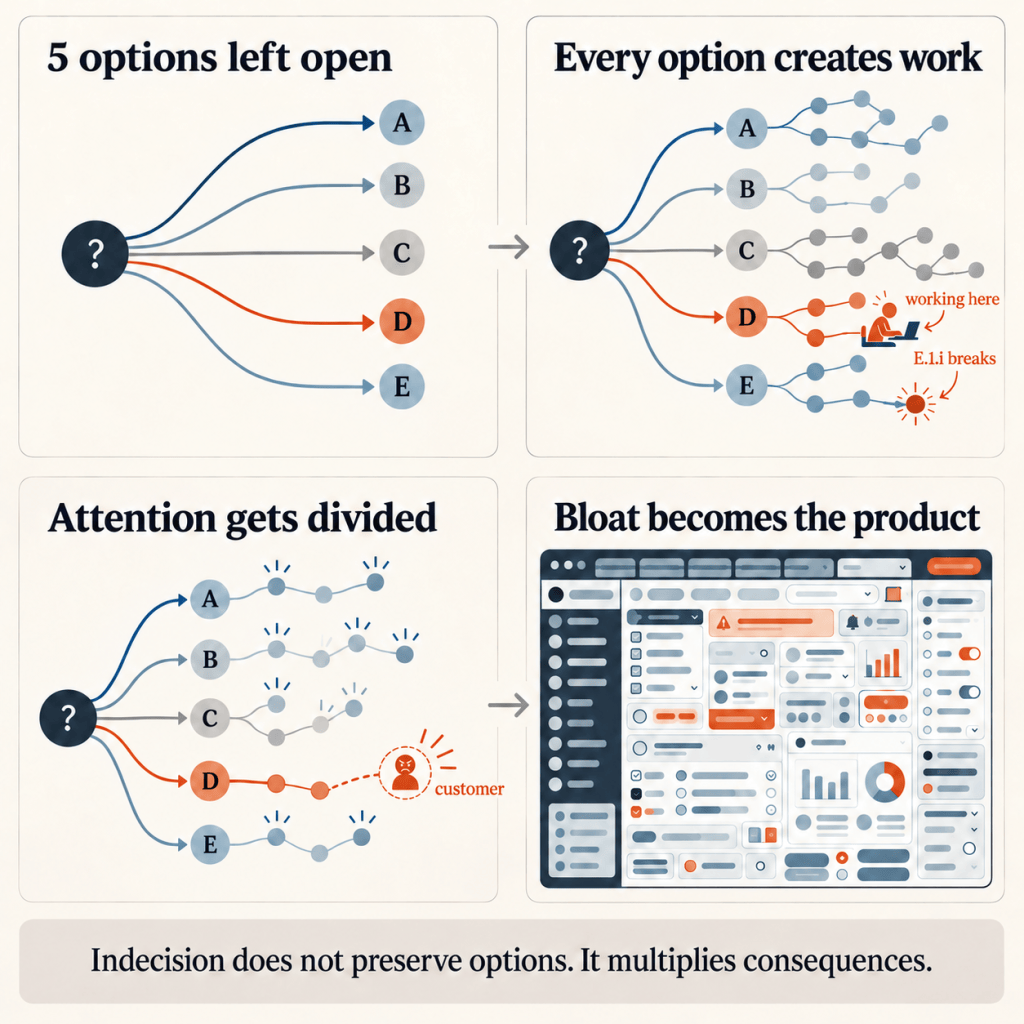
The interface gets crowded. Navigation expands. Settings multiply. A straightforward path becomes a collection of tabs, filters, alerts, roles, exceptions, and competing actions. Each piece may have a history. Each may have made sense at the moment it was added. Together, they create a product that feels fat, difficult, and strangely hard to simplify.
By then, teams often describe the problem as technical debt, feature creep, or complexity. Those descriptions are true, but they are incomplete.
The product is carrying the consequences of decisions that were never made.
This is also why rebuilding can be so valuable.
Starting over is usually treated as a dangerous impulse. There are real things to lose: working behavior, unusual customer needs, knowledge embedded in old systems. The fear is understandable. The first version contains too much history to dismiss casually.
But rebuilding is not about pretending that history did not happen. It is about forcing history to justify itself.
When a product is rebuilt, every feature has to earn its place again. Every workflow has to explain why it exists. The old assumptions no longer receive automatic authority simply because they have been in the product for a long time.
Some things should carry forward. Many will.
But some complexity only survives because nobody has paused long enough to ask what it was protecting. The things that melt away during a rebuild are often the most revealing. They are not necessarily mistakes. They are artifacts of uncertainty that became permanent by accident.
The first version teaches the team what it did not know. The next version has the chance to decide.
This does not mean every unanswered question needs an immediate answer. Uncertainty is real, and sometimes waiting is the right decision. But waiting should be a decision too. It should have an owner, a reason, and a point at which the team comes back to resolve it.
Otherwise, the product will resolve it for you.
And it will do so by getting bigger.

