

We crossed the Chain Bridge onto the Buda side of the city to see the castle and church in the old village. Afterwards, we made our way onto the Danube for a leisurely boat ride accompanied by a guided tour, some champagne and most enjoyably our awesome friend Peter. Not a bad way to spend the day 🙂
Author: sshadmand

Expo Milan (World’s Fair) 2015
Expectations Vs. Results
We were pretty excited to get a chance to see our first ever World’s Fair while in Milan. Expo Milan 2015, as this World’s Fair is called, is held under the theme Feeding the planet, energy for life.
So what was I expecting that got me so excited? I was looking forward to seeing the latest in innovations that help “feed the planet” or provide “energy for life”, basically I wanted to see how the future will improve things. I was hoping we’d get the added bonus of trying unique foods and watching cultural open-air events.
For €69/person, and a jacked up metro ride price, we got to enter a very expensive international food court. For €20/person you *may* get a chance to try a plate of a nation’s traditional food. If you stood in line for over an hour or so you *may* get to walk through an exhibit featuring videos (not real people) of what foods the country *currently* produces. Not only could most of the world not afford to enter the Expo, but a majority wouldn’t be able to afford to eat there.
I didn’t see a single advancement in how any country is doing things when it comes to “feeding the planet” or “providing energy for life”. How can you feed the planet when you can’t even easily feed a private exhibition with pricey entrance fees?! Sadly, McDonalds was the only place that offered an advanced ordering system (that was kind of neat) and reasonable prices.
Some Highlights
The US had a nice technology that allowed you to turn on/of the electrically tinted windows. However, it was tucked away in the back of the pavilion and not getting any use (except from me).
The only thing being handed out were Strawberries from the kind hearted people of Poland. And if you waited for a show you *may* get to a sample of chocolates or gelato.
Venezuela had a neay hologram video display, but it closed right after we got there.
For the most part, the exhibits were filled with table settings, native crops, and video screens.
Architecture
By far, the most interesting part of the expo was the Architecture. The buildings were all unique and beautiful. It was definitely the highlight of our walk through the event.
The Tree of Life
The “Tree of Life” (one of the things we were looking towards seeing) was a sad display of smoke and water technics (with a slowly filled air balloon – see video) that lasted about 2 minutes.
Of course, we made the best of it and pushed ourselves to not judge too early. After the 3rd hour though, we agreed we had to come to terms with the fact that the Expo was a severe disappointment. Watch us turn the frown upside down in the video below.
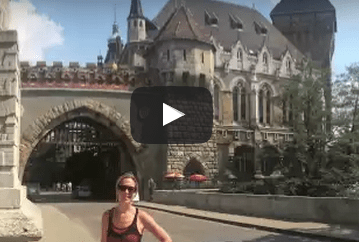
Videos of Budapest: Walking tour of the Pest Side
Pest Day 1
I don’t know if this is common knowledge in the states but I didn’t know that Budapest was actually a combination of two towns split by the Danube. Pest is the newer town filled with some amazing architecture, parks, malls, shopping and sites including the Parliament and Hero Square. The Buda side is the more historic side of Budapest and contains sites like the Buda Castle and Fisherman’s Bastille.
As a whole Budapest is pretty incredible. We continued to be surprised as to just how big the town is. Just when you think you’ve seen it all, there is another part of town rich with even more monuments and building. Then, once you think you have the hang of the city you realize that at night there is an entirely new dimension to it all that deserve another lap.
You can watch our timelapse tour of Pest in the videos below.
Pest Day 2

Beerfest at Buda Castle in Budapest Hungary
One thing we have learned from traveling is how much different a city can feel when you are able to hang with the locals. If not for Soma and Peter, two friends we happen to meet in San Francisco a few months earlier, we would never have known about this awesome beerfest event in the Buda Castle. We tasted great new beers (like Jackie’s now favorite Red Delirium) and listened to throw back music. What an awesome night!
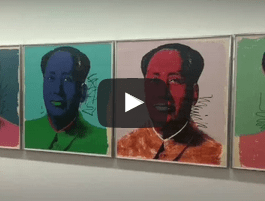
Our video walking tours of Vienna: Buildings, Palaces, Sites and Food.
Vienna was a beautiful city. Clean, rich with history, and both trendy while still retaining its classic history. We were lucky enough to grab an AirBnB with Thomas whom showed us around the city and introduced us to some great restaurants, bars and wines. Time and time again we are shown just how much the people you meet in a city will impact your stay there.
We tried foods, desserts and visited some of the many museums this town has to offer in the videos below. Enjoy!
More pics @ https://goo.gl/photos/KWzBzSEBzvvvDzTt7
District One
Palaces
Amusement Park
Food
Avoiding Fines While Driving Through New Zealand and Australia
Speeding
When we drove through NZ and AU we found it incredibly odd how slow people were driving. I’ve never been on a highway where almost everyone is driving UNDER the speed limit by 10K/hour on wide open roads. Where we’re from, the speed limit is realistically +/- 5Mph the posted number.
There is A TON of space between each city in NZ and AU and to make good time we made a habit of passing the unusual number of “slow pokes.”
About a month or so later I get a ~$30 charge from each car rental company. A week after that a letter from AUS highway patrol sent tickets to my parents house. Each ticket was between $100 and $200. I did some research on tickets in those countries and supposedly there is a huge crackdown on speeding; some roads monitored by drones.
No wonder everyone was overly cautious with their speed. You never know who is watching and when a simple pass of another car could cost you $100 bucks a month later. I’m not hating on them, we were going fast. We paid the ticket. Our bad.
For everyone else out there, fair warning: obey the posted speed limits in Australia and New Zealand to a T!

Tour of Prague in Hyperlapse
So – we walk into the oldest brewery in the city for a beer and Goulash. The second we sat down (before a word was uttered) the server puts two dark beers and two shots on the table in front of us and walked away. We decide to go with it.

Creativity Inc. by Ed Catmull

I really enjoyed reading this book! Not only did it have the insight into how a successful entrepreneur created his empire, but it is a story of how a pioneer gave birth to an entirely new industry. To add to the storyline you’ll get a behind the scenes look into the making of some of the classic pixar movies like “Up”; interactions with the late, great Steve Jobs; a look into a merger with one of the largest culture-driven companies in history, Disney; sprinkled in with nerdy facts like who invented anti-aliasing and where the name Pixar came from. It wasn’t like many business books out there, but, then again, I wouldn’t expect less from a book written by Ed Catmull with the word “creativity” in the title.
One thing I am skeptical about is how his glowing positive outlook on all the events and outcomes that transpired actually trickled down emotionally to the average employee. Having been on both sides of the founder/employee persona I know it is easy to relishes your triumphs while realistically most people don’t care as much as you think. At times the book sounds a bit “let them eat cake” esque. That being said, I don’t think it takes away from the stories and points he makes. After all, he did create a billion dollar company, a trillion dollar industry and many award winning films along the way – so I still think his advice is sound 😉
Based on the above you may think I would say he lacked humility in the book, that’s not quite what I am saying. One thing I enjoyed immensely is how upfront he was about where things went wrong and how he pushed his ideal of creating a candid work environment. I just wonder how everyone else responded to the ideals in the day-to-day.
Throughout the book Ed does a great job giving the reader what they are ultimately looking for: tips. He summarizes many of his stories as concise lessons and at the end of the book he literally creates a list of overarching tips he believes are important. What can I say, the man knows how to tell a story. Definitely a must read.
Related Books with Similar Themes:
Some of my Kindle Highlights, with notes, from the book:
Mistakes aren’t a necessary evil. They aren’t evil at all. They are an inevitable consequence of doing something new (and, as such, should be seen as valuable; without them, we’d have no originality).
This is a common thought, but how he frames it as a “consequence of doing something new” was especially attractive to me.
“Get a bike that’s as low to the ground as you can find, put on elbow and knee pads so you’re not afraid of falling, and go,”
If you aren’t experiencing failure, then you are making a far worse mistake: You are being driven by the desire to avoid it.
Is the question being asked: Whose fault was this? If so, your culture is one that vilifies failure. Failure is difficult enough without it being compounded by the search for a scapegoat.
In a fear-based, failure-averse culture, people will consciously or unconsciously avoid risk. They will seek instead to repeat something safe that’s been good enough in the past. Their work will be derivative, not innovative. But if you can foster a positive understanding of failure, the opposite will happen.
A nice way to tweeze out the root causes that lead to a lack of innovation (on this case creativity.) A culture that grows into creating repeats and derivatives to avoid risk. Overtime, it can becomes so hidden within a culture that no one can see it. This concept comes up again when he describes the merger with Disney.
it’s easier to plan derivative work—
overplanners just take longer to be wrong (and, when things inevitably go awry, are more crushed by the feeling that they have failed).
I found a life lesson here. I am a major advocate when it comes to product development to recognize that almost no plans can be too long term since variables constantly change along the way; my playbook is often to iterate with a big picture vision. For some reason, in life outside of work, I tend to overplan a lot. And, get upset when all the work that went into planning goes awry. Until I read this passage I never viewed them side by side. For me it was eye opening.
It was as if we’d picked four talented musicians, left them to their own devices, and hoped like hell they’d figure out how to be the Beatles.
Part of our job is to protect the new from people who don’t understand that in order for greatness to emerge, there must be phases of not-so-greatness
I have found some companies want it all. They want new, greatness, speed, and growth all at once. In that way they use one rule for all situations and inevitably lose the ability to grow and be creative. In their mind they are iterating away from problems – in actuality they are killing the seeds of a truly iterable future.
Making the process better, easier, and cheaper is an important aspiration, something we continually work on—but it is not the goal. Making something great is the goal.
Love that. Definitely a first principles thought that I try to remind myself of all the time. Take a step back, what is the true root problem you are solving. Then regroup.
When efficiency or consistency of workflow are not balanced by other equally strong countervailing forces, the result is that new ideas—our ugly babies—aren’t afforded the attention and protection they need to shine and mature.
Each group, then, is trying to do the right thing, but they’re pulling in different directions. If any one of those groups “wins,” we lose.
Ed makes a great case for making sure you have an environment in which many cultures can exists, but they must have the same ideals and mindset. The importance of conflict in perspective is in how it can spawn new and creative ideas.
In an unhealthy culture, each group believes that if their objectives trump the goals of the other groups, the company will be better off. In a healthy culture, all constituencies recognize the importance of balancing competing desires—they want to be heard, but they don’t have to win.
The key is to view conflict as essential, because that’s how we know the best ideas will be tested and survive.
It is management’s job to figure out how to help others see conflict as healthy—as a route to balance, which benefits us all in the long run. I’m
if history is any guide, some are diligently trying to polish a brick.
It wasn’t just that the interns lightened the workload by taking on projects. Teaching them Pixar’s ways made our people examine how they did things, which led to improvements for all.
The unpredictable is the ground on which creativity occurs.
Which meant that the people working on Up had to be able to roll with that evolution without panicking, shutting down, or growing discouraged. It helped that Pete understood what they were feeling.
“It wasn’t until I finished directing Monsters, Inc. that I realized failure is a healthy part of the process,” he told me. “Throughout the making of that film, I took it personally—I believed my mistakes were personal shortcomings, and if I were only a better director I wouldn’t make them.” To this day, he says, “I tend to flood and freeze up if I’m feeling overwhelmed. When this happens, it’s usually because I feel like the world is crashing down and all is lost. One trick I’ve learned is to force myself to make a list of what’s actually wrong.
It also helped that Pete never lost sight of his mission on Up, which was to drill down to the emotional core of his characters and then build the story around that.
“I feel like the only reason we’re able to find some of these unique ideas, characters, and story twists is through discovery. And, by definition, ‘discovery’ means you don’t know the answer when you start.
For many people, changing course is also a sign of weakness, tantamount to admitting that you don’t know what you are doing. This strikes me as particularly bizarre—personally, I think the person who can’t change his or her mind is dangerous. Steve Jobs was known for changing his mind instantly in the light of new facts, and I don’t know anyone who thought he was weak.
This was an interesting bit of insight. I have personally seen people change their mind at work and to many (often including myself) it called in to question our ability to trust their judgement. With this section I took a different tune. If you can’t change your mind you can’t make those important mistakes and learnings. With those I was particularly close to we changed one another’s minds all the time – and I actually enjoyed the feelings and perspectives it gave me. So, how do you create a trusting culture where anyone can make claims and change their mind without consequence? Something to think about.
“Better the devil you know than the devil you don’t.” For many, these are words to live by.
To be clear, I am not endorsing change for change’s sake. There are often good reasons to hang on to things that work. The wrong kind of change can endanger our projects, which is why those who oppose it are in earnest when they say that they just want to protect the companies in which they work.
When companies are successful, it is natural to assume that this is a result of leaders making shrewd decisions. Those leaders go forward believing that they have figured out the key to building a thriving company. In fact, randomness and luck played a key role in that success.
After the loss of the film, our list of priorities, in order, were: (1) Restore the film; (2) Fix our …. Notably, one item was not on our list: Find the person responsible who typed the wrong command and punish him or her. Some people may question that decision, reasoning that as valuable as creating a trusting environment can be, responsibility without accountability can undermine an expectation of excellence. I’m all for accountability. But in this case, my reasoning went like this: Our people have good intentions. To think you can control or prevent random problems by making an example of someone is naïve and wrongheaded. Moreover, if you say it is important to let the people you work with solve their own problems, then you must behave like you mean it. Drill down, certainly, to make sure everyone understands how important it is that we strive to avoid such problems in the future. But always—always—walk your talk.
If you don’t try to uncover what is unseen and understand its nature, you will be ill prepared to lead.
. If we start with the attitude that different viewpoints are additive rather than competitive, we become more effective because our ideas or decisions are honed and tempered by that discourse
Mark Twain once said, “lest we be like the cat that sits down on a hot stove-lid. She will never sit down on a hot stove-lid again—and that is well; but also she will never sit down on a cold one anymore.” The cat’s hindsight, in other words, distorts her view. The past should be our teacher, not our master.
I especially like the summary, “The past should be our teacher, not our master.” It eloquently puts the conflict between when we change from our past and when we don’t. There isn’t one answer, and that summary says it all.
An adage worth repeating is also halfway to being irrelevant.
Ed often dives into how much he is afraid of creating “rules of thumb.” He is afraid that with every repetition the meaning and reasoning is slightly lost and eventually it gets misused or becomes a crutch. He touches on a huge philosophical perspective here that I find relates to life as a whole. The fear of dogma. This reminds me of my a but of my favorite philosopher Nietzsche that speak of the same avoidances.
Do not fall for the illusion that by preventing errors, you won’t have errors to fix. The truth is, the cost of preventing errors is often far greater than the cost of fixing them.
Similarly, it is not the manager’s job to prevent risks. It is the manager’s job to make it safe to take them.
Trust doesn’t mean that you trust that someone won’t screw up—it means you trust them even when they do screw up.
I like the way he frames it. In essence you trust that they likely screwed up for understandable reasons. Or, in other words, they would not have screwed up had it not be for a good reason.
Protect the future, not the past.
Balance is more important than stability.
Stability is an illusion after all 😉

Reaction to Anti-Islam Protester at Phoenix Mosque
In an effort to practice what I preach I counted down from ten to my initial reaction to this video from the Arizona Mosque Protest. I then re-constructed my reaction into this:
I’m glad we give freedom of speech to all. I’m sad they chose to use it the way they have. Im glad people showed up to use their free speech to show their love for their fellow citizens in the face of hate. I’m glad we have good Police like those to allow both sides to express themselves without escalation. I’m glad people did not resort to assuming everyone there is a thug. I don’t believe these people represent all whites or that whites need to explain themselves because of these people. I will try to be consistent in these views no matter the situation. I understand these protesters are scared and have had no help to cope with their fear as a community. That fear/ignorance is all of our faults and we should reach out to them to close the gap between their fears and their fellow humans.
Comparing Google Photos and Amazon Cloud Drive
Since starting this trip about 2 months ago we’ve taken an average of about 50 photos/videos a day, between our two iPhones and our Coolpix Camera. A month into the trip my external hard drive was filling up fast and I began to worry about how I could keep our growing collection of photos safe without spending a ton of money.
When Amazon offered its unlimited storage CloudDrive product for $55/year (with a 3 month free trial) I jumped at the chance to get in. I’ve uploaded about 70 gigs of photos and video since then and have dealt with some annoying features along the way. I just brushed the annoyances off because I figured A) Amazon would keep iterating on the product to improve it over time and B) there wasn’t any deal out there as good as theirs.
Then a few days ago Google released their unlimited Photo storage product too. Damn. At first I felt as though having options made things worst. Now I had to decide which product to go with, and, if I did change products, I had to download 70+ gigs of data from Amazon over these shitty hotel networks and reupload them to Google.
I started uploading our new pics to Google this week to give it a whirl and the differences have been fairly major. Google seem to me to be the clear winner for me so far, here’s why.
Amazon Cloud Drive (ACD)
Problems I have with ACD
- You can only share a couple photos/videos at a time
- The web interface fails if there is a disconnection or network problem.
- The desktop interface was not better than the web – so why have it?
- The download of the thumbnails on the media viewer were slow and many photos didn’t ever make it down.
- Sometimes the video didn’t play or trying to enlarging photos for preview wouldn’t work.
- Search rarely worked.
The good parts of ACD
- I liked the folder system to organize things manually
- You can store ANYTHING with unlimited storage. Files or Photos.
- There are no limits on the size of your media you upload
- They were first?
Google Photos
Problems With Google Photos
- Can only store photos and video
- There is a limit on the size of the photos and video you upload.
- At first that concerned me but none of my media hits those limits so it is moot.
- No file system.
- Though, now that I have used it for a week I don’t think I really needed one.
- Not really sure what the “Assistant” can do for me.
- It does a few cool things but not all that valuable. Like it created an animated gif of random files in case I wanted them….Maybe I will dig it down the road…
What I love about Google Photos
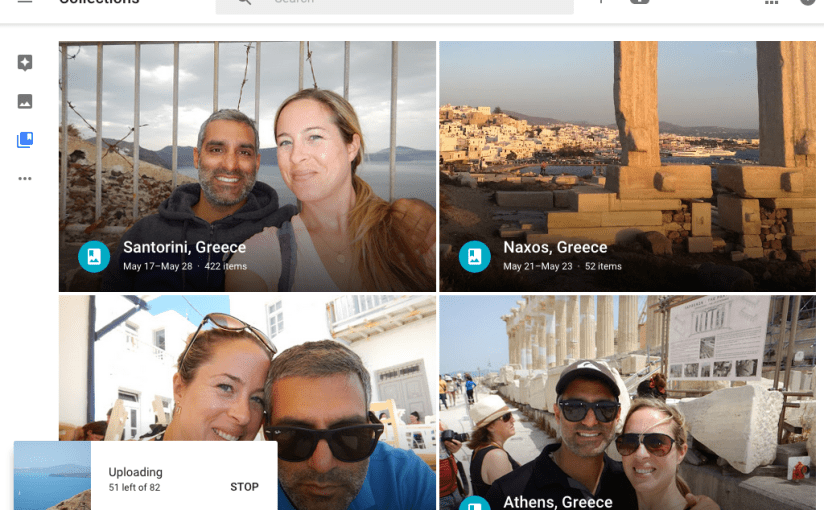
- It organizes my photos/videos into locations
- I can share entire collections or individual photos. I can easily manage those shared photos easily through a management console.
- The image viewer loads super quickly. Same network, no missing images thumbnails
- Search works great and you can use it to find more than just file names.
- It recognizes THINGS! Like “ruins” and “beaches.”
- I don’t know how I will use that, maybe when writing blogs and I want to find something quickly. More importantly, who cares how I use it – it is freaking cool!
- Smoother flowing design. Not fancy, just clean.
- The web uploader is way nicer than ACD.
- It shows you thumbnails of your photo and video being uploaded. You can pause it. And when you lose connection it just holds its current upload position until it gets a connection again (even when the computer sleeps.) I have not got an error yet – and with ACD it was always an issue.
- I can organize my albums visually.
- With ACD I had folders (w/ a listview of the files) or a photo view with ALL of my media by date. With Google my collections are as easy to skim through.
Overall the UX of ACD was clunky and the service was more expensive. So, I guess I don’t have that hard of a decision to make after all.
One thing I wish they both did is allow me to use my cloud stores images as IMG’s in my website. It would be great not to have to upload them twice for display. It seems like they provide only a temporary link for the photo itself.
 Sean Shadmand