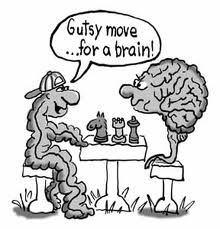
Book Review: Thinking Fast and Slow

ThinkingHow do the implications of how quickly you can add 3+3 and how much time you will take calculate 11*27 have on your daily life? Well – quite a lot says Daniel Kahneman, the writer of Thinking Fast and Slow and the winner of the Nobel Prize for Economics. The fundamental occurrence between the “think fast brain” (which he calls Version 1) and the “thinking slow brain” (called Version 2) dictate how well we are able to make decisions at large. This book helps lay down a more clear understand of how we are able to, or unable to, make decision as they relate to specific topics such as finance, bias, regret, politics, happiness and more.

In it Daniel describes how the Version 1 brain allows us to make quick decisions using heuristics so that we don’t freeze up (like our Version 2 Brain would do) when we are asked a complex questions. Unfortunately although effective often times those heuristics are very wrong and we rarely are able to notice when they are. How can you slow your brain down when it is thinking fast and speed it up when thinking slow? It starts first with an understanding of how they fit together. It helped me understand why I have always created “rules of thumbs” and “red flags” in my life while having a desire and fascination for also creating “repeatable processes” and my love for making “extreme theories” that guide me through my decision making process. Based on the book it is a fairly optimal way of allow yourself to think fast as often as possible with an backup system to slow down and challenge what sounds good with what has been predetermined to be an irrational thought pattern.

This is a great foundational book for understanding how the mind interact with the world around it through a mix of psychology, statistics and probability. It is Freakonomics meets Tipping Point meets Stumbling on Happiness (all of which I greatly enjoyed reading). Where as each of those books are more focused on answering questions for a specific subject matter, Thinking Fast and Slow is a far more robust book that jumps into all the inputs and outputs surrounding life. Think of it as A History or Nearly Everything by Bill Bryson for the human condition.


I’ll leave you with another example of the fast thinking heuristics and the slow deliberate one battling it out:

A man drives a gas guzzler that gets 10 miles per gallon and his more environmentally friendly friend has an economic car that drives at 30 miles per gallon. In an effort to improve their carbon footprint they both upgrade from 10 mpg to 12 mpg and from 30 mpg to 40 mpg. Which upgrade has a greater net effect to the gallons used if they both drive an equal number of miles?

Let your quick mind answer, then grab a calculator and check your hunch. In the example the 10 mpg person improved by 10% where the 30 mpg increased by 33%. The difficulty is in the use of miles per gallon as the metric which does not work well for this comparison.

Now calculate them both before and after the upgrade traveling 3,000 miles.

3000/10=300
3000/12=250
50 less gallons used

3000/30=75
3000/40=50
25 less gallons used

The gas guzzling friend made a greater improvement to the world twice as much than the Eco friendly one.

You can see my running read book list on Facebook here https://www.facebook.com/sshadmand/books

Why You Can’t Just Show Up to Innovation Day

I often get the “Hey, how can we innovate as a company?” question with little attention to each individual employee’s drive to innovate in their daily work lives being a major factor in one’s mind. That is the equivalent of asking “Hey, how can I win the super bowl?” without having a team composed of NFL football players.

Innovation is a sport to be practiced not something you can just show up on game day and expect to win. How many NFL football players don’t practice being great football players everyday and expect to win games every weekend?

Like any professional sport: if you don’t innovate in your daily life you won’t innovate anywhere else.  The funny thing is if you tell someone who wants to be the greatest football player in the world to practice everyday and to push themselves to be a better player every time they practice you will get nods of support from just about anyone listening. (After all running the same drill with the same times will keep you playing JV your whole life.) Conversely, if you ask someone within a business that wants to innovate to constantly be thinking and implementing ways to change their best practices, improve their tools set, update their processes, or try new ways to be more efficient at the office you will often get a majority of employees supporting a resistance and responding with rolled eyes followed by something to the effect of “it’s fine just the way it is – and it has been for years. Why change it now?”

How can you expect to innovate a few times a year with a company filled with workers that don’t believe in practicing innovating with the tools they use, the environment they are use to, and the way they interact with one another on a daily basis? How would a superbowl NFL coach react to an athlete that would rather just run his usual drills when asked to try something new? You can’t expect a company of employees resistant to change or improve HOW they work to then all of a sudden change how a company or the world around them works, can you? It all relates – like the seeds in a root of a blossoming flower. (Sorry, probably too dainty an analogy for a football heavy post, huh?)

Furthermore, just like with football it won’t work with one star player or one small group embracing this ideal. Use the best tools, challenge the old ideas, and try out new processes when you get the opportunity. The more the WHOLE company pushes and adopts an ever changing, improving, and growing daily work life the more that company will get a shot at the innovation ring.

Happy Super Bowl Weekend to all those out there wanting to be their best every chance they get!

OpenCO 2013 – Why we love SF, how we work, and our world of content in 2023


OpenCo is the city’s answer to the question: “What makes San Francisco – San Francisco?” Instead of trying to explain the nuances to the culture here the founders of OpenCo decided the best way to describe it is by opening the doors to as many offices as possible within and allow people to come in and see for themselves. At OpenCo attendees sign up for a free pass to any of the over 100 SF offices, from theater troops, to restaurants, to tech startups and more. During the event attendees tour around the city walking into offices to check out their space and take part in an interactive presentation about what that company is doing to try to make an impact on the world. It’s not a lecture, nor a sales pitch, nor is it focused on recruiting, but instead it is a presentation that takes a look into what a company is thinking and how they work. Now expanding into NY, London, and Detroit, the OpenCo movement will be an exciting one for those interested in peeking into to the companies that make a city tick.

This year ShareThis was proud to be invited to host the second annual OpenCo event and we were excited to open their doors to their San Francisco office. There Sean Shadmand talked about the difficulties companies in the industry of social/tech are faced with and how they plan on innovating in the years to come. Check out a video of the presentation and slide decks below.

Video on Vimeo

Slides recorded by Penxy

What a company manifesto means to me and what I would expect it to accomplish

A Manifesto reveals the strengths and values within a company, and does so in a way that decreases the number of complex decision making hurdles for its employees in the day-to-day.

The manifesto will be “the bible” (though only a page) of reasons that lead a team without a need for individual leaders to be present, and can help create the next generation of leaders to form in the same vein.

It relieves people from the stresses and distractions inherent to complex (or seemingly complex) decisions, in the middle of the workday, while fighting in the trenches.Screen Shot 2013-05-14 at 12.22.05 PM

Picture this: A team of army rangers are falling back in the middle of an amazonian battlefield. They realize one of their platoon members went missing while under fire. What do they do? Unorganized soldiers may scatter under this pressure and lose their head. Should the next step be “Every man for themselves!”, or “Let’s hide it out until morning”? Luckily this group of rangers knows that there is one core value that prevails in situations like this: “never leave a soldier behind”. – Boom, decision made. They spend their time devising a plan to find him first and foremost  (no matter the hurdles – it will be resolved).

Values help form a strategy. Most importantly, when things go wrong, values help keep the bigger picture moving tactically. Especially when “fires” make decision making  difficult. Plans fail, but values do not.


bf3-jungle

More practically speaking, the battles on a tech company’s floor may be less tragic, but are battles nonetheless. Imagine there is a team developing a widget. It is done so with poor (if any) design, but  is backend-ready and functional. A discussion may come up around the pros and cons of deploying something that doesn’t look good but is ready to ship for testing. The debate could rage on, but, with a core manifesto that decision is already made: if the core value says design is key to our tests – then the decision is made to implement a design before deploying. If the core value says release when ready and iterate – again the decision is already made.


Those decisions shape a company and should not change week-to-week, problem-to-problem, or day-by-day from department to department. They shape outcomes and the character of a company through a decision tree that is easy to repeat. Consistent and efficient decision-making is more important than re-assessing the perfect decision for the situation each and every time it comes up. The written word is amazing at facilitating that.


Of course, we all have great thoughts and your company has awesome values already, but having them written down is the difference between an interesting legend shared by some and a religion followed by many.

Documentation, although necessary, does not substitute for a short list of values. Documentation is rarely re-read, and often forgotten; we remember “Go when green” not “Statute 32 Section 5: All those that use public road shall obey stop lights based on the following color …..”

Finally, it is extremely important that your list of values are glossed over. One lazy move away from following your values can easily turn into a utter mess over the years. That does not mean you can’t change your values. If a situation comes up, and your values does not represent how you want to act two things MUST happen: 1) You re-examine your values and change them accordingly or 2) You adjust the situation to fit your values. Period.

As for my suggestions regarding the setting for how a document can be built  as a team here are some thoughts.


  1. Make sure people feel heard (i.e. right down every idea)
  2. Help filter outlaws that promote restrictions (which end up being things people feel reprimanded for doing)  and turn them into the concept that create direction and productivity to help people grow, expand, and focus. It is a document of supportiveness.
  3. Use it to help give people clarity in situations that need tie breakers, or rules of thumb. For example, “future value does not trump current value” has saved our team from missing out on what we have while over planning for something we do not.
  4. Be clear on what an item suggested means when it is written (often times one person’s perspective on what “awareness” can be, for instance, is different than another’s) Be descriptive.
  5. Find a/the person that matches the essence of what a manifesto item describes. They will most likely be the champion of that thought and help keep it alive and well. Find the passion in the people and you will also find the strength in the doc.

I believe once the fundamental concepts are solidified into the manifesto it becomes a spine for current, and as importantly, new employees that come in so they can quickly latch onto and adopt the companies process/thinking as it expands in size.
There will be the debate over the items presented, and debate is good. As such, it may also be a good idea to nail down some keywords that keep the conversation on track to what we believe the manifesto points should adhere to.

The words I propose are:

  • positive
  • smooth
  • friendly
  • helpful
  • productive

If an item does not instill many of these words, for instance, then the item may be off track.

Efficiently Inefficient: Processes that can improve quality and quantity of life

For our latest project at Socialize Isaac and I are going to increase the release cycle even further and go from a few releases per group per week, to a few releases per day. I find moving more efficiently and quickly over the years always takes a few non-intuitive jarring mental steps. (If they didn’t we would have been way more efficient as a society way earlier on in history).

Here are a couple things that always seem to be the foundation of inching your way up the efficiency hill.

1) Get to a point at which you truly trust your results, not just feel good or secure about them, but quantitative based results that have a quantitative “I trust this” number. This is what I call the “don’t look over your shoulder moment”, because if you’re looking over your shoulder to make sure nothing has gone wrong, you are not looking forward to make sure new things go right. This accomplished with unit/itests tests, or in our everyday lives marking your calendar or adding a reminder. Even at managing people in the office, time and time again setting up employees to be trusted and autonomous, with a simple audit system to make you aware only if something is wrong, has proven time and time again to produce happier, more creative, more productive employees in a company that can scale. Basically every one wins big when you make sure you create process that handles things that are set to let you know if you need to take action, and quite %100 otherwise.

2) Really reconsider what you’re are willing to bare in mistakes. This is usually a major brain switch moment. Sometimes people can work 100x more efficiently and productively if they just allow themselves to be wrong for a totally fixable 1 minute per year. Yes your server may go down once a year, but instead of working hard to make sure that never happens (which is impossible), work hard to make sure systems are in place to recover super quickly. The funny thing is when you accomplish #1 above, mixed with this #2 item, you start performing better than you could have imagined.

3) Remove process that is there to support the more intuitive faux “warm and fuzzy” feelings that keep 1 and 2 from happening.

4) Always push yourself, and those around you, to test process that offer efficiency gains even if you don’t feel comfortable at first. Comfort is often the foundation of slowness, and trying new things even against your “better judgement” are the only ways to break free.


For you nerds out there, here is the article from github Isaac passed on to me that sparked our latest evolution in product releases. Although this post and its sentiment are, in my book, universal throughout life and business and not code.

http://scottchacon.com/2011/08/31/github-flow.html

Deciding on a new feature: An Insta-Test-market. (AKA: Ghetto Testing)

I love making a decisions tree as efficnet as possible, especial around discussion that steer the business or the product within a business. Or in another words, I HATE “tough decisions.”

Here is another addition to the decision tree to make life easier, it is called “Ghetto Testing” and coined by the founder of Zenga.

How do you figure out if you should go with a feature with minmal disruption to the company or its engineers, and how can you invest in it with the highest posible certainty of success? Ghetto Testing a feature. The concept is there are a wide range of data points you can aquire to guage interest on an idea before the idea is fleshed out. At the “Ghetto” stage, it sint so much a test of the product value or feature set itself, as much of a servey to see if the concept will get clicks or interest by the public. It’s basically an adhoc test market. If you think people will love feature x for instance, create a google adword promoting the vapor-ware concept and run it for 5,10,30 mins.  The resulting page of the ad could technically go to a 404 page, and although that would be a horrible experience it still wouldbe a valid ghetto test.

From there you can invest incrementally into how deep of a gauge you want to testing of the idea i.e. a pretty landing page with feature highlights, a download, or a purchase wall.

http://grattisfaction.com/2010/01/how-zynga-does-customer-development-minimum-viable-product/


"Should I add x to my product line?" litmus test

For small startups it is essential to decide what not to do as much as what you decide *to* do. As new technologies come and go, ideas for change could cripple a companies productivity or ability to reach any single objective (AKA Distractions.)

If your objective is to build an awesome product, and work hard at solving a problem that others may not have been able to solve yet, then here is a “is this a distraction right now, or a need for change?”  litmus test for small startups.

Test:

Do I believe we should *only* do [new idea] and grow the company out from from there?

(i.e. stop focusing on the other thing you had previsouly decided was *the* way to grow the company from.)

If you find yourself getting to a strong yes, then the convo to get into the new idea may be ripe for discussion, and it may be time to focus energy on a new strategy and to pool your resources to build a world class product. I’ll go into what you can do to break the new idea down further from there, to see if it makes sense in your business in other ways, in later blogs.

Side notes as to why this problem may often come about:

For one, the grass is always greener. So you need to be carefull when shifting towards an idea that is not on your mind every hour of every day…There will often be different problems, not less, to overcome when you switch.

Second is brain time. The amount you spend on solving a problem has some (not sure yet what amount yet) relation on the lack of time you have spent thinking about the new thing. All the litte details that are reflex knowladge for you for is lost with a new idea and direction.

Analogous Exmaples in life:

For a simplified abstract example, you spend a few hours packing the night before a trip. Last minute the morning of the flight you realize, “Hey, I can just take the smaller bag! How much smarter of me, I can save much space!” So you do.

At the airport you realize that one of the side reasons you wanted the bigger bag was not just to carry more, but to so your friend could but his shoes in it. Damn! You over looked ne of the many small details that led to the dscisoin to pack the big bag in the first place, but the new idea that came to mind, that you took action on in a shorter amount of time, did not allow you to consider all the many reasons why you made the decisions you did the night before.

A more common example: “Ughhh, I left my wallet in my other pants pocket!” You look better, and it’s a good thing too because now you need to find someone to pay for your dinner :p

Closing

You may not be able to avoid these smaller mishaps, but you definitely have the power to minimize disrupting a company by paying attention to these business distractions vs changing directions type decision points.

Remember: A small comapany needsto solve *a* problem, focus on it, and when they get their fit and a few wins the grow into more spaces. Here is a great article on focus as it pertains to Product Market Fit and MVP:

http://www.svproduct.com/mvp-vs-product-vision/

“…But of course that was just the beginning of the product line and not the end.”


“Should I add x to my product line?” litmus test

For small startups it is essential to decide what not to do as much as what you decide *to* do. As new technologies come and go, ideas for change could cripple a companies productivity or ability to reach any single objective (AKA Distractions.)

If your objective is to build an awesome product, and work hard at solving a problem that others may not have been able to solve yet, then here is a “is this a distraction right now, or a need for change?”  litmus test for small startups.

Test:

Do I believe we should *only* do [new idea] and grow the company out from from there?

(i.e. stop focusing on the other thing you had previsouly decided was *the* way to grow the company from.)

If you find yourself getting to a strong yes, then the convo to get into the new idea may be ripe for discussion, and it may be time to focus energy on a new strategy and to pool your resources to build a world class product. I’ll go into what you can do to break the new idea down further from there, to see if it makes sense in your business in other ways, in later blogs.

Side notes as to why this problem may often come about:

For one, the grass is always greener. So you need to be carefull when shifting towards an idea that is not on your mind every hour of every day…There will often be different problems, not less, to overcome when you switch.

Second is brain time. The amount you spend on solving a problem has some (not sure yet what amount yet) relation on the lack of time you have spent thinking about the new thing. All the litte details that are reflex knowladge for you for is lost with a new idea and direction.

Analogous Exmaples in life:

For a simplified abstract example, you spend a few hours packing the night before a trip. Last minute the morning of the flight you realize, “Hey, I can just take the smaller bag! How much smarter of me, I can save much space!” So you do.

At the airport you realize that one of the side reasons you wanted the bigger bag was not just to carry more, but to so your friend could but his shoes in it. Damn! You over looked ne of the many small details that led to the dscisoin to pack the big bag in the first place, but the new idea that came to mind, that you took action on in a shorter amount of time, did not allow you to consider all the many reasons why you made the decisions you did the night before.

A more common example: “Ughhh, I left my wallet in my other pants pocket!” You look better, and it’s a good thing too because now you need to find someone to pay for your dinner :p

Closing

You may not be able to avoid these smaller mishaps, but you definitely have the power to minimize disrupting a company by paying attention to these business distractions vs changing directions type decision points.

Remember: A small comapany needsto solve *a* problem, focus on it, and when they get their fit and a few wins the grow into more spaces. Here is a great article on focus as it pertains to Product Market Fit and MVP:

http://www.svproduct.com/mvp-vs-product-vision/

“…But of course that was just the beginning of the product line and not the end.”