I am a big fan of creative and captivating site design. One way of telling your story through your website’s design is by using animates scrolling effects. How they work is the viewer controls the animation and presentation through the amount the scroll wheel has been moved. Every pixel scrolled triggers a movent to some aspect or object on the web page. In many cases the web designer makes a sort of symphony with the multitude of events being moved and morphed on the page. You can see some past blog posts of mine on animated scrolling website designs here.
Here are some more recent orchestrations of stories being told in that fashion below. For this blog I am including video screen captures with the screenshots of the site as some of the sites in my older blog posts have since disapeared and there is no longer a way to see how they animated in the past. Live and learn 😉
(Note: Click the titles of each site to visit their webpage)
I really liked the use of paper like textures on the site. It makes it feel like a book or pamphlet has exploded into life. I also really liked how they put a whole slew of characters and objects into motion without making the site feel cluttered or confusing. This site is a super rich scrolling experience.
Your really gonna like this one. Not only are the graphics smooth, but they capture a great affect and time-period quite elegantly. The concept of having a single machine traverse and change as it scrolls through the deeper pages within it, while also tying it into the story being told is exceptionally well done.
It was the subtle animations created in the background that really caught my eye on this one. There wasn’t as many objects in motion in the foreground as the others, but the scenery chosen to be animated did a good job supplementing the site instead of going heavy on the scroll animations being the star of the show. It looks like these guys put up a new version of the site quite a bit so check out the video, but makes sure you check out the site as well as they may already have a new one out by the time you read this.
A good use of foreground and background in the scrolling animation. Also a great demo of their product offerings, and I like that it is their “pitch deck” (Something given to clients or investors which is usually done in a power point or pdf).
I really give credit to this site. It is a site for a leather bag which could easily have been made into a static site like others in their space. They do a great job display the bag using a 3d rotation, and also do a cute tie in between the scroll and the bag by using a zipper as the scroll progress bar at the bottom of the screen.
You can find more here: http://favbulous.com/post/983/23-stunning-parallax-scroll-websites-you-have-to-know
Erec Makes a Fire is a story of how a group of kids stumble upon a cave covered in ancient writings depicting the story of how a unique young cave boy (Erec) accidentally created his first great invention, fire. The story shows how, even in the simplest of times, one is able to form a business, sell a product, and create a success. The book is written to subtly embed one of the most fundamental parts of business in a child’s mind: leveraging an opportunity when finding demand in your community and providing a supply for it. Even before cash, computers, technology, LLC formation or business entities, business and entrepreneurs thrived through observation and invention, and they still do so today. This story helps teach youngsters, and remind their parents, that entrepreneurism is all around us and to keep an eye out for one’s own personal “fire” opportunity.
Why did I write the book?
As a person who loves the world of entrepreneurism, I also love telling a story about how anyone can turn a will or idea into a business. I have enjoyed telling that story, and giving tips on how to do it best, for a number of years through various mediums such as interviews in print, in person, and on TV. Now that more and more of my close friends are having kids I want to share that passion and story through a form that their kids can benefit from. I noticed there wasn’t much out there in the world of children’s books that took business concepts and simplified them into stories kids could love, as well as learn from. So, what else was I to do as an entrepreneur but to fill that void. Erec Makes a Fire is the first in a hopeful series of books that builds a foundation of business mindedness in our children.
Beliefs that inspired
Two major beliefs of mine contributed greatly to the creation of this story: First, immersion is a great key to early developmental learning, and secondly, kids are extremely capable of learning and understanding complex concepts early on, especially when it is told through story and analogy.
In regards to immersion, I believe that even if a child does not understand a concept introduced to them directly, being surrounded by that concept will help them become more comfortable with the subject matter as they mature. This makes the principles taught far less foreign to them, and therefore more easily consumed when they grow up, as compared to those learning the same concepts for the first time later in life.
I also believe that children can grasp complex concepts, like supply and demand or finance, far earlier in their lives than is generally taught today. I have always been amazed at how kids pick up core concepts so deeply. Yet, adults at times “protect them” from complicated concepts for worry of it going over their heads. Supply and demand can have complexities within – yes, but the basics are – well – basic and building stories around those concepts can most definitely be consumed by children. Look how well they understand other stories we give them, like ones around “how to share”, a concept that I find many adults still struggling to grasp. I remember sitting with adults during dinners as a kid while they talked to one another about their businesses around me. Over time and many family diners a grew more familiar with many of the things they talked about while still being a child. Although I was unable to articulate my perspectives on the subjects at the time I mades notes to remind myself that one day, when I got older, I would remember this: kids get more than you think.
Sticker Collection Available Through KickStarter
Erec Makes a Fire is a new kind of children’s book that immerses young people in concepts they should be given the chance to understand early in life so that they can have a foundation for understanding it more deeply as they grow up. As such the company under which the book is created is called “Small People. Big Ideas. LLC”
How and When Can I get it?
The first few copies will be made available as gifted items through a fundraising drive on KickStarter. I have my initial proofs and prototypes complete. Based on how much I can raise through KickStarter I am shooting to making it available by the spring of 2015. There will be special gifts given out through KickStarter in addition to the books themselves to make things more interesting, such as: signed copies; custom printed copies; packages including digital, print version and stickers; as well as custom designs where our artist injects a characterization of your child into a character in the book! Books will be made available through softcovers, hardcovers, and ebooks.
About Kick Starter:
KickStarter is a crowd funding platform that allows projects to get funded before they start. It is a great way to start a business or project and works perfectly with the Erec Makes A Fire book as the funds are only released if the book gets enough demand. The simplest way to think of KickStarter is this: think of those PBS drives on TV, the “If you pledge more than $50 you get this free tote bag” type of promotions. For a project like mine my gift will be an early copy of the book and other creative unique offers mentioned above that only funders will be able to receive. You can read more about KickStarter here: http://www.kickstarter.com/help/faq/kickstarter%20basics#Kick
Erg: Erec’s first customer as a Sticker
Why Did you Spell “Erec” with an “e” instead of an “i” ?
The names of the book are witten with some historical significance in mind. Homo Erectus and Homo Ergaster are the scientific names for the two homonids believed to be around during the time period fire was discovered. So, the characters names in the book take each half of each of those names: Erec, and his friend Tus are the first two characters introduced. Followed by his first two customers Erg and Aster. Just in case though, we made sure Eric Makes a Fire works too 😉
You may have already used the Chrome incognito profile, but what you may not know about is the fact that chrome now allows you to create and use multiple profiles on your computer. While incognito us used to specfically ensure that no data is stored or tracked on your system based on the sites and pages you visit, profiles allow you to better manage the various ways those pages are stored either online or off. Here is how to use them.
Incognito Mode:
Incognito mode ( i.e. the mode with the browser icon as a sunglass and hat wearing fellow in this blog’s screen shot ) prevents pages you visit from being tracked, stored in history and clears all cookies from your session once the window is closed, no matter what the site you are visiting has set. There are many reasons why you may want to do this. The cite version: You and your girlfriend use the same computer and you don’t want her to know about the surprise earrings you have been shopping for her online. The not so cute version, well, let’s just say you can avoid getting in trouble like Jim Levenstein does in American Reunion. (BTW, that movie is not worth seeing even if to only get the joke)
To enable incognito mode go to the menu ( ) option in the top right corner of your Chrome browser and select “New Incognito Window” or press Command+Shift+N . Also note: Chrome in your app on your mobile device has the same options and works the same way.
Signing in to Chrome
Chrome can connect to your GMail account, and doing so allows you to do things like sync bookmarks between devices, as well as allow you to edit your Google Drive documents stored on the cloud even while you have no internet connection available. This tool came in handy recently when I came up with some ideas for a document I was working on while at a hotel that didn’t have wifi available. I simply made the changes needed and when internet resumed the doc was synced and merged to my online version of the doc. By signing in to your Google account on chrome a default profile for your computer ( i.e. the mode with the browser icon as a head with no face in this blog’s screen shot ) will be automatically assigned to you and connected to the account you signed in with.
To login to your Google account in Chrome go to the menu ( ) option in the top right corner of your Chrome browser and select “Sign In”. You will then be given the Google login page. Sign in as you would with your GMail account and you are all set.
Enabling Your Chrome Profile to Work on Docs Offline
If you haven’t used your Google Drive already you should really take a second to get to know it. Not only can you store 5GB of files of any type for free in your Google Drive AND use them as a local drive on your computer and phone just like Dropbox, BUT you can use it to create and save documents of various types that you can use to collaborate on simultaneous with other users.
To explain the latter more clearly through example: We use Google Docs at Socialize at all our meetings. During the meeting we create a google doc and throughout the meeting anyone can add, append, change or update the way the notes are taken all at the same time. You can see one another typing as you type and often times most of the meeting will be completed in silence while everyone adds their notes to the doc. Collaboration is saved and shared in a document instantly.
But I digress…
To enable your Google docs to have offline access first go to your Google Drive (http://drive.google.com). On the left hand menu select the “more” drop down to reveal extra options. Finally click “offline docs” and enable. Your drive will sync your docs to your local Chrome profile. Note: If you do not see the “Offline Docs” in the “more” dropdown, and you are using Google App for work, you will need to either enable the feature in your Google App’s Admin portal, or get your sysadmin to do it for you. It is located in the Google Drive sectionof the Admin’s “Settings” tab.
Multiple Chrome Profiles
You are probably just fine getting your Google Drive working on your default Chrome profile to work on offline docs, just as I was for quite some time. The problem is that when I tried to enable offline docs for my personal Google Drive documents, as well as my work docs, the Google Drive system did not allow it. Chrome only allows one offline sync per Chrome profile. To fix this problem you will need to create an additional Chrome Profile on your browser ( i.e. create a mode with a different browser icon like the one with the Ninja in this blog’s screen shot ), and then enable Offline Docs in your Google Drive while in the correct profile.
To add additional profiles to Chrome go to the menu ( ) option in the top right corner of your Chrome browser and select “Settings”. Scroll down to the “Users” section and choose “Add new user.” Once you have added a profile correctly your Users section should look something like this:
Switching Between Profiles
To switch between profile simply click the icon for your current profile in the top right of the browser and choose the profile you wish to use. Once selected, a new browser window will open with that profile enabled.
I was watching Doomsday Preppers and one of the segments was on a prepper preparing for over population. As my typical curiosity provokes, I looked up some world growth population stats to see what we are dealing with. I figured I might as share some things I found.
Fertility RateInterestingly, as the life expectancy of the world has increased the fertility rate has decreased. This graph is pretty neat, press play and watch the changes by country over time.
As for the worlds population limit, it turns out to be harder to find. Variables such as technology, and how the environment could change as the population grows makes it difficult to nail down. I seems that a average expectation is 50 Billion, but I have seen estimates to be over 100 Billion as well.
Regarding that, I see the opportunity for how Shazam commercial tagging technology and the Conan show technology, written about in the post will play out for the positive in the near future.
The intonow iPad app (by Yahoo: https://itunes.apple.com/us/app/intonow-from-yahoo!/id406436404?mt=8) allows TV watchers to sync up with any show on TV. It actually works great and integrates social into every show live. I noticed that when I try to sync when a commercial is on it gives a warning: “You cannot sync commercials Which is great — it knows it was a commercial. Now that my iPad is on and open, and sync is well made and works consistently, I can now see the Shazam tagging work beautiful. I don’t expect it to be very far away.
Also, regarding Yahoo, this is the second time (first with producing Burning Love, a great web only comedy series; and the second the intonow mobile app) in a matter of month I have been impressed with what they are putting out in the TV media space. They have a nothing to lose attitude and are able to take the necessary chances needed to be taken by a big company to change the landscape and lead the charge in the inevitable transition into the digital first media world. A great early indicator that they will be big players in 2013.
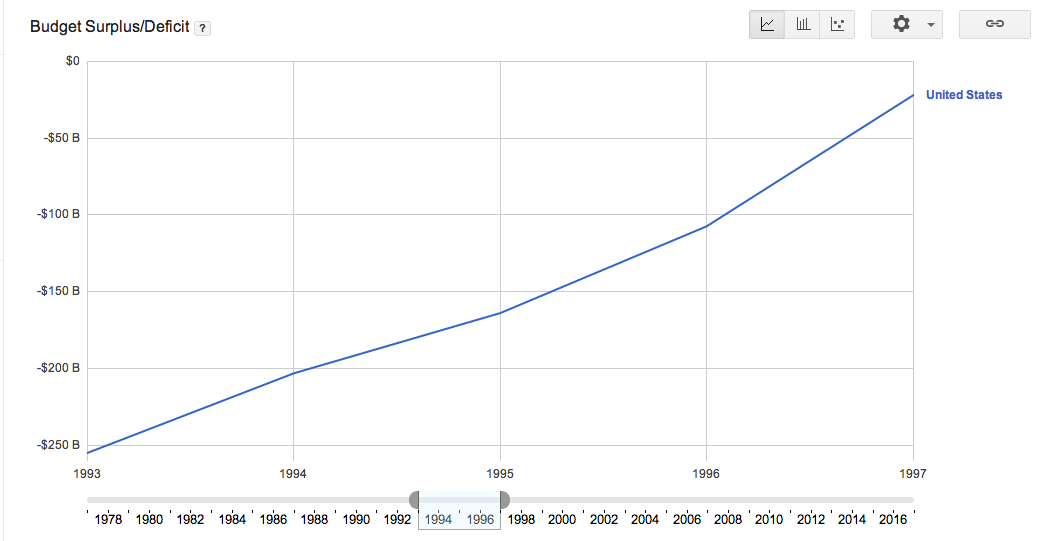
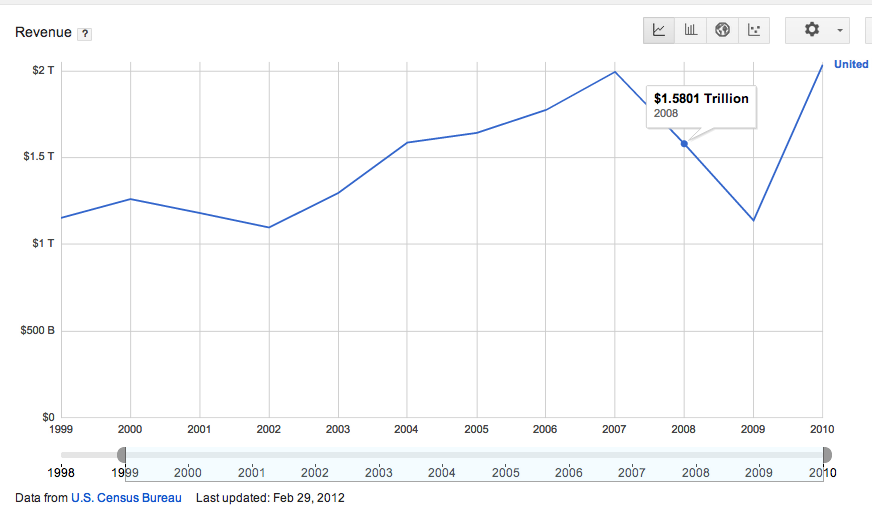
I hear quite a few people tell me that they are “voting on the economy” or that they are fearful of the future. The funny thing is we don’t need to be fearful or imagine the future we have lived through some scary ups and downs in the past 10 years. The problem with voters that stick to one party or the other is they don’t realize that they are voting for the party, not the economy. How can I demonstrate this? Well instead of me assuming that *you* specifically have a certain type of economic voting track record, I will let you be the judge for yourself. Below is census data since 1993 in four year increments. Look through them and ask yourself how did you vote at the end of the shown term. Did you vote on the economy then? It is very possible that you got what you asked for.
1993-1997: A 200 billion dollar deficit became an almost break even budget.
Did you vote for more of the same, or for change?
1997-2001: If you voted for the same, you got it. A break even budget turned into a 100 billion dollar surplus with highs in the 200 billions.
Did you vote to change or more of the same?
2001-2005: If you voted for change you got it. A 100 billion dollar surplus turned into a sub 300 billion dollar deficit.
Did you vote for change or more of the same?
2005-2009: If you voted for more of the same you got it. A 300 billion dollar deficit turned into a 1.4 trillion dollar one.
Did you vote for change or the same?
2009-2013: Not much happened, but we went from 1.4 trillion dollar deficit to 1.3 (I agreed the dotted lines are fake, so I removed them)
The way I see it is all those years in the past you had a chance to vote for more of the same or change, and in the past it’s exactly what you got. Sticking to your “party” instead of voting on what is best for the country is very much what you get: a party in office, not necessarily a better country. So the main thing I want to do is put to sleep the concept of “I’m voting for the economy”. Based on your past it is very possible that you never really have.
I am posting some updates to census stats since, as I said before, the data is there, it’s public and people should be exposed to it without ads or “interpretations” in the middle.
I just saw Morgan Spurlocks “The Greatest Movie Ever Sold”
The tight contracts, partner rejections, pitch meetings, cold calls, partnership management, moments of loss of control, brand push back, product placement challenges, and managing the selling of ones sole is depicted with more real reality in this movie than all reality shows on TV today.
I wanted to post this as a blog because I wanted to get your take on it. I feel that Morgan has yet again done a public service by exposing a hidden world in a creative and digestible way.
Do not trust or love politics, love your people, peers, country, and family.
Politicians will use data for their agenda. If you get wrapped up in it, and start believing what you are *told*, through sound bites and ads, you will be misinformed 100% of the time. More information isn’t tantamount to a depth of information.
This is why I have learned not to trust politics, they bet on people not reading the full story (as wel only have so much time in the day) and try to create anger and conflict to make people mad enough to vote how they want. It feels like THAT is what has gotten worst over the years, not so much what is happening in the world, just the way its agenda is given to us. China does it by cutting off information, the US does it by overloading its people with one sided information.
The good news is that with the advent of the Internet it is now so easy to get the data and documents from the source, and fight back as a citizen saying “don’t use me for your agenda”. No need to go to the library and send letters requesting data that may take days or weeks; it is available now if you are willing to read it.
As my methods to get to the data evolve, I try and follow some procedures to navigate past the political propaganda.
First, If I find a “fact” that I am researching on any news site, I look for the citation for the “fact” so I know where it came from, and then look that fact up from it source to read it myself. If there is not citation, I start over. A citation does not make it data, it just helps you get a path to the source. Secondly, if I find the source I read it, if I cannot find the source I look for the source directly. At this stage in the evolution of my process I have deemed .gov sites and non-profit census bureaus as a final source. In some situation you can never be sure unless you count the numbers yourself, but I have found the most consistency at that level. Yes I know that even the government stats, non profits, and census bureaus can lie but if I can find some consitancy at that level I am pleased.
Lastly, how to spot a fact with skeletons in its closet that should trigger an investigation like the one above before having the debate.
Well, the main thing that triggers a fact check to me are statistics, and references to bill being voted on. Why? Well, over the years I have found that stats have a high potential to be screwed. Or example, what constitutes “1 year” – Fiscal year or calendar year etc. Another example is is the stats extrapolated from previous data or data that has already happened. Another read flag is the use of tag lines, sound bits and general words like “taxes”, and “everyone”, and “higher” — higher then when and what for whom? Also, the reference to bills, are tough to believe from something like “he voted to….” After living in DC and working on capitol hill with you realize that both sides of the fence will quote the same document at different parts and come up with completely different conclusion. It is impossible for both are either to be entirely right, but both sides would never realize that they both *think* they are 100% right. As my readers and friends know by now, one of my big rules of thumb is: If experts disagree it is time to make your own decisions. A bill is written by many people with many agendas for their state. They are stiuffed, written and re-written over and over to try to get as much as they each want to get in it, and keep out as much as they don’t. They do this hours and hours everyday to come to a final document that is then voted on by all parties. It is very important to remember that time line, for no document has one message, and if it passed their is a big chance that both parties voted yes on it (unless there was a big split with few deciding votes). Point being, much could have gone into a document and so much more history to that document then any sound bite could articulate.
So, one of the bills that was brought as a point of contention was based on a sound bites saying “Obama voted on late term abortion”, and it was said that the bill was made to let mothers have the right to kill a baby after it is born alive. Well, personal, I did not know about that bill first hand, and that I promised to look it up. Speaking from my own perspectives I don’t like the sound of it, but I want the source and document first before my personal conclusions on that vote are spoken.
This is one of the actual bills voted on for Illinois referenced. It only took a few minutes to bring up. It was indeed named “Partial-birth Abortion Ban Act”, so that is a true data point. As it turns out was voted on 44-7 (almost everyone agreed in both parties, that decided to attend). Also there were 5 present votes. What does a present vote mean?
The “present” vote is in effect a “no” vote, but it is a “no” vote that sends a message. The “present” vote is used by lawmakers in situations where they agree with a bill in spirit, however the current version of the bill is not good enough to vote “yes;”
The bill, in my first hand summary, would be this: A bill for late term abortion *if* it will kill the mother to have the baby, but still says it is illegal otherwise. But please, do not take my word for it! Read it here:
So it is important for me to see just how complex a bill can be, in addition to how complex it is to create, finalize,vote on and pass, on it.
Another topic was immigration. Stats are the hardest data to really find concrete numbers. There isn’t a list of people that are counted ever. It is def not as easy to get to the bottom of as a document being references. Old census bureus that have been around and referenced over time by both parties is, to me, a better place to start than from a news site, network, or politician.
So here is census data from the Pew Foundation on immigration stats, highest in 2007, and leveled off down by a million the following years.
It is important to note that data usually doesn’t come with a “should”, “good”, “bad”, or “won’t” list of words around it. Why did it go up? That is as complex as why did it go down? And as you will see that once why is added to statistics rarely does a group of experts agree. There are so many variables, and that is where debates and politics I suppose have a place. But I would implore you all out there to start the debate after the data is presented, and be sure not to find yourself repeating an ad or politicians claim that a statistic is “up” or “down” until you read it for yourself from the source.
I think my new strategy will be to make sure that before I argue on big issues like this, especially in DC where the ads and politics are so ripe with contention, I will just say show me the document we are arguing over before getting involved. If we do, maybe the citizens of this country can take back their right to be informed, and to make decisions without political agenda being the force that drives them.
Complaining about gas prices is like complaining that your love of ice cream has made you fat. This is the data points that should matter to you: http://cl.ly/0H0R1H312e1h0n1h3x42… Stop buying big cars that suck gas, EVEN when this fall/winter gas prices go down, as they usually do.
If you feel like a baller and you want to get a big car that sucks gas, then keep that top-dog mentality and pay the high gas prices in with some pride. As a matter of fact, it would make more sense if you bragged about how much you get to pay for your big high-roller rich-boy status.
Again, please read the data before you shout form a hill and light those torches in the street, based on some guy in a suite trying to get the most sought after job in the world, and tells you something that makes him look good — no matter what side that may be.
As usual, here is my non-political mouthed stats and data, from the source, with links to where you can read more in case you are without time, or just lazy.:
” (OPEC) was founded in Baghdad, Iraq, with the signing of an agreement in September 1960 by five countries namely Islamic Republic of Iran, Iraq, Kuwait, Saudi Arabia and Venezuela. They were to become the Founder Members of the Organization.
These countries were later joined by Qatar (1961), Indonesia (1962), Libya (1962), the United Arab Emirates (1967), Algeria (1969), Nigeria (1971), Ecuador (1973), Gabon (1975) and Angola (2007).”
” OPEC members collectively hold 79% of world crude oil reserves and 44% of the world’s crude oil production, affording them considerable control over the global marke”
You also might have forgotten the highest increase in gas was between 2001 and 2008. Remember when we had all those awesome Hummers that were sold only a few years later? Oh and those wars in those countries that are the leaders of OPEC because we were “so angry”? Yeah – remember, learn, be smart.
Get more data about energy use and projections here: http://www.eia.gov/
Control what you can control, and think ahead next time some one out there tries to save up money in our national bank, asks you to help them cut down on our dependency on oil, and says you will look cool in a big gas thirsty car. Whether gas prices or high OR LOW.

 I am a big fan of creative and captivating site design. One way of telling your story through your website’s design is by using animates scrolling effects. How they work is the viewer controls the animation and presentation through the amount the scroll wheel has been moved. Every pixel scrolled triggers a movent to some aspect or object on the web page. In many cases the web designer makes a sort of symphony with the multitude of events being moved and morphed on the page. You can see some past blog posts of mine on animated scrolling website designs here.



 ) option in the top right corner of your Chrome browser and select “New Incognito Window” or press










 Sean Shadmand