Long Lost Bucket List

I was going through some old Google docs of mine and came across a bucket list a wrote in 2008. Haha, I can even remember writing it. It was after I saw Ted Leonsis speak about what he has learned and accomplished in his life, and how his bucket list helped in decide to do the things he did. In his words [paraphrased]:

“[when the oppertuity came to produce a movie at first it was a hard descision, but looking back at my bucket list, and seeing it on their, reminded me to take the oppertunity I was given before I die]”

It felt much like finding a time capsule, and one that I forgot I even placed. With so much having happened in the last 4 years, and so much happening in the last week, it offered a pretty perspective on things. As I read through the message in a bottle sent to me by my former self, I was excited to be able to cross of a couple items on the list, and dissapointed at the vast majority of things I could not.

I really encourage those out there to mak a bucket list. It offers perspective into you life as yo find yourself focusing on so manythings over the years. It helps bring you back to a core goal, or reminds you of one you may have forgotten.

From a more technological perspective (I can’t help it, I am a technologist after all,) I encourage you to write it in google docs. I was not obly able to easily find this old list, but since Google Docs are live docs I can see the revision history of the document over time. I can imagine how interesting it will be to check out the changes, and additions I make to this list over the next 20 years.

While looking for bucket list-esque pictures for this post on the web I stumbled onto this site (http://bucketlist.org/) that helps people share their bucket list publicly.

What startup babies did Yahoo, Google and Facebook give birth to?

Here is an info-graphic my friend turned me onto (click the image to get the full view.)

It shows the exodus from some of the biggest tech companies (facebook, yahoo, google…) that supplied the man power, and brain power, to feul various startups such as: Zoosk, Hunch, Tapjoy, Color, Foursquare, Quara and more.

Want more?

Here is an article outlining the biggest winners and losers involved:


http://blog.topprospect.com/2011/06/the-biggest-talent-losers-and-winners/

The Quintessential Optical Illusions


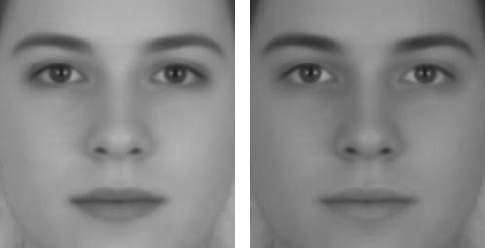
Check out this Quara post (http://goo.gl/YjQYI) for some new and old optical illusions. What caught my eye was the optical illiso on the left I haven’t seen before. Can you tell the difference between the male and female pictured? Well you shouldn’t, they are the exact same image. The illusion here takes advantage of how our perception of gender is based on hues and tones as much as the facial features themselves.

Braille 2.0

The iPad (tablets) is at it again. After all these years Stanford has uped the anti on what the bar is for acceptable braille reading and writing devices. The tablet system shown here calibrates through a swipe and audio queues, and sets the type pad to where ever the users fingers lie. (This solves the problem with the lack of tactile response the flat screen of an iPad provides. In essence, as descried in the video, the input points find the users fingers, not the other way around.)

Pictures that are literally worth over a million words

Check out this cool little tool: Google N-Grams

It shows a graphical representation of the frequency words used in books over a rangeof years. It is based on on all the books google has scanned into their database to date.

This TED talk is what turned me on to the project.

The project, the tool and the lecture are all quite entertaining.
Here are some graphs I created playing with the tool. Graphic data, especially that which is based on sentiment represented by our societies authors,  gives us amazing clues into how perception and reality intersect.


Creative ways to tell your story through scrolling.

I read somewhere many years ago that the experience of allowing the user to ready just enough content until the fold, but giving them just enough info that there is more uner the fold was a better tactic then framing your site above the fold with links to actions. For sites that want to say allot, and take users on a journy the scroll is smoother and quicker. It is like a timeline of content from top to bottom, as apposed to a choose yoru own adventure. Since then, I have seen some pretty cool examples of implementations like this. The lastst one I came across was from mozilla (https://webfwd.org/en-US/) Which would make sence since they are the advocates of the web.

Here are some slides (in case they change the site by the time you read this.)

The main home screen looks pretty standard. But notice the color and the footer….

As you scroll up he page the footer rises from the bottom, revealing a whole other expereince….

As the you scroll up, the color of the back ground fades into white, and the old footer is now the new header. I thought it was a beautiful experience…

I have seen many variations of the concept of scrolling while browsing the internet. Here are some others:

This one is called “Ben the body guard” and it was a website for a game. (http://goo.gl/HG9PQ) In this creative experience, the body guard tells you his story as you scroll down the page. The animation of his walking and the street passing by are all based on your scrolling down the page. After the story and his walk is over, the links are neon signs on the buildings rooftops, and the bottom of the page gives you a link to the appstore and a close up of ben peerig down the edge of the top of a high rise. Well done!


Do you see what I see?

Can you guess who that famous person is in the image on the left? Not a clue huh? Well it’s Steve Martin in a scene from the movie Pink Panther. But it isn’t exactly straight from the big screen film, and it isn’t exactly not from the movie either. Confused? Well, it is a mind boggling concept. The technology that Jack Gallant, a neuroscientist at U.C., has developed is able to produce a video from what a persons mind is seeing or thinking.

It really is hard to explain the amazing nature of the this technology so I attached a video below showing it in action. It’s is a must see, and probably is THE most amazing technology I have seen in my entire life.

It’s is interesting how many of the representations of people look primarily the same from the minds eye, and how there are strange over laps of data on others at times. Almost like you can see the minds eye wander, or you can see the related emotions that are associated with some visual queues.

You also have to give allot of credit to the impressionist movement. They were way ahead of their time. As you can see they completely got the nature of the difference between what we “see”, and what we remember or interpret even though we don’t realize it. The videos also remind me allot of what it feels like when I am dreaming.


Video: Left side what was actually seen, right side what the technology decoded from the brain:

Video games may rot your brain, but those gamers may help find the cure for AIDS

Just when parents and wives everywhere finally got thier point across to get their loved ones out from in front of the large screen TV and unplugged from their beloved game console, a twist emerges.

As it turns out even our most powerful computers have problems figuring out the right combinations, patters and sequences necessary to solve large complex problems. AN example of these complex problems that baffle our silicon constructed counter parts is defining the model of many viruses, and you can’t defeat what you do not understand. By leveraging the power of crowd sourcing and the serendipitous realizations that only humans can have (so far,) creating a game to engage gamers to figure out the unique characteristics (folds) of  the simian AIDS-causing Mason – Pfizer monkey virus retroviral protease (AKA M-MVP) is having some great success. It’s kind of like Tetris meets chemistry class. Move over xenga, no virtual good in the world will trump the prize of being the person who helped conqore aids!

Even after this gaming experiment ends, the analyzation of the methods and patterms applied to the game by the gamers will be adopted by the computer algorithms, thereby furthering our ability to solve problems at scale.


Check out the video:

Google Labs is Shutting Down :(

Early on in transformation into an official entrepreneur I began preaching the benfiist of focus, and the trap that any small task will invariably have the potential to become a time suck from what you should be spending brain cycles on instead (what has now been known as ABBA in our circle). But I am still left with a small sense of saddens to find out that Google Labs is shuttung down. 😦

Check out the list of many of the apps that will be phased out, and find those are already gone: http://www.googlelabs.com/

It was a good feeling to know that Google maintained their, seemingly altruistic, attention to the experimentation of new ideas for the sake of simply knowing more, and fixing our uneeded hudles in data through tech and science. They were the “casual NASA” of our dat, and althought I understand the need to focus, I had always hoped Google would remain the exception to the rule, and give us something to map our ideals to.

Farewell Google Labs, I hope what you represented does not fall by the wayside in your company or our tech community as well.

An ethical rule of thumb

History has a way of repeating itself. I try to keep myself objective about todays events and ethics, so I am able to rise above the norm and into the right.

Apply what you believe in today: how your perceive morality, ethics and kindness, and apply it to the past, 200, 100 and 50 years. Would you be in what history has decided was good or evil? In what we now see as right or wrong? That should tell you how the future will look back at you, and help guide your perspective on how you see the world today, allowing for some objectivity. This extra step in your thought process while making descisions about morality and ethics in today’s current events, could help prevent you from becoming the great grandfather or grandmother no one wants to talk about in public.

There is one extra step to make this ability to predict how the world will view your stance on current issues in 100 years+. you have to recognize the general terms in which a situation is defined. For instance, racism is not a question of race, but about human equality, poverty is as much about greed and sharing than it is about finance, science is a question about asking questions and challenging systems as much as it’s about what is “proven”, and culture is more about fear of the unknown than it is about what you beleive is right or acceptable.