Finally audio based commands and tagging that doesn’t suck

QR Codes

I have kept an eye on QR codes for a few years now; it is a simple technology. Simple technologies win because – well, they just plain work. So many new technologies do a better job of adding complexities to solve a problem than they do to decrease them. I mean, as an example, the majority of the world still uses headphone jacks and earbuds to listen to their iPod, even though blue tooth is a great technology that removes the need to use those easily tangled cords. BUT those annoying tangled cords are still far more reliable and simpler to use than bluetooth. So we wait for the “simpler” technology to become – simpler. QR codes have the same M.O. They are simple and work, but they are also annoyingly primitive. For example, that QR code image you see on the left of this article means absolulty nothing to you visually. Yet I use it to take up space on the page, because it can provide value if you are willing to pull out your phone and take a snapshot of it.

The QR code works becuase it is a unique image that contains data within all its black and wite specks, like a data finger print or a bar code.  A device with an app that can read those specks convert the “fingerprint” into a equally unique URL that the app can then direct you too.

A more complex, yet more direct solution, is to have an image that is human readable, like and ad, act as the data rich finger print. That way a person can either take advantage of the precious realestate of the ad by siimply reading it, or taking a picture of the ad and get directed to the related URL. It looks like technolgies such as Google Goggles are on their way to crakingthat nut. For now however, Google Goggles is not more reliable or simpler to use then our ugly, cryptic; yet simple, and relaibale QR code.

Audio Commands and Tagging


The use of audio commands has had a problem finding its place as a “simpler” solution to the everyday problems they always claim to have solved, but as often fall short on expectations. I don’t know how many friends of mine have had voice-command car systems that in the end just dont work as reliably and effectively as turning a dial or pressing a button on their dash.

John’s car: “bee-eep. Can I help you?”

John in his car: “Call Sean”

John’s car: “Looking for Jons and bathrooms in the area.”

John: “Ugghhh! No , Call Sean!”

Car: “Bee-eep. Thank you. Calling Don now…”

John: :-[

Siri seems to be making voice commands better, or at least marketing it that way, but the dream of talking to our computers, as the easier way to interact with them, still seems as far away as it did here (See min 3:00 in 1984) http://www.youtube.com/watch?v=2B-XwPjn9YY


Okay, Siri and Google voice commands are doing better, and getting used more use than I have ever seen in the past with similar technologies, so that is promising…but yelling into your phone to “search for near by bars” in a crowded room is – well – shitty.

Shazam made some great leaps forward in the audio tagging and command space by finding the unique characteristics in songs, and turning that into pertinent data. That uniqueness is used so that the app can determine the song name, and its singer, just by holding up your phone to a song you hear on the radio.

This year, as some you may have already seen, Shazam has gotten into the QR related space by bringing their technology to TV comercials. When you see the Shazaam logo on a comercial open your Shazam app and let Shazam listen to the commercials unique audio. Their ability to link the unique “fingerprint” of sound coming form the commercials audio, and turn it into useful data allows them to link commercials to open a website on your device; much like a QR code. It is neat because the audio is as easily interpreted by human ears as it is by the Shazam app; maximizing the use of the allotted ad space. Unfortunately it falls short in the fact that it is impractical to expect a viewer to chase down their phone, open the Shazam app, and tag the comecials audio, before the comercial is over.

Audio Sync


I think I just saw a technology that actually make sense. Practical in its use, efficient in it implementation, and it solves a problem by decreasing complexity more then it adds.

In this case the audio is used to sync your tablet to a show you are watching. With this strategy you’re truly decreasing the steps needed to get what the show, and the viewer wants. No extra steps, no rushing for a unrelated app to open a web page, no ugly QR code images taking up space, just simply a way to help the user link the app their are using to the show they are watching.

It works by listening to the show you are watching, and applying the Shazaam like technology to the audio of the show to recognize what part of what show you are watching. The data is processed, and instead of just opening a web page, it sync your application’s experience to meta data surrounding the show on you TV. You can then interact with others watching the same moment at the same time, or listen to back stories related to the segment. Cool beans.



What do 1250 Horses feel like?

Well, when they are supercharged and upgraded from a turbo Lamborugini the answer is  – obviously amazing!

The experience was so cool that I felt like it was worth more than just a Facebook post to describe it all. It was nighttime so the video I got below doesn’t show much, but the sounds you hear are all 100% genuine. And I swear I got into the car trying to be as unbiased as I could be. How much of a difference could it REALLY feel like? Right? I figured it would be fun, fast, and exciting, but nothing too jarring.

Well, I immediately realized how wrong that presumption was. Almost all of my body’s senses were involved. As we pointed the car toward the straight and empty road you could feel the car tense up. It didn’t necessarily rumble like a muscle car, but you could feel the power simmering up behind you. The sound was tough to describe. It was as if all the air around us began to be sucked into the car with a “just switched the jet engines on”-esaqe sound. Actually you know what it sounded like? It sounded like the proton packs did when the Ghostbusters switched them on.

So the car tenses up, the jet engine sound spins up, and the pedal drops. Boom! I’m not sure if it was just from the overload of all my senses going off, as the jaring impact of the car lifted me from the back of my seat, as I felt the front of the car lifting of the ground, but the lights in the road started to blur. It sort of blurred like the way the movies depict the Star Trek Enterprise jumping into warp speed. You could hear the popping of the transmission, and the switching on and off of the turbo charges. It was a large thudding sound.

The funny thing was the whole experience didn’t even leave 2nd gear, and you could tell that there was so much of the car left tucked away.


Oh, and one more thing…The exhaust did this!

Apple stores put their money where their mouth is

Ahhh the checkout line.

I know what I want, I found what I want in your store, AND I want to pay for it. So what do you do? You make me wait in line to give you my money! Man, that system is so archaic. Talk of “self checkout” has been around for a while, but I have seen very few instances of it in practice. Aside from the self checkout in the grocery store, that is still just a line in the end, checking out while picking up items in the store is not a part of our daily lives – yet.

So with all the rumors of our devices one day helping us checkout in our favorite stores, Apple finally made the decision to take the first step and offer self checkout on your iOS device at all Apple stores. Just download the newest version of the Apple Store App and buy til’ your hearts content, or your bank account runs dry, whichever comes first.

I have yet to use it myself, but am anxious to see how the company that is known for defining best practices around new concepts will implement their self checkout. I am also curious to see how they handle a jam packed store, with hundreds of very valuable items, mostly ranging in the $+1K range.


Let’s have cleaner debates with our neighbors: Not the facts, just the data.

I am not trying to get entrenched in the political back-and-forth going on. I actually do understand all of the he-said she-said going back-and-forth when it comes to peoples opinions. Opinions are each persons right to have, especially when it comes to social philosophy. Additionally, opinions are hard to “verify”; your beleifs are your prerogative.

However, it is amazing to me how non-opinion based information gets thrown AS opinion. It is even more distressing because it is so easy to find many statistic directly from the source, before they are muddied by political agenda, or distributed in off-the-cuff comments and hearsay.

So, I figured I could help…

The following are just the data & graphs of screen-shots taken from real census data (and yes the URL of where I got the data from is also noted next to each graph.) Feel free to browse the data yourself and make your own observations.

Debate the implications all your want – but below are not news reports or debate notes, they are charts taken from the actual data sources. All I ask, and hope to acheive, is that no matter what side your on, just remember not to include non-sensicle bullet points that just aren’t true and instead try to argue around your beliefs. Do not get caught up in baseless, inflated, skewed, or inaccurate depictions of history as it relates to hard cold metrics.

Important notes on data around first day of office dates

The first day in office for elected presidents is in late January following the election results, coming two months before in November.

George W’s First Day Obama’s First Day
 January 20, 2001  January 20, 2009

The stock market
The stock market shows the amount of money distributed in US corporation. The rich, and anyone investing in the rich wins when this graph goes up. Note 2007 and 2008 were shockingly bad, the worst downswing since the mid 80s. The good news everyone is it has only taken four years to get back from our bubble burst of 2001 which took eight.
http://www.google.com/finance?q=INDEXDJX:.DJI (You want this going up)


Unemployment Rate

This one is a often heavy argument point, but the data is all very easy to lookup. When a single percentage is called out it is hard to know its context. Those that scream and point fingers from he top of a mountain often end up implicating everyone – if those at the bottom of the mountain did a little research…. Again 2007 was the beginning of the frenzy. And if you remember there were many sad days and foreclosures making an “america is shutting down” environment. It was the intense swing from just a year before in 2006 that scared people the most. 
http://goo.gl/2O2zl (You want this going down)

  2007-2009 was the sharpest upswing of unemployment we have seen over 30 years.

Debt

Here is another amazing story of how politicians program you to just repeat what they shout, programming you to have their debate. Again, the data is there to have your own debates and ones that aren’ skewed by anyone. Debt sucks, and gus, we have had it growing for a long time. And this rate back-and-forth argument is again a graph away. You can see the linear growth of date below.
http://goo.gl/d9Wvz (You want this going down)


Personal Income

This is one that people don’t talk much about, because we like focusing on the negatives. BUT your incomes have been growing fairly steadily for a long time. We had a short blip of our first downward trajectory in 2008, actually the only one in recorded history of the US, but it corrected itself pretty quickly after 2009.
http://goo.gl/2CaIc (You want this going up)


I also found interesting that the following census data shows a steady increase in revenue and income in the US for decades.

Disposable Income per capita

This is also a great graph to be going up. Like the income graph we saw our first real blip ever in 2008, but for the most part we have consistently been getting a linear growth.
http://goo.gl/QQOlG

Revenue

This one is a bit less cheerful, but t’s the reality. We had some great years as a country with revenue, but unfortunately the money stopped coming in in 2007 and we have all felt this graph at home.
http://goo.gl/DFMK8


Facebook gets into the continuous scroll promo page game

Facebook has embraced the continuous scrolling, animated-esque homepage style. Like I mentioned in my other posts about this style of website (animated scroll sites), the format reduced the closing doors effect that clicking around a site can create. You bring the user into a story and prevents the message from being broken up. The single stream of consciousness keep a user curious to see what comes next. Combine the scroll with the hit-the-bottom-to-load-more-content system the potential for great workflows is there. Im really liking these design patterns, and they keep getting better. I wouldn’t be surprised if this style of website becomes the standard in the next year.

https://www.facebook.com/about/timeline (2011-12-15)

You are introduced to the homepage with a video. A pretty good one at that.

Clicking a button on the bottom quickly scrolls to a new section, so whether you start by scrolling or you are more of a clickster you are taken cre of. And both actions quickly teach you how to interact with ethe site.

As you scroll, the section headers rise to the top and stay there. (much like the other sites I have blogged about, and possibly started form the ios table header design pattern). ALso becoming a standard is the button navigation animates to sync up with where you are scrolled to in the website.

Long Lost Bucket List

I was going through some old Google docs of mine and came across a bucket list a wrote in 2008. Haha, I can even remember writing it. It was after I saw Ted Leonsis speak about what he has learned and accomplished in his life, and how his bucket list helped in decide to do the things he did. In his words [paraphrased]:

“[when the oppertuity came to produce a movie at first it was a hard descision, but looking back at my bucket list, and seeing it on their, reminded me to take the oppertunity I was given before I die]”

It felt much like finding a time capsule, and one that I forgot I even placed. With so much having happened in the last 4 years, and so much happening in the last week, it offered a pretty perspective on things. As I read through the message in a bottle sent to me by my former self, I was excited to be able to cross of a couple items on the list, and dissapointed at the vast majority of things I could not.

I really encourage those out there to mak a bucket list. It offers perspective into you life as yo find yourself focusing on so manythings over the years. It helps bring you back to a core goal, or reminds you of one you may have forgotten.

From a more technological perspective (I can’t help it, I am a technologist after all,) I encourage you to write it in google docs. I was not obly able to easily find this old list, but since Google Docs are live docs I can see the revision history of the document over time. I can imagine how interesting it will be to check out the changes, and additions I make to this list over the next 20 years.

While looking for bucket list-esque pictures for this post on the web I stumbled onto this site (http://bucketlist.org/) that helps people share their bucket list publicly.

What startup babies did Yahoo, Google and Facebook give birth to?

Here is an info-graphic my friend turned me onto (click the image to get the full view.)

It shows the exodus from some of the biggest tech companies (facebook, yahoo, google…) that supplied the man power, and brain power, to feul various startups such as: Zoosk, Hunch, Tapjoy, Color, Foursquare, Quara and more.

Want more?

Here is an article outlining the biggest winners and losers involved:


http://blog.topprospect.com/2011/06/the-biggest-talent-losers-and-winners/

The Quintessential Optical Illusions


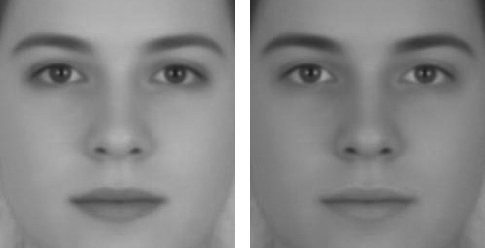
Check out this Quara post (http://goo.gl/YjQYI) for some new and old optical illusions. What caught my eye was the optical illiso on the left I haven’t seen before. Can you tell the difference between the male and female pictured? Well you shouldn’t, they are the exact same image. The illusion here takes advantage of how our perception of gender is based on hues and tones as much as the facial features themselves.

Braille 2.0

The iPad (tablets) is at it again. After all these years Stanford has uped the anti on what the bar is for acceptable braille reading and writing devices. The tablet system shown here calibrates through a swipe and audio queues, and sets the type pad to where ever the users fingers lie. (This solves the problem with the lack of tactile response the flat screen of an iPad provides. In essence, as descried in the video, the input points find the users fingers, not the other way around.)

Pictures that are literally worth over a million words

Check out this cool little tool: Google N-Grams

It shows a graphical representation of the frequency words used in books over a rangeof years. It is based on on all the books google has scanned into their database to date.

This TED talk is what turned me on to the project.

The project, the tool and the lecture are all quite entertaining.
Here are some graphs I created playing with the tool. Graphic data, especially that which is based on sentiment represented by our societies authors,  gives us amazing clues into how perception and reality intersect.