Based out of Pittsburg Pennsylvania this app was created by the founder of reCaptcha and has taken a truly new approach to learning foreign languages. For one, as compared to other tools like Rosetta Stone that costs its customers hundreds of dollars per language, Duolingo is free to use!
Beyond just being free, the app has done an excellent job in gamifying the language learning process with daily challenges, points, and levels. One simple feature that caught my eye was they option to “test out” of individual levels avoiding the need to review an entire section you may know. I’ve been using it for the last three days and have thoroughly enjoyed it.
Here are some screenshots of gameplay:
There is a second mission to Duolingo’s story that makes the app even more unique. In the backend, while you are using the app to learn a language, their algorithms are simultaneously using your answers to help improve translations for websites and other documents!
If you are interested in picking up another language Duolingo leaves you with few excuses not to start today. Adios y gracias!
I’ve been hearing a lot of debate between financial “experts” and casual investors around the pros and cons of ETFs and managed VS. unmanaged accounts. As I mentioned in this posts about “when experts disagree do your own thing” I figured the only way to get a non-bias answer is to spread my investments in them all and see what happens in 30 years. Sure, anything could happen but if nothing else I’ll learn a lot.
I recently invested 50/50 in Betterment and Wealthfront for my unmanaged ETF test (based on my good friends Daniel Odio’s post) to see how they perform overtime and to compare the results to my fully managed investment account. This won’t be as much of an investigation and extension of any debate but rather a summary of my personal experience with products and services across the board. For this post I will focus on what my initial experience has been between Betterment and Wealthfront so far.
I thought it would take a while to start spooling up some experiences but in the first inning (as a new depositor into both Betterment and Wealthfront accounts. Same amounts, risk settings etc ) Betterment is definitely ahead, here’s why: the stock market took a plunge these last few weeks and I wanted to invest in the possible fire sale. Now whether or not that tactic is sound is another story. What matters to me personally is that I was able to invest directly from my bank account into Betterment within 24 hours seamlessly. In addition the site and my app showed me the money was deployed and begun to display gains/loses immediately. Wealthfront took over a week to transfer and although the money shows as being pulled from my bank account there is still no sign of it in the Wealth front app or dashboard. The app has no insight into anything and just shows a list of recently posted blogs by the company.
That lag has already cost me 3% and If the market continues to recover it who knows how much that will mean long term. Of course if the market continues to dip the lag in wealth front will be a lucky break but I don’t use a service hoping it will work poorly so that sways in the market will work in my favor.
Regarding the apps, Betterment is the winner so far as well. Welathfront may have no more information and graphs once the funds display correctly, but who knows at this point as a new investor – current there is just a 0 on the screen that is not clickable. Betterment lists my pending transaction, as well as current deployed capital broken down by earnings to date. And it’s the same story for the website. From a user experience point of view Welathfront just shows me the same form it showed me when I initiated the bank transfer – no updates or info is accessible for this account with any useful information.
The lack of “warm and fuzzy” information I am getting as a new customer leaves me concerned for what my future experiences will be like with Wealthfront. It’s far to early to count them out since, if after the funds are deployed, I may get great graphs, information, tax benefits, and more but as a new user the cold hard fact it I am more satisfied with the way Betterment is taking care of me than Wealthfront.
In closing, at this stage of the experiment I:
a) hope that the post-funding user experience at Wealthfront is way better than the ramp up experience.
b) suggest that WealthFront improve upon the points listed above.
I know there may be many features and options that I am missing that both can do but in the initial experience where features are limited as is my expertise with using the systems I can only comment on what I know as a new customer and that is what I have done. Honestly, I win if both do well so I mean it when I say: best of luck to the challengers!
I think life’s choices is a lot like a room full of candles. So many candles that the light they produce is blinding. Walking into the room is the equivalent of living with a questions about what your purpose is. Now, imagine there is one candle in the room that holds the answer. How do you find it being that you are blinded by all the other options/choices/decisions you must make.
A common method, other than giving up entirely, is the equivalent of grasping in the air – hoping to find the right candle (aka answer) you are looking for. That strategy can get frustrating, it is a game of chance and out of your control after all.
I suggest a practice of blowing out the candles, one-by-one, to reveal the answer that best suites you. Take a chance here, try and play out a curiosity there, or maybe take a shot and following a dream so you can put a burning curiosity to rest. Eventually you will dim the room just enough for you to more clearly see the candle with the answer that is right for you .
options can make for distractions, and eat up a great deal of your brain power on wonder “what if” or “should I” or “could I”. Answer the question, dim the room, find the light meant for you.
Last year we really enjoyed opening our office up to OpenCo and revealing how we think and work as well as how we see technology transforming the world we live in. We ended with a look at “2023” and what all that may mean over the next decade. This year, after we were asked to present again under the new NewCo brand we took a different approach. In our talk today we hosted a thought experiment, taking a philosophical journey into what is content, how we know the difference between good and bad content, and how we can use that information to create the next set of products (or just appreciate the ones that come out a bit more.)
A talk about content in only one form of t would be sadly ironic. So, if you missed it we recorded and are presenting a few forms of the talk for ya.
I used this snazzy little tool that records voice on my iPhone and syncs the slides as a remote while giving a preso. Check out the tool at http://penxy.com/ or the final resulting “talking slides” at http://penxy.com/hyw
Slide Notes
(Min 14:00 in Slides Above)
This year for NewCos new track named Yahoo’s content series we’ll take a different approach and start off by asking a more fundamental (seemingly obvious) question.
What is content?
For the most part we know it when we see it. It’s the substance or material we deal with in a speech, images, tweets, or memes. It can look like this [Essay], or content can look like this [Donald Trump tweet].
As we have access to more and more content in our daily lives the question that becomes more and more important to viewers is whether this content is worse or better than the previous one? Many will say the latter is awful, yet we read content like this in droves everyday. Why?
Let’s upgrade the question a bit and ask:
What is good content?
That’s a pretty tough question to answer but an important one too. As more and more innovative products come out we can get caught up in critiquing or dismissing one from the next. One super popular dismissal is the “I don’t care about you eating waffles on Twitter – I hate twitter it’s just noise”. When we take this point of view we can miss out on some amazing developments in our culture not to mention some amazing opportunities that come from that level of access.
Fair warning this discussion is gonna get philosophical. We’ll keep diving deeper into questions like that around content.
I know – we all love a presentations structure that involves action items, best practices or check lists ready to go by the time we leave.
Sometimes though it’s important to step back before you ask, or answer, a deeper question. After all the concept of “good” and “bad” is one of the oldest philosophical conundrums in existence. Furthermore is it even the right question to ask at all? Let’s see what we discover…
So let’s get dirty and start our philosophical journey by restructuring a very – very old question:
If a tree falls in a forest and no one is there to hear it does it make a sound?
We may be quick to answer: “of course it makes a sound. I’ve heard a tree fall and heard its sound – my presence is not required.”
But the question’s more of a thought experiment than anything else. What makes the question interesting isn’t the science of sound but the philosophy behind observation and reality of what sound is without an observer. Thought experiments like that can uncover new questions that may live beneath the surface that are able to more directly answer more monumental questions.
So let’s use our time together to dive into a thought experiment around content and see where we end up
If information is created but is never shared for others to see it is it still content?
I mean if content can stand on its own without the communication aspect…
Would you say then that all the hundreds or thousands of ideas and thoughts locked in our heads are actually hundreds or thousands of pieces of content then? Maybe. Or maybe content is so inextricably tied to sharing that the two can’t maintain the definition on their own.
Hmmm.. Okay…if that’s the case then what side is more important in determining goodness? How well it’s distributed OR how well it’s formed and presented?
On one hand can we determine how good or bad content is if no one ever sees it? And, on the other hand, how worthwhile is content that everyone sees if it’s not useful or actionable? Content is more than text, sound, or an image in and of itself. In its most basic form it’s a projection of our thoughts that we thrust out into the world. As Maslov would probably put it: it’s a basic human need that makes us social and allows us to self-actualize.
If Descartes was alive today he may devise a whole new Cogito (“I think therefor I am”) to “I Share Therefore I am.”
We always hear there are no good or bad questions. And we are all unique – all our thoughts are important reflections of ourselves (which you may realize after thousands of dollars of therapy.) So why are we so driven to deem content good or bad if it is fundamentally a projection of self? Hmmmm… Interesting but I don’t think we’ve dived deep enough yet to form an answer… Let’s take another dive…
Let’s deconstruct content even further and ask
WHY is content?
(Min 23:00 in Slides Above)
(not a well formed sentence I know but you get the idea.)
Content is a transferring of our minds and being into an everlasting form.
It gives us eternal life and has so for thousands of years. In that regard it is one of the most advanced technologies ever created in the world. Our short finite lives are made infinite!
As the acronym YOLO so eloquently states, “You only live once” – but with the entire world filled with all these projected minds in the form of content we can live many lives vicariously through others.
If those concept are too abstract for your fancy and you’re more of the practical type then let’s frame it this way: Content gets stuff done more quickly. The faster we communicate the faster we can act between us.
I give you information locked in my head – you give your version back to me –
and like DNA all our contributions result in a greater overall result that may have taken ages had we attempted to think through it all on our own.
So with that I present my first thesis: The figuring out how to label content as good or bad comes from entirely the wrong place. The real question should be how do we use THIS content or THAT content? Where can we put each bit of content to allow our thoughts a chance to live in the open so that anyone can get the value from it if they so choose? Content is simply a medium we use at the moments we have thoughts to overcome our inability to be able to be inside one another’s head.
The real endeavor is to cut out the middleman completely and just exchange thoughts. And until we can do that our goal is to shorten the time it takes to transfer our emotions, ideas, and – our lives – as much as possible. Ultimate efficiency, eternal life, and dare I say maybe even peace will be achieved in that final move. It won’t be about us dealing with good and bad content it will be about us accepting all thoughts as a chance to achieve those ultimate goals.
If you appreciate the reality that a single mind is the ultimate goal then it will give way to clues to foresee what product, or content society will embrace next. I’m not saying we will achieve singularity tomorrow,
nor am I here to rally everyone to start making change so we do something – because it is inevitable whether you like it or not. I am here to help add to a map on how and why content exists so we can navigate what comes our way, or create useful products along the way.
The real problem we are attempting to solve in almost all products created today is: how do we decrease the inefficiency impeding us from what can be called a mind meld. Each new product attempts to close that time-gap from one persons mind and emotion to the next.
Still not convinced that is the ultimate direction?– lets take a break from the abstract and look at our known history for validation…
In the beginning it was the lack of the written word, passing down information through story. It got the job done but it could take a lifetime or more for anyone to have a chance to see ones work or hear ones thoughts in order to make use of them. It was also super lossy – changing with each storyteller and generation. The written word helped us set those words in stone so although interpretation was still at play the base from which we worked was identical to those that could read the original. Unfortunately there was only one original so it still took a while to get it circulating and – you break, you buy.
Then, boom, the creation of the printing press! Anyone with an idea could have a shot of distributing their thoughts in ones lifetime – rich or poor, academically educated or not –– well, as long as you could read or had someone that could read to you. An example of how powerful an easily copied text can be is seen in the 1500s when the Christian world’s perception of their religion was altered because of a German Friar named Martin Luther and the content he shared. Powerful yes,
but it still took 2 YEARS for his thoughts to circulate in his community. Could you imagine waiting 2 years for your questions or ideas to be circulated?
How frustrating for us to imagine?! At that time not only did communication work on a schedule like that but the perception was that not everyone needed to read or share content in the first place because the common folk were too dumb to make use of it. What value could they bring to the table?
We look back then and see a travesty around the freedom of information – but does our generation think all that differently? When we created AppMakr the same objections came up – “not everyone needs an app.”
The prediction was we would maybe make 4 apps a month. In our first day we had requests to make thousands. Against all doubt we knew that it has always been true that the power of distributing content should be given to the people “good” or “bad” – it was our guiding principle. … But I’m jumping ahead …
We’ve seen the drive to democratize content and speed its ability to be distributed for hundreds of years since the printing press.
Getting our thoughts out to the world in years
to weeks, to seconds with radio and TV. But then a problem still remained – instant is great but everyone should have a voice and the access to hear it – not just the privileged – we still wanted more.
And so the Internet was born: Instant transfer of anyone’s thoughts to anyone willing to access it. It was given the perfect term: “getting connected.” And our path to do so continued.
From dial up to Wi-Fi, from PC to laptop, from Laptop to phone. We are decreasing the time it takes for each of our thoughts to get out there.
The iPhone was also thought of as a fad by critiques after its release – for years large corporations wondered how they succeeded. Many missed that its main achievement was to further decrease the time and complexity it takes for us to create, share, and ingest content from anyone saying anything more instantly.
Whether it’s a lifetime to years or 3 seconds to 1 second. If you can decrease the time it takes to get ANYONES mind into the open you are on to something.
Of course we all hear the call to arms that everything is so different now, and bad, and chaotic – we are so much worst and impatient than in the past! I offer a different perspective, things are only different in the tools we use but our yearning and desires are exactly the same: “Hear me!”
Or, may I please have access to what is going out there.
Our heads are no more immersed in that desire today.
Than it has been in generations before us. We are just able to achieve those goals more practically.
Data has always been thrust upon us.
We are simply trying to make it ALL more manageable from one person to the next.
What we’re driving towards is a moment where my thoughts are yours in the same moment. Think of the frustration you’ve ever felt when you just wanted someone to understand what you were trying to convey but left only with words and gestures and maybe a white board. How awfully inefficient it is! Just get in my head for a second so we can move on! The channels we’ve seen are just manifestations of that desire we have. It’s still far away but that IS the direction we’re headed and have been headed since the word “I”.
Anything that shortens that gap for ANYONE to get ANYTHING to ANYONE ELSE is following that trajectory and delivering goodness.
Is it asking too much? Are we really so much more impatient than the past?
Why is a month too long to wait but a minute juuuuust short enough?
What is it compared to?
Cutting the time in half is cutting time in half when you move forward – period. And it will always take twice as long as it does now to those looking back. It’s not time thats a problem – time is relative.
All content that is caged is bad content because it doesn’t have the chance to allow someone to try and make their mark, live vicariously through shared story, or help them self-actualize. Sure with this digital tool there’s great power, fear and concern in how we will handle it all but it’s not about getting rid of some of it based on it being good or bad. Content is a tool to convey our thoughts – and we have all kinds of them that seem like garbage or gold from one person to the next.
It’s the difference between this
and this. Same tool different purpose
This is a knife
and so is this. And there are tons others out there. More and more a minute with a better edge or handle or metal or balance. They’re the channels we use to express ourselves with one another more quickly.
We connect in less time by decreasing the physical distance between us and our technology.
We connect with less clicks or gestures.
And yes sometimes that stream of consciousness means we trade breadth of connection about something trivial and seemingly painful to read
for accuracy and depth of critical information that is otherwise caged. Never the less, in both instances we are connecting more effectively. Believe me when we do end up truly “connecting” our thoughts it will be scarier and far noisier than today but innovators will be propelled to figure out how to appreciate and allow for that connection to build from – not work on tearing them down. And each passing generation will have a higher bandwidth they can handle than the last.
So. Maybe it’s not about whether the content is good or bad quality, heck maybe it’s not even about how much it gets shared –
maybe it’s always been purely about how many people are connected and how quickly they can achieve that connection.
Content and sharing are the two fundamental ways we are able to do it today – they are the means to the ends. They are our rocks, and knives, and arrows for lack of any other available means. But they themselves is not the goal. So, maybe good content could be defined as ANY-THING that connects ANY-ONE in less time or complexity then what is currently out there.
From stones
to books
to TV still lacking the option to connect or comment
To the websites and blogs where interaction intertwined itself with the content being shared.
Once communication and distribution became instant we shifted our strategy to decrease the time-gap between exchanges by limiting the amount of content exchanged when conveying a thought in the first place.
Those thoughts, emotions and ideas were created and deployed more quickly and frequently with statuses, and 140 letter max tweets – a real stream of consciousness was born. And that consciousness was further fed with the ability to post even if you weren’t by a computer.
So who are we to judge even shorter content still?
The end goal is about getting a feeling, thought and/or emotion to whom ever you want or as many people as you want with the least amount of friction.
So why is Yo so surprising?
Less characters and a quick intuitive interface has created a quicker connection between people. In first principles we aren’t searching for depth in substance – we are searching for a mind meld.
With 2 clicks I can convey “yo I’m thinking of you”, or
YO “I’m in town” – if the message is received and the minds are linked then it is content and it is valuable and it is good.
Yes, there is beauty in the creation process and that shouldn’t be forgotten, but let’s also recognize that the PROCESS was originally created to convey the idea with the tools available at the time. Losing site of one is as destructive as the other. The art comes from the need and some of our needs are satisfied within the art.
Which could be why memes are so powerful. Quick, efficient, creatively assembled, instantly connecting complex an otherwise tough to describe moment of humor or feelings with others through a shared experience we can relate to.
We can have taken the concept of video and trimmed it to its essence in a 5 second clip.
if you are afraid to share because to many people will see it then
a product removes that barrier so your security can be guaranteed with ephemeral storage.
We want to be closer still and our tools are extensions of that. Now we are cutting out the middleman entirely (pun intended) and letting our body do the communicating for us – instantly.
It’s amazing – in the pursuit of closing the time-gap between us we’ve managed to jumped right over our stream of consciousness and found a way to release what our body is saying even before our consciousness realizes it; a whole new level of getting connected.
So I that I think our thought experiment has yielded a conclusion for the question on what is good content:
GOOD CONTENT IS: ANYTHING THAT CONNECTS ANYONE’S THOUGHTS EFFECTIVELY IN LESS TIME OR WITH LESS COMPLEXITY THATN IS CURRENTLY OUT THERE.
So if nothing else keep that in mind when you see the next best thing and wonder why.
Thank you for keeping an open mind.
=============================================
We used the Google On Air tool (basically Google Hangouts but for public live streams that are also automatically uploaded to Youtube when the broadcast ends.) This is my 3rd attempt to use On Air in some live stream capacity and it finally worked well! The trick was setting up a second computer than from my own with more memory. Long story short, here is the presentation using that product:
If you are a bit weary but still curious on what’s coming here are a few sneak peak looks on features being released:
In an attempt to decrease the “easter egg”-ness that is iOS feature a helpful tips app will come pre-installed giving you information weekly on what features exist that you can take advantage of in the new OS.
Voice activated Siri so you don’t need your hands to get beamed up to the mothership, – or boil the perfect egg:
Countdown timer for your camera. Take selfies to the next level without needing a fantastic-four-like elastic arm.
Quicker access to your contacts by double-clicking your home button:
There is also the ability to set up a Family sharing plan for your iCloud images – but I don’t know if I will be turning it on just yet as it is unclear just how it will work and how everyone in the group will be charged for the service. Still playing 🙂
Oh and I am sure everyone is aware of the new health features in the app. A bit on the interface and how it will work: You basically give access (much like notifications) to different apps so they can pull information you (or other apps) set such as age, steps, calories like so:
I’ll let you know if more cool things pop up 🙂
Like this new interface for attaching photos to SMS
It turns out that this has been around since iOS 7 but just happened to find it now… You can flick up
To three apps closed in the background at the same time.
Creating a product is inherently riddled with unknowns and hurdles. As we refine and define processes to streamline the confluence of a team’s efforts, following those processes can be distracting. Process should help streamline work, not create it; it is the ever present balancing act of development and managing a team.
For this post I wanted to share one aspect of that process that tries to measure your team’s output called “Story Points” where the “story” represents the work requested and its set of requirements, and the metric applied to it called a “point”. Since estimating time is almost always inaccurate, processes like Scrum work within that reality by using points instead of time; it embraces the grey of estimation.
Problem is if you try to be too exacting with those points then you have gone full circle, back to the original problem of an inability to be accurate. In our team we developed a loose definition of what each point means so that product owners and developers can communicate with a “rule of thumb” quickly in planning meetings, that way the “hard work” can be focused back on output.
We use fibonacci to list our point values. Why? Well, it’s not a scientific answer but we believe it does a better job enforcing the concept of “fuzzy numbers” into more separated buckets. In our point breakdown, we relate points to complexity, not time, and summarize the amount of unknowns into the point as well. Here is our list of points and their meaning:
1 = Simple text change 2 = Simple code change 3 = More complex code change
Notes: 1 – 3 are changes that the developer has a strong grasp and awareness on what needs to be changed/created and where it needs to be done. The more complex the number of changes are (i.e. you work between many function vs working within one function) the higher the number, but in all cases it’s a fairly well known problem/solution. Then we have:
5 = Complex code change with a few unknowns 8 = Complex changes with many unknowns
5 and 8 represent complex changes that involve known unknowns. For example, a developer may know what is being requested but that developer may have no idea how to do it. We find that when a 5 point story appears in a project (and definitely when 8 pointers show up) then it’s a red flag that something may not be clear in the requirements, or the story has become too bulky and needs to be broken down into smaller chunks. In rare occasions, something ends up simply being a 5 or 8.
In the world of product development completing smaller chunks of work help you deliver and iterate on your results more quickly. Any time there is an opportunity to catch a bulky implementation its a good thing. With this point system those warnings are built into the pipeline naturally.
Hope that helps add consistency and ease to your development process!
I often get the “Hey, how can we innovate as a company?” question with little attention to each individual employee’s drive to innovate in their daily work lives being a major factor in one’s mind. That is the equivalent of asking “Hey, how can I win the super bowl?” without having a team composed of NFL football players.
Innovation is a sport to be practiced not something you can just show up on game day and expect to win. How many NFL football players don’t practice being great football players everyday and expect to win games every weekend?
Like any professional sport: if you don’t innovate in your daily life you won’t innovate anywhere else. The funny thing is if you tell someone who wants to be the greatest football player in the world to practice everyday and to push themselves to be a better player every time they practice you will get nods of support from just about anyone listening. (After all running the same drill with the same times will keep you playing JV your whole life.) Conversely, if you ask someone within a business that wants to innovate to constantly be thinking and implementing ways to change their best practices, improve their tools set, update their processes, or try new ways to be more efficient at the office you will often get a majority of employees supporting a resistance and responding with rolled eyes followed by something to the effect of “it’s fine just the way it is – and it has been for years. Why change it now?”
How can you expect to innovate a few times a year with a company filled with workers that don’t believe in practicing innovating with the tools they use, the environment they are use to, and the way they interact with one another on a daily basis? How would a superbowl NFL coach react to an athlete that would rather just run his usual drills when asked to try something new? You can’t expect a company of employees resistant to change or improve HOW they work to then all of a sudden change how a company or the world around them works, can you? It all relates – like the seeds in a root of a blossoming flower. (Sorry, probably too dainty an analogy for a football heavy post, huh?)
Furthermore, just like with football it won’t work with one star player or one small group embracing this ideal. Use the best tools, challenge the old ideas, and try out new processes when you get the opportunity. The more the WHOLE company pushes and adopts an ever changing, improving, and growing daily work life the more that company will get a shot at the innovation ring.
Happy Super Bowl Weekend to all those out there wanting to be their best every chance they get!
OpenCo is the city’s answer to the question: “What makes San Francisco – San Francisco?” Instead of trying to explain the nuances to the culture here the founders of OpenCo decided the best way to describe it is by opening the doors to as many offices as possible within and allow people to come in and see for themselves. At OpenCo attendees sign up for a free pass to any of the over 100 SF offices, from theater troops, to restaurants, to tech startups and more. During the event attendees tour around the city walking into offices to check out their space and take part in an interactive presentation about what that company is doing to try to make an impact on the world. It’s not a lecture, nor a sales pitch, nor is it focused on recruiting, but instead it is a presentation that takes a look into what a company is thinking and how they work. Now expanding into NY, London, and Detroit, the OpenCo movement will be an exciting one for those interested in peeking into to the companies that make a city tick.
This year ShareThis was proud to be invited to host the second annual OpenCo event and we were excited to open their doors to their San Francisco office. There Sean Shadmand talked about the difficulties companies in the industry of social/tech are faced with and how they plan on innovating in the years to come. Check out a video of the presentation and slide decks below.
I love my Google Chromecast. It’s light weight, cheap, simple to use and is very transportable. I’ve tried many bulky pieces of equipment to enhance my home theater experience such as a Roku, Google TV, and Apple TV. For all the extra features those products could provide, and the extra costs they had to have them, Google Chromecast is the only that has given me exactly what I needed. Sometimes less is more; this is one of those cases.
One thing the other products failed to appreciate is how much of my time is based on my laptop, and how readily available it (or my iphone) is. I don’t need a second computer to run my TV. My laptop has everything I need so making the main media hub makes sense. No additional keyboards or remotes needed.
Chromecast uses your wifi network and its built-in HDMI jack to create a media bridge between your computer and your TV. Once connected you will need to download the Chromecast extension for your chrome browser. Once it place you’ll have the ability connect your browser (and everything on it) to your screen. If you want to play movies then all you need to do is drag your movie file into Chrome and the browser will play it as well. If you want to share your desktop with your screen just use the Beta screen casting option – which is still a bit hit or miss.
I don’t need more and I am happy to pay less. (Chromecast is 66% less than most alternatives in the market today.) If you haven’t taken the leap to get one I suggest you do, or make sure it is on your christmas list 🙂
Okay, fair warning this is, as my friend Kanad would say, “Nerdy Gigabyting” stuff.
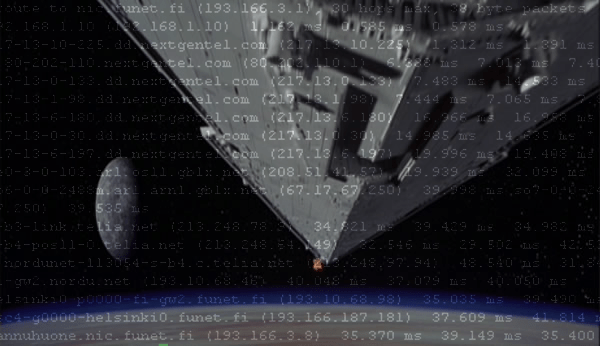
For all you Star Wars fans out there, and even some op engineers that may not like Star Wars check out these hops in your terminal shared with me my friend and co-worker Jason P.
#> traceroute 216.81.59.173
For those of you that are curious about what the hell a traceroute is, it is a way to see the set of network hops taken to get to the destination in question. For instance, when you visit http://www.seanshadmand.com from your computer the request is sent to your local network, then a nearby network and then the next switching and moving between networks until it arrived at the network that holds my website. Just ike taking multiple roads to get to and from work your request must travle through different “intersection” to get to a web page.
Sean-Shadmands-MacBook-Pro:~ seanshadmand$ traceroute seanshadmand.com
traceroute to seanshadmand.com (54.245.121.115), 64 hops max, 52 byte packets
 1  10.4.11.1 (10.4.11.1)  3.884 ms  1.013 ms  2.993 ms
 2  10.4.1.1 (10.4.1.1)  0.842 ms  0.977 ms  1.194 ms
 3  50-0-241-217.dedicated.static.sonic.net (50.0.241.217)  9.055 ms  8.422 ms  10.212 ms
 4  gig1-28.cr1.colaca01.sonic.net (70.36.228.97)  9.576 ms  6.047 ms  7.426 ms
 5  po3.cr1.lsatca11.sonic.net (75.101.33.166)  8.560 ms  9.594 ms *
 6  * * *
 7  0.xe-6-0-0.gw.equinix-sj.sonic.net (64.142.0.185)  6.043 ms * *
 8  * equinix01-sfo5.amazon.com (206.223.116.177)  13.506 ms *
 9  * 205.251.229.173 (205.251.229.173)  49.171 ms *
10  205.251.232.70 (205.251.232.70)  38.752 ms
    205.251.232.112 (205.251.232.112)  32.057 ms
    205.251.232.68 (205.251.232.68)  34.793 ms
11  205.251.232.141 (205.251.232.141)  29.312 ms  32.983 ms
    205.251.232.159 (205.251.232.159)  41.429 ms
12  205.251.232.165 (205.251.232.165)  34.375 ms  35.858 ms  64.349 ms
13  ec2-50-112-0-241.us-west-2.compute.amazonaws.com (50.112.0.241)  41.451 ms
    ec2-50-112-0-163.us-west-2.compute.amazonaws.com (50.112.0.163)  30.499 ms  28.531 ms
Here you can see the request working its way from our local network to our Sonic.net provider all the way down to the network hosting my site, Amazon.
Okay, so here is what the original traceroute I mentioned above did in 64 hops – the following is a spoiler alert, do not scroll down if you want to try it yourself 🙂
Sean-Shadmands-MacBook-Pro:~ seanshadmand$ traceroute 216.81.59.173
traceroute to 216.81.59.173 (216.81.59.173), 64 hops max, 52 byte packets
 1  10.4.11.1 (10.4.11.1)  1.586 ms  0.751 ms  0.748 ms
 2  10.4.1.1 (10.4.1.1)  0.863 ms  0.922 ms  0.976 ms
 3  50-0-241-217.dedicated.static.sonic.net (50.0.241.217)  9.179 ms  7.557 ms  11.639 ms
 4  gig1-28.cr1.colaca01.sonic.net (70.36.228.97)  9.738 ms  8.369 ms  6.678 ms
 5  po3.cr1.lsatca11.sonic.net (75.101.33.166)  7.323 ms  50.077 ms  7.756 ms
 6  0.xe-5-1-0.gw.pao1.sonic.net (69.12.211.1)  6.980 ms  12.417 ms  6.569 ms
 7  0.xe-6-0-0.gw.equinix-sj.sonic.net (64.142.0.185)  5.534 ms  5.873 ms  5.865 ms
 8  10gigabitethernet2-3.core1.sjc2.he.net (206.223.116.37)  6.746 ms  13.966 ms  12.247 ms
 9  10gigabitethernet14-7.core1.lax2.he.net (184.105.213.5)  26.900 ms  20.975 ms  22.262 ms
10  10gigabitethernet2-3.core1.phx2.he.net (184.105.222.85)  74.895 ms  40.622 ms  29.217 ms
11  10gigabitethernet5-3.core1.dal1.he.net (184.105.222.78)  56.980 ms  55.502 ms  54.686 ms
12  10gigabitethernet5-4.core1.atl1.he.net (184.105.213.114)  75.773 ms  74.998 ms  72.689 ms
13  216.66.0.26 (216.66.0.26)  73.062 ms  74.324 ms  72.802 ms
14  * * *
15  episode.iv (206.214.251.1)  116.403 ms  130.009 ms  112.626 ms
16  a.new.hope (206.214.251.6)  111.127 ms  112.484 ms  109.912 ms
17  it.is.a.period.of.civil.war (206.214.251.9)  109.559 ms * *
18  * rebel.spaceships (206.214.251.14)  112.966 ms *
19  * * striking.from.a.hidden.base (206.214.251.17)  114.395 ms
20  * have.won.their.first.victory (206.214.251.22)  114.337 ms *
21  * * against.the.evil.galactic.empire (206.214.251.25)  136.658 ms
22  during.the.battle (206.214.251.30)  116.953 ms  115.696 ms  112.170 ms
23  rebel.spies.managed (206.214.251.33)  110.094 ms  112.563 ms  114.632 ms
24  to.steal.secret.plans (206.214.251.38)  110.638 ms  109.706 ms  109.454 ms
25  to.the.empires.ultimate.weapon (206.214.251.41)  110.453 ms  114.561 ms  114.792 ms
26  the.death.star (206.214.251.46)  113.295 ms  115.245 ms  115.005 ms
27  an.armored.space.station (206.214.251.49)  163.362 ms  113.893 ms  114.685 ms
28  with.enough.power.to (206.214.251.54)  115.263 ms  111.979 ms  117.865 ms
29  destroy.an.entire.planet (206.214.251.57)  114.727 ms  113.755 ms  126.718 ms
30  pursued.by.the.empires (206.214.251.62)  115.042 ms  116.474 ms  110.436 ms
31  sinister.agents (206.214.251.65)  113.995 ms  115.831 ms  115.973 ms
32  princess.leia.races.home (206.214.251.70)  111.079 ms  131.545 ms  115.804 ms
33  aboard.her.starship (206.214.251.73)  111.702 ms  116.699 ms  113.923 ms
34  * custodian.of.the.stolen.plans (206.214.251.78)  120.468 ms  116.254 ms
35  that.can.save.her (206.214.251.81)  112.573 ms  117.197 ms  123.432 ms
36  people.and.restore (206.214.251.86)  110.282 ms  119.757 ms  114.538 ms
37  * * *
38  0-----i-------i-----0 (206.214.251.94)  134.709 ms * *
39  * 0------------------0 (206.214.251.97)  131.887 ms *
40  * * *
41  0----------------0 (206.214.251.105)  116.773 ms  114.683 ms  111.513 ms
42  0---------------0 (206.214.251.110)  114.764 ms  111.789 ms  114.402 ms
43  0--------------0 (206.214.251.113)  111.076 ms  116.629 ms  111.154 ms
44  0-------------0 (206.214.251.118)  112.852 ms  114.205 ms  111.433 ms
45  0------------0 (206.214.251.121)  115.202 ms  112.044 ms  114.663 ms
46  0-----------0 (206.214.251.126)  201.307 ms  111.747 ms  117.750 ms
47  0----------0 (206.214.251.129)  116.196 ms  111.185 ms  110.688 ms
48  0---------0 (206.214.251.134)  110.780 ms  114.799 ms  113.196 ms
49  0--------0 (206.214.251.137)  113.402 ms  115.738 ms  114.843 ms
50  0-------0 (206.214.251.142)  113.381 ms  111.589 ms  116.851 ms
51  0------0 (206.214.251.145)  116.478 ms  111.657 ms  116.318 ms
52  0-----0 (206.214.251.150)  115.002 ms  115.580 ms  116.904 ms
53  0----0 (206.214.251.153)  138.367 ms  115.620 ms *
54  0---0 (206.214.251.158)  113.654 ms  111.288 ms  111.488 ms
55  0--0 (206.214.251.161)  117.350 ms  118.801 ms  147.315 ms
56  0-0 (206.214.251.166)  114.342 ms  120.037 ms *
57  * * 00 (206.214.251.169)  118.554 ms
58  i (206.214.251.174)  117.896 ms * *
59  * by.ryan.werber (206.214.251.177)  150.234 ms *
60  blizzards.breed.ccie.creativity (206.214.251.182)  115.374 ms * *
61  * please.try.again.tracerote.to.obiwan.scrye.net (206.214.251.185)  120.250 ms  146.107 ms
62  read.more.at.beaglenetworks.net (206.214.251.190)  116.038 ms *  115.467 ms


 Based out of Pittsburg Pennsylvania this app was created by the founder of reCaptcha and has taken a truly new approach to learning foreign languages. For one, as compared to other tools like Rosetta Stone that costs its customers hundreds of dollars per language, Duolingo is free to use!










 Sean Shadmand